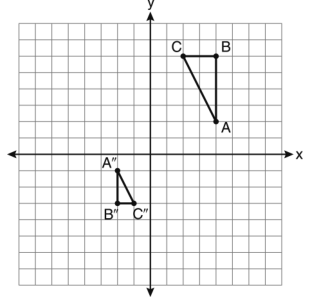
Transformations Practice
star
star
star
star
star
Last updated over 6 years ago
30 Nsɛmmisa

1
1
1
1
1
1
1
1
1
1
1
1
1
1
1
1
1
1
1
1
1
1
1
1
1
1
1
1
1
1
Today, you will practice using the transformations we've been studying. Hopefully, this will help you reach the learning targets we've been working on in class:
I can understand the difference between a translation, reflection, rotation, and dilation.
I can graph and interpret algebraic rules for translations.
I can graph and interpret algebraic rules for reflections.
I can graph and interpret algebraic rules for rotations.
I can understand how to perform sequences of transformations to map one figure onto another.
I can map a figure onto itself by using line and rotational symmetry.
A change in position, size, or shape of a figure on a coordinate plane.
A type of transformation that results from the reduction or enlargement of an image.
A type of transformation involving a slide of the graphed figure.
A type of transformation involving a flip of the graphed figure.
A type of transformation in which a figure is turned about a fixed point a certain number of degrees.
A figure is translated 3 units to the right and down 2 units. Select the algebraic rule that shows how the translation affects the figure's movement.
Which of the graphs below shows the translation described by the following rule?
(x, y) → (x+4, y+4)

Reflect ΔABC over the y-axis.
ΔABC has vertices A(-2, 4), B(1,5), and C(2, 4). After a transformation is applied to the triangle, its new vertices are A’(-2,-4), B’(1,-5), and C(2,-4). Which of the following transformations was applied to the triangle?
Quadrilateral KLMN has vertices K (3,-2), L (6,-3), M (8,-6) and N(5, -5). The quadrilateral is rotated 90° clockwise about the origin. What are the coordinates of the vertex M'?
Rectangle WXYZ has vertices W(-2,-3), X(-2, 1), Y(4,1), and Z(4, -3). If the rectangle is rotated clockwise 270°, what will be the new location of point Z?
The graph shows square PQRS and square P'QʼR'S'.
Which transformation rule creates square P'Q’R'S' from square PQRS?
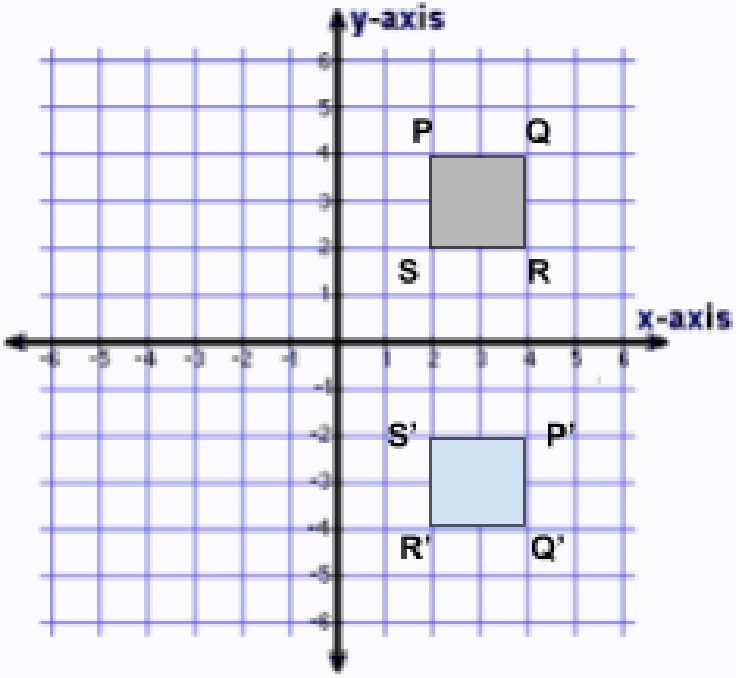
Which transformation does NOT produce congruent figures?
Rectangle ABCD has vertices A(0,-2), B(0, 1), C(4, 1), and D(4, -2). After a transformation is applied to the rectangle, its new vertices are A'(2, 0), B'(-1,0), C'(-1, 4), and D'(2, 4). Which of the following transformations was applied to the rectangle?
What does the following rule describe?
(x, y) → (x-2, y+5)
Finish the rule for a transformation that translates 2 units up and 3 units left.
(x,y) →
Which of the following shows the rule for the translation shown?
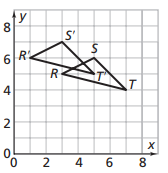
Reflect ΔMNP in the line y = -1.
Reflect ΔMNP in the line x = 1.
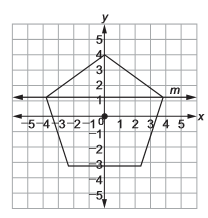
Which angles of rotation will carry the regular pentagon onto itself? Check all that apply.

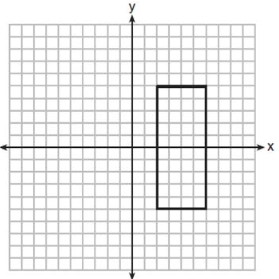
As shown in the graph below, the quadrilateral is a rectangle.
Which transformation would not map the rectangle onto itself?
What is the minimum number of degrees that a regular decagon (10-sides) must be rotated to map onto itself?
Use the line tool to draw all of the lines of symmetry on the shape.
Select all the degrees of rotation that will carry an equilateral triangle onto itself.
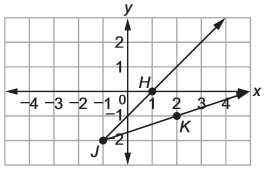
Determine K' using the translation (x, y) → (x – 3, y + 1) .
A regular pentagon is centered about the origin and has a vertex at (0, 4). Which transformation maps the pentagon to itself?
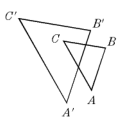
Which transformation is represented below?
Identify S' after a reflection over the x-axis.
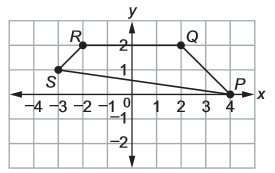
Graph the image after a reflection over the y-axis.
Which sequence of transformations is shown below?