Log in
Sign up for FREE
arrow_back
Library

2.4 Rock Cycles, Formations, and Dating

star
star
star
star
star
Last updated over 2 years ago
9 questions
4
4
4
8
4
4
4
4
Question 1
1.

Match the question to the correct answer.

Draggable itemarrow_right_altCorresponding Item
What is the geologic process that occurs between igenous and sediment?
arrow_right_alt
Heat and Pressure
What is the geologic process that occurs between sedimentary and metamorphic?
arrow_right_alt
cooling
What is the geologic process that occurs between magma and igneous?
arrow_right_alt
weathering and erosion
Question 2
2.

Check off all the ways that are used to RELATIVE date a specimen.

Question 3
3.

Check off all the ways that are used to ABSOLUTE date a specimen.

Question 4
4.

Match the following dating techniques to their 'simplified' definitions.

Draggable itemarrow_right_altCorresponding Item
Cross dating
arrow_right_alt
bottom layer = older ; top layer = newer
Stratigraphy
arrow_right_alt
bottom layer = older ; top layer = newer ...but with fossils and animals
Amino Acid dating
arrow_right_alt
comparing fossils in other layers
Thermoluminescence
arrow_right_alt
testing bone absorption
Fluorine dating
arrow_right_alt
measure of an isotopes found in fossils
Biostratigraphy
arrow_right_alt
protein content in fossils
Radiometric dating
arrow_right_alt
trees grow rings
Dendrochronology
arrow_right_alt
last time it was heated
Question 5
5.

You begin digging in the park while volunteering. You find a fossil.
Explain:
1. What would be your first step in trying to determine the age of the fossil?
2. Why would that be your first step?

Question 6
6.

You begin digging in the park while volunteering. You find a rock with a bunch of air pockets inside the rock.
Explain:
1. What would be your first step in trying to determine the age of the rock?
2. Why would that be your first step?

Question 7
7.

What is one benefit of relative dating?

Question 8
8.

What is one advantage of abolute dating?

1
Question 9
9.

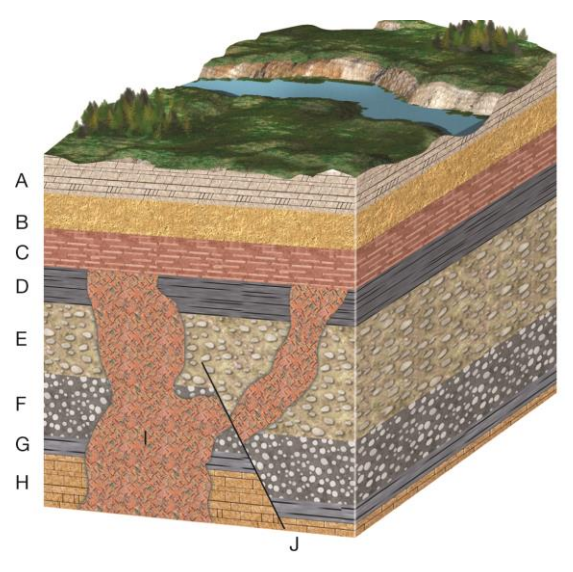
Put the letters in the correct sequence of events.

The oldest event (letter) should be at the very top, and the youngest event (letter) should be at the bottom.

  1. G
  2. J
  3. H
  4. E
  5. A
  6. C
  7. I
  8. B
  9. D
  10. F