Log in
Sign up for FREE
arrow_back
Library

Biology Unit #1 Assessment

star
star
star
star
star
Last updated over 6 years ago
26 questions
Note from the author:
1
1
1
1
1
1
1
1
1
1
1
1
1
1
1
1
1
1
1
1
1
1
1
1
1
1
Ecology
Question 1
1.

Question 2
2.

Question 3
3.

Question 4
4.

Question 5
5.

Question 6
6.

Question 7
7.

Question 8
8.

Question 9
9.

Question 10
10.

Question 11
11.

Question 12
12.

Question 13
13.

Question 14
14.

Question 15
15.

Question 16
16.

Question 17
17.

Question 18
18.

Question 19
19.

Question 20
20.

Question 21
21.

Question 22
22.

Question 23
23.

Question 24
24.

Question 25
25.

Question 26
26.

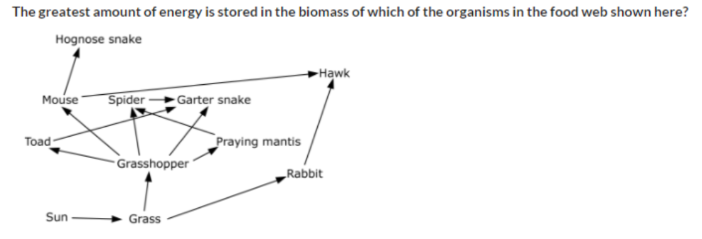
Rabbit
Spider
Grass
Hawk
If there are more prdators.
as it transfers up trophic levels
when decomposers dominate.
if there are more producers
climate change leads to prolonged growing season for pond plants.
heavy rains lead to higher water levels in the pond year-round
changes in water pH lead to fewer species of fish in the pond
Soil around the pond softens and sinks to greater depths.
A high level of diodiversity in the organism's ecosystem
Access to multiple sources of fresh water
Barriers restricting access to resources
Reduction in the populations of competing species
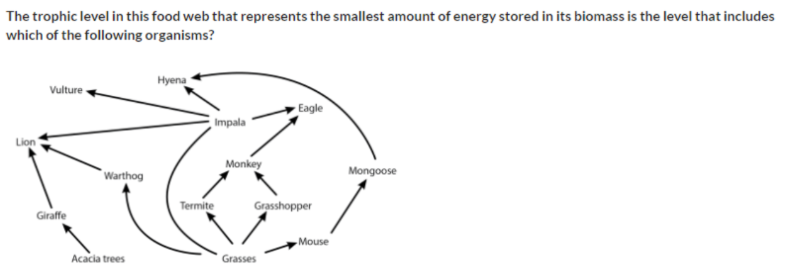
Grasses
Impala
Termite
Eagle
a shift of environmental conditions favoring prairie grass.
a reduction of organisms that rely on the trees for protection
an influx of bird species that will occupy the trees.
an increase in field mice, as they will camouflage easier.
Mutualism
parasitism
predation
commensalism
Height above sea level
Presence of insects
Amount of available sunlight
pH of surrounding soil
The bacteria obtain carbohydrates from the plant, and provide nitrogen in a usable form for the plant.
The bacteria provisde nitrogen in a usable form for the plant, and receive no benefit from the plant.
The bacteria use nutrients provided by the plant for food, eventually leading to the death of the plant.
The bacteria and the plant both require the same limited resources of water and soil to survive.
When fossil fuels are burned, carbon enters the atmosphere as carbon dioxide.
The denitrifying bacteria turns the fossil fuel into carbon dioxide gas.
Decomposers convert the fossil fuels into greenhouse gasses like carbon dioxide.
The fossil fuels react with the soil to produce carbonates and carbon dioxide.
Lightning
Fertilizers
Dead plants
Atmosphere
Organisms compete when sufficient resources are not available.
Organisms can only compete for food and water.
Only organisms of different species can compete
Plants are not capable of competing for resources.
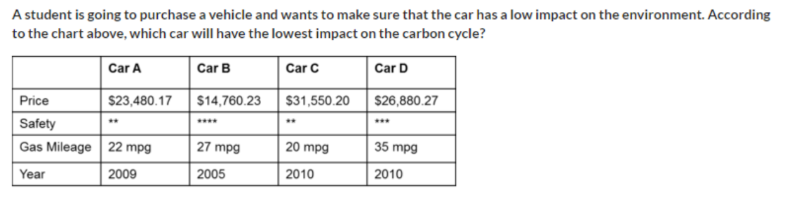
Car A
Car B
Car C
Car D
tissues that comprise organisms of that species
size of that species' population.
success of other populations in the community.
competition within other communities in the biosphere.
They produce antibiotics which destroy other microorganisms.
They metabolize substances and break down food during digestion
They decrease the amount of vitamins in the large intestine.
They purify food as it travels through the digestive system and remove contaminants.
The bacteria converts sunlight into usable nutrients for the plant.
The bacteria convert inorganic nitrogen into usable nitrogen for the plant.
The bacteria helps the roots absorb more water from the surrounding soil.
The bacteria helps the plant defend itself against predators.
Biodiversity reaches its lowest point.
Lichens and mosses dominate.
Animals begin to use plant resources.
Trees have replaced shrubs and grasses.
They can produce antibiotics.
They can release harmful toxins
They can release vitamins.
They can only infect viruses.
An increase in species diversity.
An increase in annual precipitation.
A decrease in soil complexity.
A decrease in temperature.
Ecosystems include both biotic and abiotic factors. Which of the following is an abiotic factor?
Population
Soil
Community
Organism
The long-term survival of a species is dependent on resources. The survival of the species is less likely to survive if these resources are
Limited
Not used by other species
Plentiful
Renewable as a result of natural processes
The environment can be arranged into different levels of organization. Which of the following shows a correct sequence that proceeds from a smaller specific level of organization to a larger less specific level?
biome.....habitat
population....species
community....population
ecosystem.....biome
Succession involves one community replacing another. What must be true of each community that appears?
The populations are adapted to their environment
the populations contain very simple life forms
the populations move to a different area to reestablish themselves
the new population will change from sexual reproduction to asexual reproduction of offspring.
Only 10% of energy is passed from one trophic level to the next. What happens to the energy that is not passed on?
It is given off as heat or used in cellular processes.
it is consumed by decomposers.
it is transferred to the next trophic level.
It is used in bio-magnification.

Use the image above. Which of the following correctly illustrates the flow of energy through an ecosystem?
a
b
c
d

Ultimately, what is the source of all energy for life on Earth?
cellular respiration
water cycle
denitrification
the sun