Period 3 Early Cold War
star
star
star
star
star
Last updated almost 7 years ago
14 Nsɛmmisa
1
1
1
1
1
1
1
1
1
1
1
8
Definitions
Cold War: a state of political hostility between countries characterized by threats, propaganda, and other measures short of open warfare.
Ideology: system of ideas and ideals, especially one which forms the basis of economic or political theory and policy.
Foreign Policy: a government's strategy in dealing with other nations.
Recap: During WWII the alliance of the USA and the USSR brought together two sides that were divided by their political ideologies. The political and economic systems of the USA and Britain were based on capitalism, while since its foundation after the 1917 Russian Revolution the USSR had based its economy on communism. However, the actions of Nazi Germany and its ally, Japan, in World War Two had driven these two political enemies together. As the war dwindled down, two conferences were held between the United States, Britain and Russia/USSR to determine the outcome of WWII.
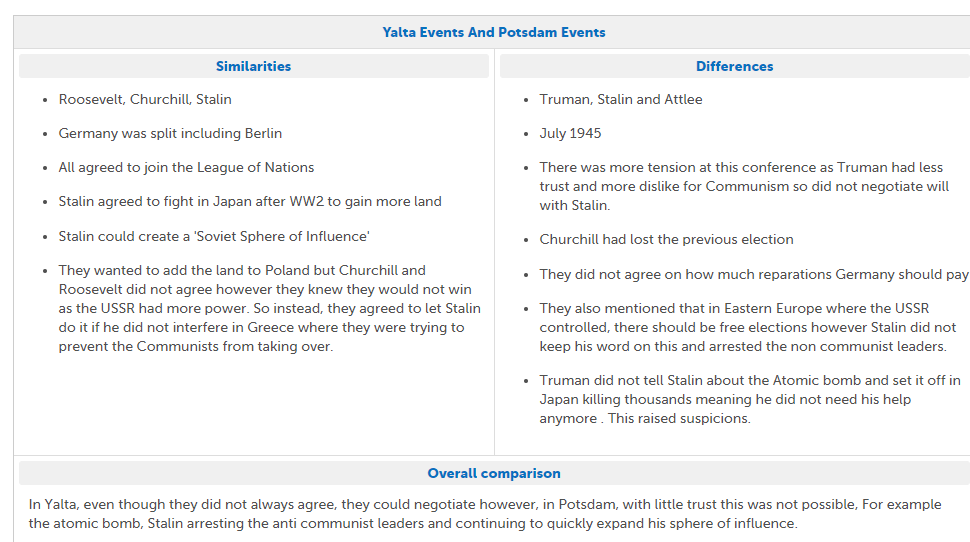
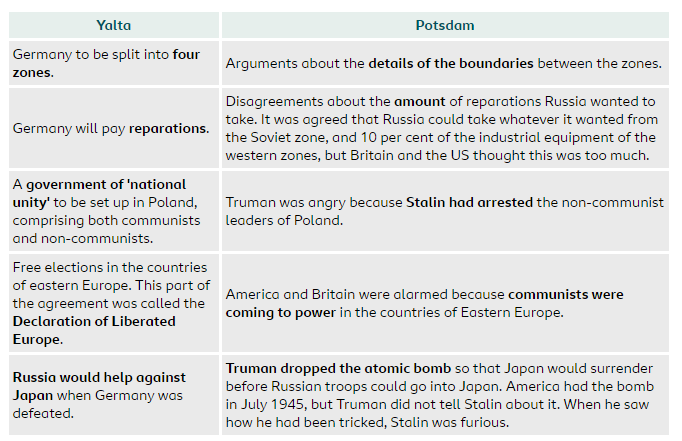
Yalta - February 1945: Germany was not yet defeated, so, although there were tensions about Poland, the big three - Stalin, Roosevelt and Churchill - managed to agree to split Germany into four zones of occupation, and to allow free elections in Eastern European countries. Russia was invited to join the United Nations, and Russia promised to join the war against Japan when Germany was defeated.
Potsdam - July 1945: Germany had been defeated, Roosevelt had died and Churchill had lost the 1945 election - so there were open disagreements.
Using the information found in the charts above to explain the the changes that took place between the Yalta and Potsdam conferences.
According to the Long Telegram, why did Stalin have to paint the outside world as "hostile" and "menacing"?
What was Kennan's idea of "containment"?
Why was Europe in jeopardy of falling to communism in 1947?
Copy an important quotation from Truman's speech in the space below.
This will likely require you to pause the video a few times. Explain why it is important.
How did events in Czechoslovakia lead Congress to approve of the Marshall Plan?
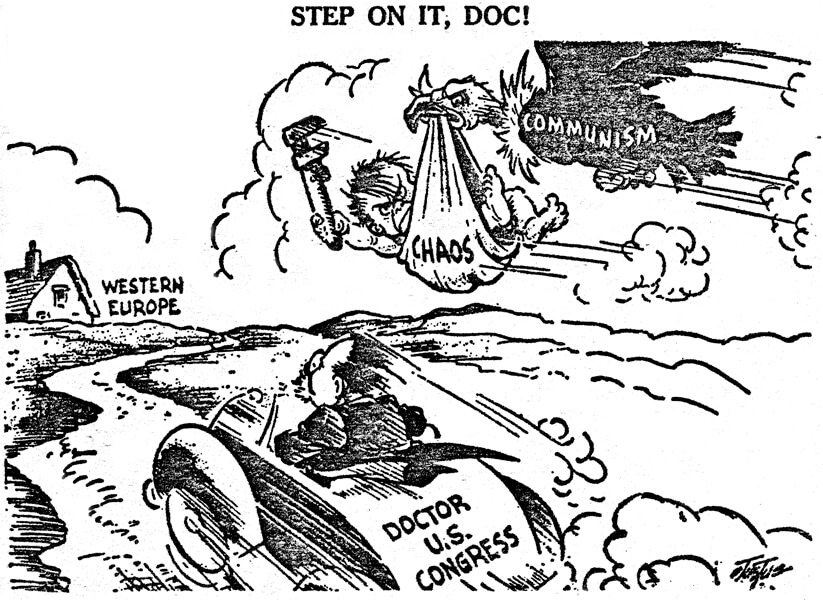
Identify and explain the symbolism present in the cartoon above.
Explain what this cartoon suggests about The Marshall Plan.
What events led to the Berlin Airlift?
How did the Berlin airlift lead to the creation of nato?
What are Truman and Churchill's goal in the Iron Curtain Speech presented to the American people?
What is the shadow that fell upon the Allied victory?
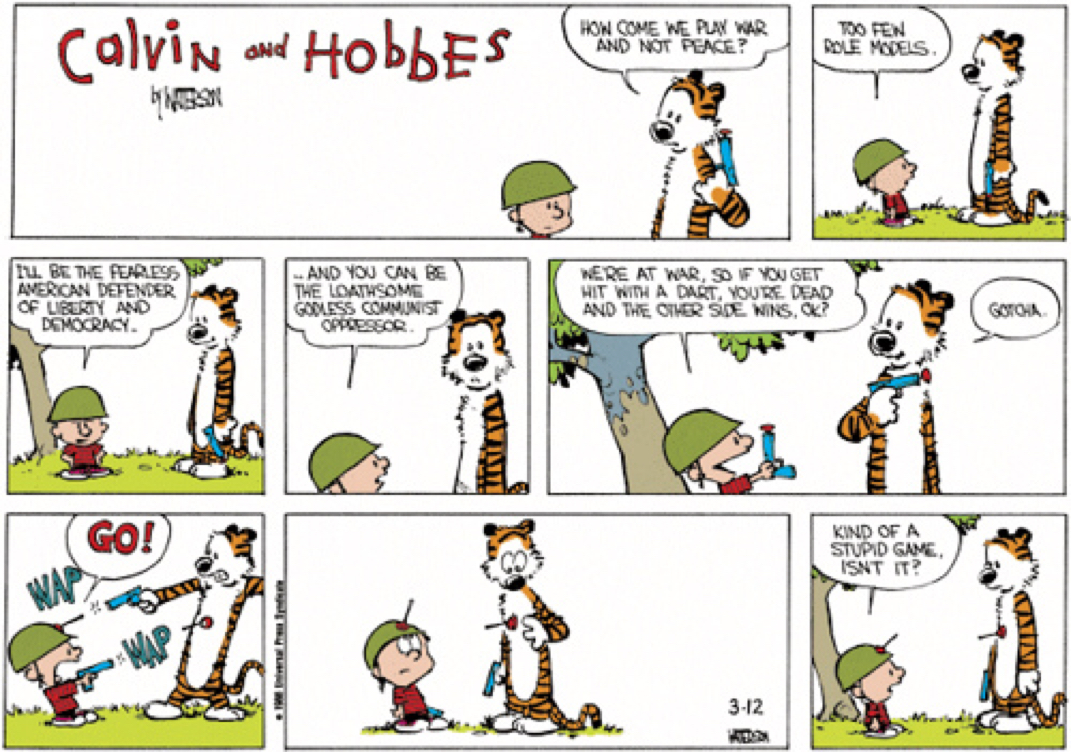
What does this cartoon demonstrate will happen if everyone has the same weapons (ie: nuclear arms)?
Which event listed above was the sgtrongest reason for the Cold War?