Log in
Sign up for FREE
arrow_back
Library
Roaring 20's
By Joe Klostermann
star
star
star
star
star
Share
share
Last updated about 2 years ago
36 questions
Add this activity
1
1
1
1
1
1
1
1
1
1
1
0
1
1
1
1
1
1
1
1
1
1
1
1
1
1
1
5
5
1
1
1
1
1
1
8
Question 1
1.
Why did President Harding reduce taxes on the wealthiest Americans?
(Laisse Faire ideas)
To encourage people to save more of their money
To increase the amount of revenue the federal government received
To help balance the federal budget
To expand business and stimulate economic growth
Question 2
2.
Which of the following effects did the
automobile
have on American life?
It forced workers to live near jobs.
It led to a decrease in the number of paved roads.
It discouraged people from moving to oil-producing states.
It made rural cities and families less isolated.
Question 3
3.
Which of the following were warning signs that the prosperity of the 1920s might not continue?
The level of national income
The increasing income gap between workers and managers (owners)
The steady increase of the stock market with no real decline
The average factory worker’s productivity level
Question 4
4.
What effect did WWI have on the attitudes of many Americans?
It encouraged people to be less fearful of outsiders.
It caused a desire to stop exporting goods to other nations.
It led to a wave of prejudice against foreign-born people.
(Xenophobia)
It sparked a desire to get more involved in world affairs.
Question 5
5.
Which of the following were Americans most fearful of during
the Red Scare
?
The possibility of a revolution in Russia
An end to the system of communism
The elimination of all forms of government
A Communist takeover of the country
Question 6
6.
What was the primary goal of the
quota system
?
To limit the number of people entering America from foreign countries
To provide Native Americans with U.S. citizenship
To prevent African Americans from getting good jobs
To completely end immigration in America
Question 7
7.
Which of the following was true of
Prohibition
.
The smuggling and bootlegging industries declined during Prohibition.
Support for Prohibition came mainly from urban areas and the Women's Christian Temperance Movement.
The majority of Americans supported Prohibition throughout the 1920s.
Reformers who believed that alcohol was sinful led the drive to pass Prohibition.
Question 8
8.
How did flappers rebel against the earlier styles and attitudes of the Victorian age?
They embraced new fashions and hairstyles.
They grew their hair long.
They became less assertive.
They dropped their bid for equal status with men.
Question 9
9.
Why did radio become the most powerful communications media to emerge in the 1920s?
It took advantage of the increase in literacy in America.
It allowed the government to transmit speeches about WWI.
It used sensational headlines to hook the public.
It created a shared national experience of hearing the news as it happened.
Question 10
10.
What did Charles Lindbergh accomplish that made him the most beloved hero of the time?
He was the first person to swim across the English Channel.
He was the first person to complete a nonstop solo trans-atlantic flight.
He was the home run king during the 1920s.
He was a celebrated tennis champion.
Question 11
11.
Which of the following methods did the NAACP use to help African Americans?
They fought for legislation to protect African Americans’ rights.
They encouraged African Americans to return to Africa.
The focused on removing barriers to black employment.
The staged violent protests to combat racism.
Question 12
12.
Which of the following themes did many African American authors write about during the Harlem Renaissance?
The necessity for war as a path to freedom
The easy life of working-class African Americans
The trials of being black in a predominately white world
The dignified lives of immigrant farmers
Question 13
13.
Jazz music was born in New Orleans and was spread to the North by such musicians as…
Martin Luther King
Paul Robeson
Louis Armstrong
Marcus Garvey
Question 14
14.
Alcohol caused all of the following issues
except
for _________________________, according to most fundamentalists.
Evangelism
(religion/Protestant church)
Crime
Child Abuse
urban slums
Question 15
15.
Which of the following correctly describes why some Americans believed that fewer immigrants should be allowed to enter the country after WWI?
The country had a more trusting view of foreign-born people.
The country had fewer jobs available for immigrants to take after the war.
Most immigrants believed in the system of capitalism.
Most immigrants refused to take jobs after entering the country.
Question 16
16.
Which of the following was an effect of
Prohibition
.
The end of the bootlegging industry.
The growth of illegal activity by organized crime.
An increase in respect for the new law.
An increase in the consumption of alcohol.
Question 17
17.
Which of the following was the main issue of
the Scopes Trial?
The accuracy of the Bible
The role of science and religion in public schools
The validity of the theory of evolution
The credibility of fundamentalism
Question 18
18.
Which of the following was true of
women
in the 1920s?
Flappers were a widespread reality in society.
Women demanded the same freedoms as men.
The new attitude of women was easily accepted by traditionalists.
Women observed the same set of principles that applied to men in society.
Question 19
19.
Which of the following correctly describes an effect of the
Harlem Renaissance
?
African Americans were inspired to take pride in their achievements and importance.
The Harlem Renaissance sparked a lasting economic boom for African Americans.
African Americans were prevented from making a significant contribution to the arts.
The Harlem Renaissance was short-lived and did little to celebrate African American culture.
Question 20
20.
By what percent did the African-American population change in New York?
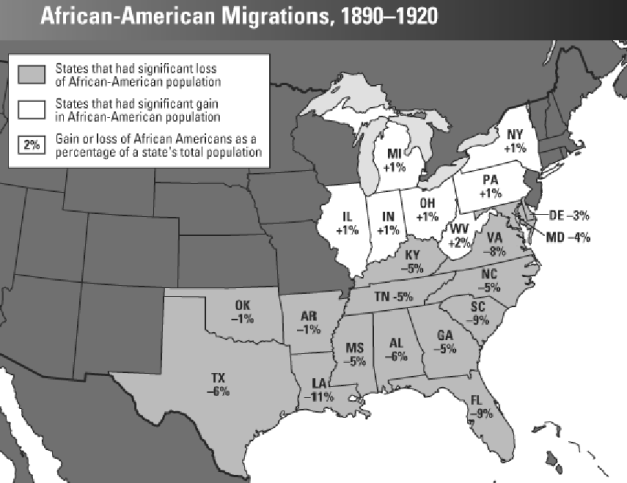
-3%
-1%
+1%
+3%
Question 21
21.
What did Tennessee, Kentucky, and North Carolina all have in common during the period represented on the map?
all were northern states
all experienced a decrease in percentage of African-American population
all experienced a increase in percentage of African-American population
The percentage of African-American population remained the same in all
Question 22
22.
Which state had the largest percent increase in its African-American population?
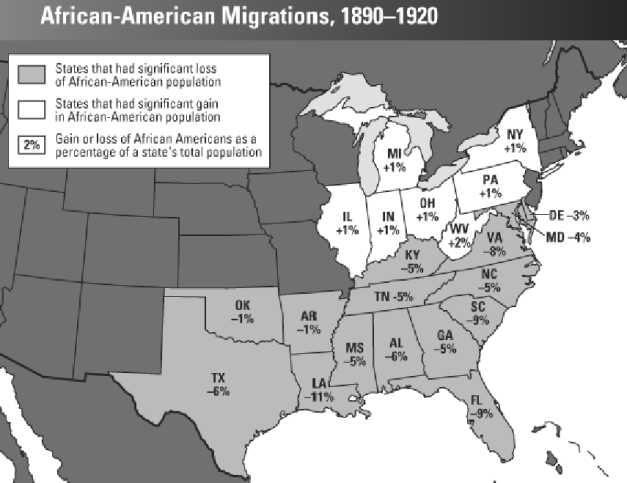
Louisiana
Florida
West Virginia
Indiana
Question 23
23.
What trend does this map illustrate?
the movement of African-Americans to the North
the movement of African-Americans to the South
The discrimination faced by African Americans in the South
The immediate effects of the abolition of slavery
Question 24
24.
In which of the following groups did all three states experience a decrease in the percentage of African-American population?
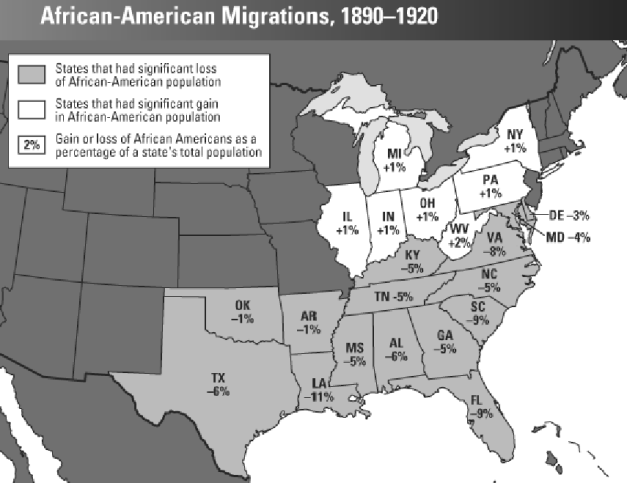
Oklahoma, Texas, Ohio
Louisiana, Georgia, Maryland
Kentucky, Deleware, Pennsylvania
New York, Georgia, Florida
Question 25
25.
Which state had the largest percent change in its African-American population?
West Viriginia
South Carolina
Florida
Louisiana
Question 26
26.
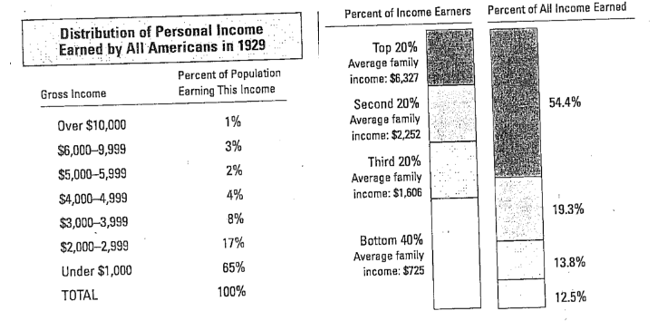
What percent of the population in 1929 had a gross income between $3,000 and $3,999?
4%
8%
12%
17%
Question 27
27.
What is the average family income of the top 20% of
the population?
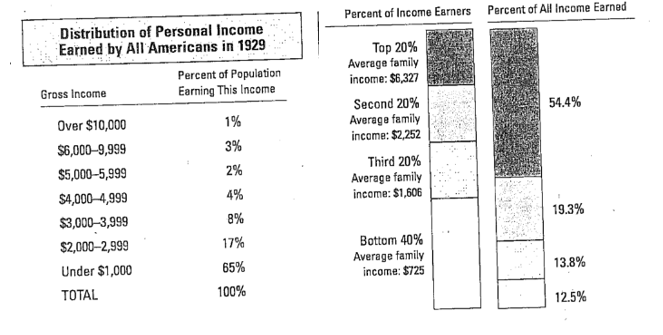
6,327
12,252
7,606
5,000
Question 28
28.
Explain the beginning
(why it started)
and the ending
(1933 - 21st amendment)
of
prohibition.
-Why it began, who supported it.
-Why it was difficult to enforce.
-Who benefited from the issues prohibition brought on?
-How did prohibition end?
Question 29
29.
Explain the Scopes Monkey Trial.
-Who was involved?
-What was the issue?
-What was the outcome?
Question 30
30.
Which amendment to the U.S. Constitution granted women's suffrage?
19th
18th
20th
21st
Question 31
31.
The African American cultural movement that valued freedom, spontaneity, music, and creativity?
Flappers
Prohibition
Harlem Renaissance
Great Migration
Question 32
32.
What was one major scandal that tarnished Harding's presidency?
Monica Lewinsky
Watergate
Teapot Dome
Iran-Contra
Question 33
33.
What was the main theme of 'The Great Gatsby'?
The decline of the American Dream
The importance of love and relationships
The pursuit of wealth and social status
The corruption of the upper class
Question 34
34.
Which American author was a prominent figure of the Lost Generation?
Ernest Hemingway
J.D. Salinger
Mark Twain
Harper Lee
Question 35
35.
What was a major influence on the Lost Generation artists?
World War I
The Great Depression
The Civil Rights Movement
The Roaring Twenties
Question 36
36.
What were the 4 reasons why the post-WW1 economy struggled and eventually collapsed by the end of the 20's?