Chapter 1 Test grade 6 2019-2020
star
star
star
star
star
Last updated almost 7 years ago
25 Nsɛmmisa
Hyɛ no nsow a efi ɔkyerɛwfo no hɔ:
Chapter 1 summative exam
1
1
1
1
1
1
1
1
1
1
1
1
1
1
1
1
1
1

1

1

1

1

1

1

1
Chapter 1 summative exam
The five fields of Social Studies are history, economics, culture, government and _____________________.
The field of Social Studies that is a record of the past is _________________.
Government is the people and groups within a society that have the authority to _______________________.
In economics, the conflict between unlimited desires and limited resources is called_________________________.
The beliefs, customs, laws, art, and ways of living that a group of people share is called its ________________________.
A legal member of a country is called a (an) _________________.
The economic, political, and social dependence of culture regions on one another is called _____________________.
An area of the world in which many people share similar beliefs, history and languages is called a ___________________.
Which of the following is an example of a culture region?
Which of these defines non-material aspects of culture?
Which of these is/are considered a material aspect of culture?
Products of nature are examples of __________________.
The study of how people manage their resources is called __________________.
Forests, fertile soil and water are examples of which resource?
The skills that people use to produce goods and services are called ______________________.
The things that people make, such as machines and equipment, to produce goods and services are _____________________.
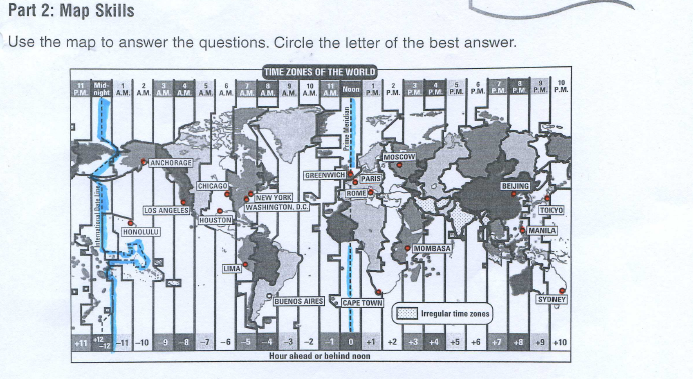
What is the name of the line where one-day ends and a new day begins?
If it is Saturday in Honolulu, in which city is it Sunday?
The prime meridian runs closest to which city?
Which city is in the same time zone as New York?
Which country has a lower literacy rate than Ghana?
Which country has a higher literacy rate than Brazil?
What is the literacy rate of Pakistan?
What is the literacy rate of Kuwait?
Which country has a literacy rate of about 66%?