Two students turned in their homework with two different pictures. Which model is correct? Explain why.
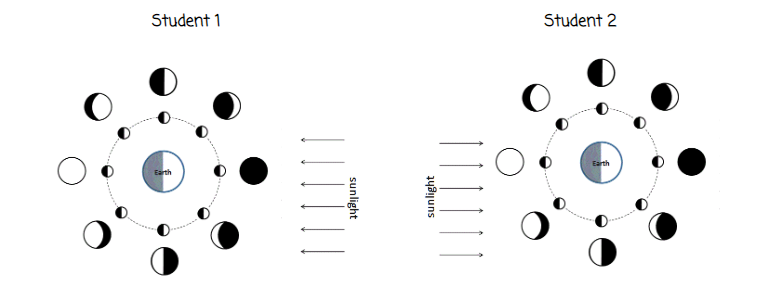
Two students turned in their homework with two different pictures. Which model is correct? Explain why.
Centerville
Two students turned in their homework with two different pictures. Which model is correct? Explain why.
Draw a line to match the model of the Sun, Earth, and Moon to the correct lunar phase.
About how long does it take for the moon to complete one lunar cycle?
In a solar eclipse, the moon blocks the light from the sun casting a shadow in some areas on the earth. Why is the moon able to block the light from the sun when the moon is very small compared to the sun?
When the moon is waxing, the light side of the moon is on the right side.
You’re asked to observe the moon. On Day 1 you look up and draw what you see. Fill in what you should see on these different days according to the pattern of the phases of the moon.
Which of the following statements are correct regarding a total lunar eclipse?
Which of the following explanations best describes the difference between solar eclipse and lunar eclipse?
Suggestion: Draw a model on a scrap peice of paper to help identify the correct answer.
You hear on the news that a new computer program tracks the patterns of solar and lunar eclipses. This program predicts that the next total solar eclipse will happen on August 21 of next year. Your friend asks why this doesn’t happen in a regular pattern every moon phase cycle like the other phases of the moon. Explain why.
Using the information from the table , select all statements that are true.
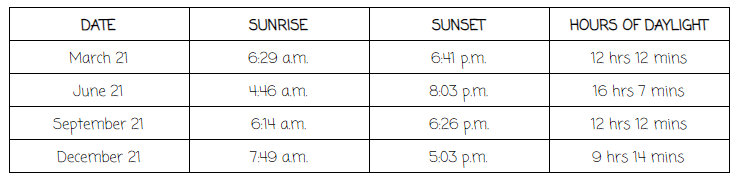
Hugh visited Alaska during the Summer of 2014 and was impressed with the fact that the sun was up, bringing daylight, nearly all day! She planned a return trip in the Winter of 2015 and was disappointed when she found the days short and the hours of daylight. Which scientific phenomenon helps to explain why was this the case?
In the graphic to the right, at which point(s) will the day and night hours be equal in length?
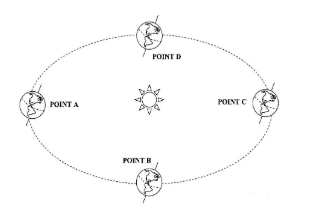
Use the Model to select all that are true.

What is directly related to the change in season at a given place on earth?
What two forces keep objects in orbital motion?
The closer two objects are together, the stronger the gravitational force is between them.
Two students are in an argument about why the planets stay in orbit and do not fly off into space. They decide to create a model by spinning a tennis ball inside of a hula hoop. They observe that the hula hoop keeps the tennis ball in a circular motion, similar to the planets’ orbits. Which BEST explains how the students’ model relates to the orbits of the planets around the sun?
Label the arrows on the diagram to explain how the moon stays in orbital motion around the earth.
Based on the information in the table, choose all the correct generalizations that can be made about the inner planets (Mercury, Venus, Earth, Mars) and the outer planets (Jupiter, Saturn, Uranus, Neptune).
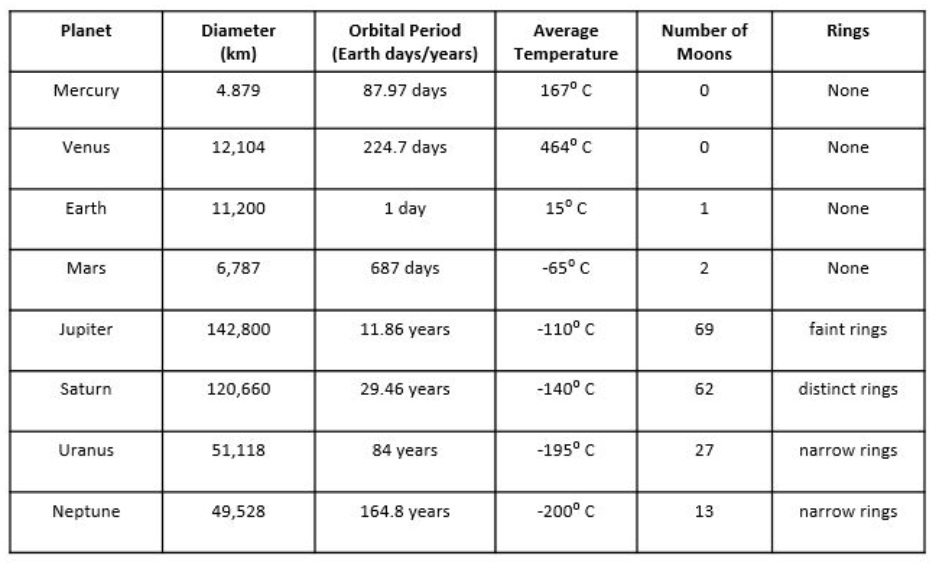
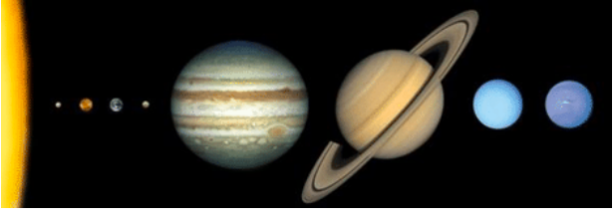
The four planets closest to the Sun are called the inner planets. They are considered terrestrial planets, meaning they are made of rock. Some of them have a thin atmosphere of gas surrounding the planet. The core is the inner part of the planet and made up mostly of metals like iron and nickel.
The four outer planets are gas giants. These planets are very far from the Sun. They don't have a hard surface that a spacecraft can land on. Instead, they are giant balls of very cold gases. Astronomers think that these planets have hot, solid cores deep beneath their atmospheres.
Which of the following conclusions can be drawn from the evidence above?
In astronomical units (AU), Earth is 1 away from the sun. Jupiter is 5.203 AU on average from the sun, Saturn is 9.537 AU from the sun, and Mercury is 0.387 AU from the sun. Use computational thinking to analyze this data, and choose all the statements that are TRUE.
Analyze data from the chart to determine if the following statement is True or False.
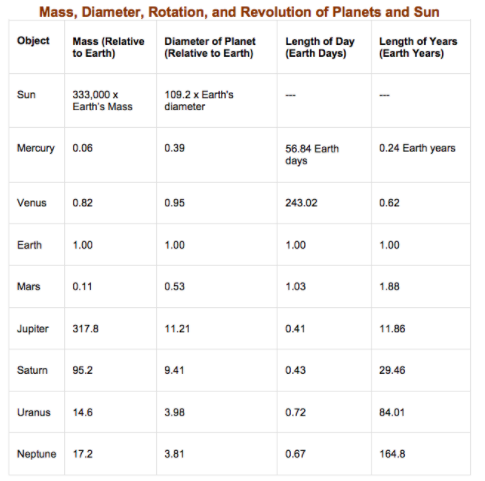
As the mass of each object increases, the diameter of the object generally decreases.
Analyze data from the chart to determine if the following statement is True or False.
The closer to the Sun an object gets, the shorter the planet’s years are.
Analyze data from the chart to determine if the following statement is True or False.
The length of the planets day is related to the length of the planets year.