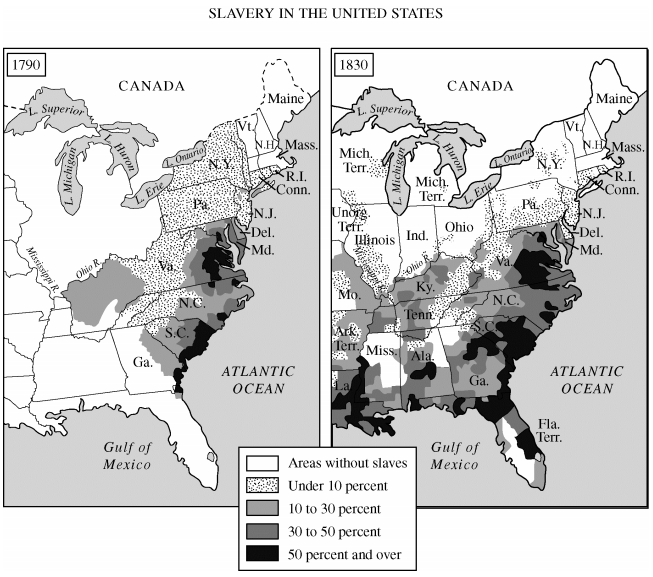
According to the map above, what historical event allowed for the expansion of the slavery in the Southern United States?
According to the map above, what historical event allowed for the expansion of the slavery in the Southern United States?
US History Exam 2020 semester one
Before 1492, many American Indian cultures were strongly influenced by the:
Which answer below best describes how Joint Stock Companies profited from the colonization of the Americas?
“The Americas were discovered in 1492, and the first Christian settlements established by the Spanish the following year.... [I]t would seem... that the Almighty selected this part of the world as home to the greater part of the human race.... [T]heir delicate constitutions make them unable to withstand hard work or suffering and render them liable to succumb to almost any illness, no matter how mild. . . . It was upon these gentle lambs... that, from the very first day they clapped eyes on them, the Spanish fell like ravening wolves upon the fold, or like tigers and savage lions who have not eaten meat for days. . . . The native population, which once numbered some five hundred thousand, was wiped out by forcible expatriation to the island of Hispaniola.”
Bartolomé de Las Casas, 1552
An implication of Las Casas’ argument is that a major cause of the decline of the native populations in the Americas after 1492 was the:
Which of the following explains the most likely reason why English colonists wanted to come to North America?
In the Colonial period, Quakers were known for all of the following EXCEPT their
Colonists from which of the following European nations generally had the most cooperative relations with American Indians?
VALUE OF SELECTED GOODS EXPORTED TO BRITISH NORTH AMERICA FROM ENGLAND
£ = British pounds, a form of currency
Good 1699 1749
Wool textiles £95,200 £359,700
Linen textiles £11,300 £115,600
Leather £14,200 £12,100
Iron £25,300 £110,000
Other manufactures £79,500 £125,400
Cheese and foodstuffs £2,300 £5,400
Which of the following describes a trend in exports from England to British North America between 1699 and 1749 indicated in the table?
The Pequod Wars (1675-1676) was instigated by which one of the following issues:
Which answer below best describes which colony below was responsible for starting the first European colony in North America and what was the main motivation for starting the colony.
What social characterstic made the Jamestown colony different than the Plymouth colony settlers?
Which answer below would best describe the economic system that would have been found in the Carolina colonies during the early colonial period?
Match the items on the left with the society most associated with it on the right you can use each item only once:
private property rights
patrilineal
illiterate
literate
Non-Christian
Chrisitan
matrineal
all land belongs to the tribe
Puritan Society
Pequod Society
The Sons of Liberty initiated the Boston Tea Party in direct response to
Which answer below best describes some of the reasons why Colonists were angered by the Intolable Acts?
The Declaration of Independence did all of the following EXCEPT
The main effect of the Tea Act, and the Intolerable Acts showed a change in British Policy, which action below best illustrates this change?
Which answer below best explains the significance of the Battle of Lexington and Concord?
“It was painful for me, on a subject of such national importance, to differ from the respectable members who signed the Constitution; but conceiving, as I did, that the liberties of America were not secured by the system, it was my duty to oppose it.
“My principal objections to the plan are, that there is no adequate provision for a representation of the people; . . . that some of the powers of the legislature are ambiguous . . . ; that the executive is blended with, and will have an undue influence over, the legislature; that the judicial department will be oppressive; . . . and that the system is without the security of a bill of rights. These are objections which are not local, but apply equally to all the states.
“As the Convention was called for the ‘sole and express purpose of revising the Articles of Confederation . . . ,’ I did not conceive that these powers extend to the formation of the plan proposed; but the Convention being of a different opinion, I acquiesced [agreed] in it, being fully convinced that, to preserve the Union, an efficient government was indispensably necessary, and that it would be difficult to make proper amendments to the Articles of Confederation.
“The Constitution proposed has few, if any, federal features, but is rather a system of national government. Nevertheless, in many respects, I think it has great merit, and, by proper amendments, may be adapted. . . .
“Others may suppose that the Constitution may be safely adopted, because therein provision is made to amend it. But cannot this object be better attained before a ratification than after it? And should a free people adopt a form of government under conviction that it wants [needs] amendment?”
Elbridge Gerry, letter to the Massachusetts state legislature, 1787
Arguments for creating a stronger federal government arose primarily as the result of long-term concerns about the:
The principal motivation for drafting the Bill of Rights was the desire to
“Louisiana as ceded by France is made part of the United States. Congress may make part of the United States other adjacent territories which shall be justly acquired.
“Congress may sever from the United States territory not heretofore within the United States, with consent of a majority of the free males above 21 years, inhabiting such territory.”
James Madison, secretary of state, proposed constitutional amendment [not passed], 1803
Which of the following best describes the historical situation in which the amendment was proposed?
Question refers to the excerpt below.
“Few historians would dispute that the market revolution brought substantial material benefits to most northeasterners, urban and rural.... Those who benefited most from the market revolution—merchants and manufacturers, lawyers and other professionals, and successful commercial farmers, along with their families—faced life situations very different from those known to earlier generations. The decline of the household as the focus of production led directly to a growing impersonality in the economic realm; household heads, instead of directing family enterprises or small shops, often had to find ways to recruit and discipline a wage-labor force; in all cases, they had to stay abreast of or even surpass their competitors.”
Sean Wilentz, historian, “Society, Politics, and the Market Revolution, 1815–1848,” published in 1997
Which of the following historical developments contributed most directly to the market revolution?
President George Washington’s Farewell Address set a course for the nation by
The Alien and Sedition Acts were designed to
According to the map above, what historical event allowed for the expansion of the slavery in the Southern United States?
All of the following accurately describes the effect of the 3/5th compromise on American politics EXCEPT:
The dramatic increase in the South’s slave labor force between 1810 and 1860 was due to:
“As [political leader Henry] Clay envisioned it [in the 1820s], the American System constituted the... basis for social improvement.... Through sale of its enormous land holdings, the federal government could well afford to subsidize internal improvements. By levying protective tariffs, the government should foster the development of American manufacturing and agricultural enterprises that, in their infancy, might not be able to withstand foreign competition. The promotion of industry would create a home market for agricultural commodities, just as farms provided a market for manufactured products.”
Daniel Walker Howe, historian, What Hath God Wrought: The Transformation of America, 1815–1848, published in 2007
Based on the excerpt, which of the following groups would have been most likely to oppose Henry Clay’s ideas?
Henry Clay’s “American System” called for all of the following EXCEPT
The answers below illustrated the need to develop the "American System" except:
The Monroe Doctrine maintained that
Which answer below best explains why southern Democrats did not like the use of Tariffs
Which of the following is true of John Marshall’s decision in McCulloch v. Maryland?
Which of the following is true of the Supreme Courts decision in Gibbons v. Ogden Case?
Which of the following is true of the Supreme Courts decision in Fletcher vs Peck?
Which answer below best explains the change in the relationship between the national government and state governments between the years 1810 - 1837?
Which answer below is not one of the benefits associated with having a National Bank?
During the 1800s the most common form of resistance to slavery by slaves themselves was
In the early 1830’s, the majority of workers in the textile mills of Massachusetts were
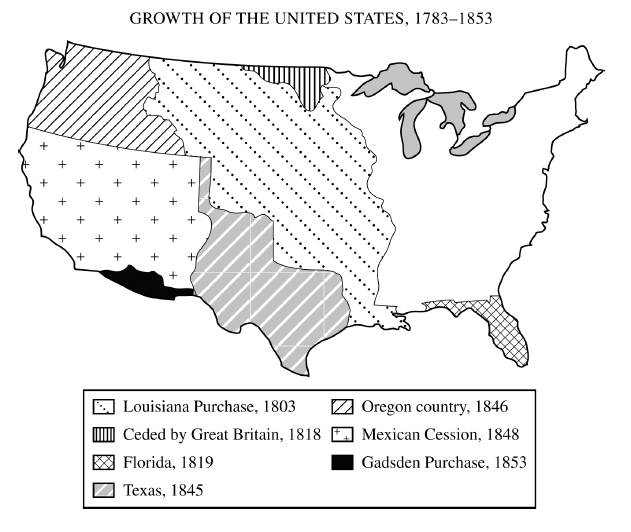
In the mid-nineteenth century, the process shown in the map was advocated by supporters of which of the following ideologies?
The Second Great Awakening was the first national movement to oppose this institution:
The Missouri Compromise did which of the following?
“Not far from this time Nat Turner’s insurrection [a slave rebellion] broke out; and the news threw our town into great commotion. . . .
“It was always the custom to have a muster every year. On that occasion every White man shouldered his musket. The citizens and the so-called country gentlemen wore military uniforms. . . .
“I knew the houses were to be searched; and I expected it would be done by country bullies and the poor Whites. . . .
“It was a grand opportunity for the low Whites, who had no Negroes of their own to scourge. They exulted in such a chance to exercise a little brief authority, and show their subserviency to the slaveholders; not reflecting that the power which trampled on the colored people also kept themselves in poverty, ignorance, and moral degradation. . . . Colored people and slaves who lived in remote parts of the town suffered in an especial manner. In some cases the searchers scattered [gun]powder and shot among their clothes, and then sent other parties to find them, and bring them forward as proof that they were plotting insurrection.”
Harriet Ann Jacobs, Incidents in the Life of a Slave Girl, published in 1861, describing events earlier in the nineteenth century
Which of the following pieces of evidence best supports the excerpt’s depiction of reactions to slave rebellions?
Jacksonian Democracy was distinguished by the belief that
“We, therefore, the people of the State of South Carolina, in convention assembled, do declare and ordain... that the several acts and parts of acts of the Congress of the United States, purporting to be laws for the imposing of duties and imposts on the importation of foreign commodities...are unauthorized by the Constitution of the United States, and violate the true meaning and intent thereof and are null, void, and no law, nor binding upon this State....”
South Carolina Ordinance of Nullification, 1832
The ideas expressed in the excerpt emerged most directly from a larger intellectual debate over the
President Andrew Jackson’s creation of a monetary system based on state-chartered banks most likely contributed to which of the following?
What effect did President Jackson's Indian Removal Act have on land use in Georgia and Tennessee?