Sedimentary Rocks and Fossils Fuels cloned 10/2/2019
star
star
star
star
star
Last updated over 6 years ago
5 questions
1
1
1
1
1
Question 1
1.
Question 2
2.
Question 3
3.
Question 4
4.
Question 5
5.
Two students are discussing natural resources fand fossils fuels. Which student's thinking is correct?
Student A says, " Fossil fuels are renewable resources such as coal and plants formed from soil and sedimentary rock."
Student B says," Fossil fuels are nonrenewable resources such as natural gas and petroleum formed from once-living organisms."
Student C says, " Fossil fuels are renewable resources such as natural gas, coal and oil."
Which of the following answers are the third step in the formation of fossil fuels?
Time passes as more layers form over the once-living organism.
A small organism lives in the ocean.
A fossil fuel forms through increased time, temperature and pressure.
The prehistoric organism dies and is buried under soil.
The diagram below shows layers deposited under a body of water. The layering continued for millions of years.
What most likely happened to the dead and plants and animals.
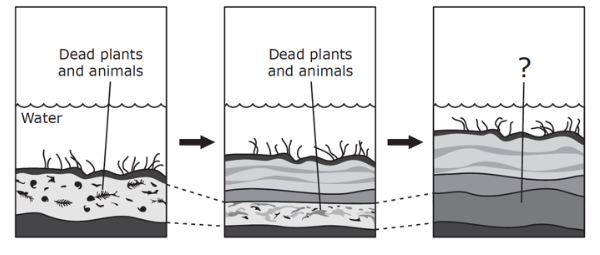
They were eaten by scavengers.
They became fossil fuels.
They were washed away by water.
They became an underwater aquifer.
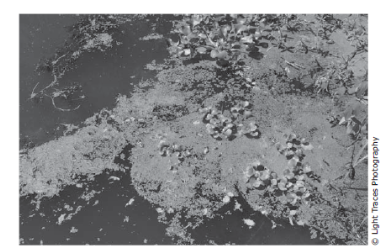
This photographs shows plants growing on the surface of the pond. How do plants like these form fossil fuels?
Dead plants sink to the bottom of the pond and get buried by sediment for millions of years.
Live plants sink to the bottom of the pond and get covered and turn into fossil fuels after 5 years.
Dead plants sink to the bottom of the pond and consumed by decomposers.
Dead plants produce carbon which is consumed by fish, which form fossil fuels.
Students created a model to show the formation of sedimentary rock. The students poured light colored sand into the plastic container. Then they added gravel and next dark colored sand on top. What characteristic of sedimentary rock does this model show?