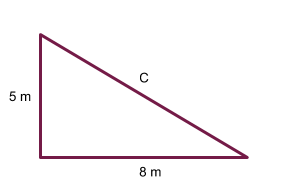
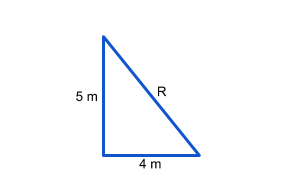
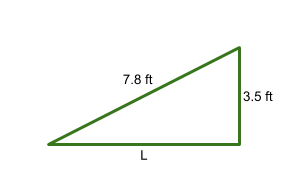
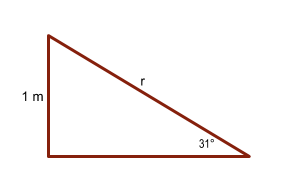
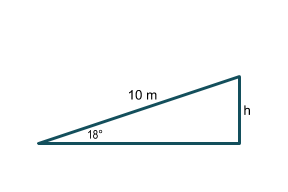
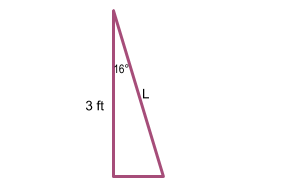
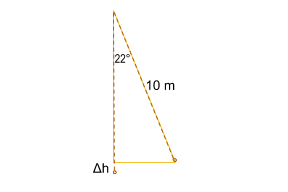
Right triangles are particularly useful when studying nature because it is easy to assign a reference frame that has perpendicular lines, such as North/South and East/West or Up/Down and Left/Right or ±x and ±y. In all triangles, the sum of the angles (A+B+C) is 180°. In a right triangle, two sides are set perpendicular to each other so their angle is 90°, which leaves the sum of the remaining 2 angles to equal 90°. In the figure, angle C = 90° and A+B = 90°.
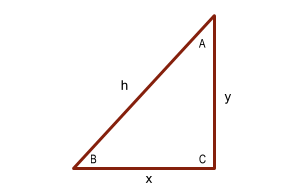
We call the diagonal between A and B the hypotenuse. The pythagorean theroem allows us to calculate the length of the edges of a right triangles because the sum of the squares of the two sides equals the square of the hypotenuse. This is sometimes written a2+b2=c2 or if you use my example triangle x2+y2=h2.
We know that angle C will always equal 90°... this is basically the definition of a right triangle. But we need some trigonometry to determine the exact angles of B and C, knowing that together they again equal 90°.
SOHCAHTOA is hopefully a familiar phrase, but maybe not an easily applicable one. The acronym stands for
S sine
O opposite over
H hypontenuse.
C cosine
A adjacent over
H hypotenuse.
T tangent
O opposite over
A adjacent.
You always need to know at least two things to find an unknown. To find a side when you know an angle, first identify if you know the adjacent, opposite, or hypotenuse. For example, if you know B, x would be adjacent, y opposite, and h hypotenuse - which two you know will determine which trig function you're able to use. If we know one side and one angle, identify how that side is related to the angle. Is it the hypotenuse or is it touching/adjacent or not connected/opposite? For example, if I know angle A and the hypotenuse and want to find x, where x is opposite A, we'd need sine.
Multiply both sides by h and reduce
sin(A)=x/h
h*sin(A)= x
If we know at least two sides, we can find the angle using the inverse functions (those are usually accessed by a second key on your calculator and have a -1 exponent by them). For example, if I know x and the hypotenuse and want to know the angle B, cosine (CAH) would be appropriate and the inverse cosine or arccos needed for the angle. It would be set up as cos-1(x/h) = angle B. Note, we don't ever need to calculate C because it's our loyal right angle = 90°.