1
1
1
1
1
1
1
Enter your First Name (ex: Pierre)
Enter your Last Name (ex: Dupont)
Enter your Skema Student ID Number
How many environmental problems can you list? (Not natural disasters, but man made problems) Try to list as many as possible.
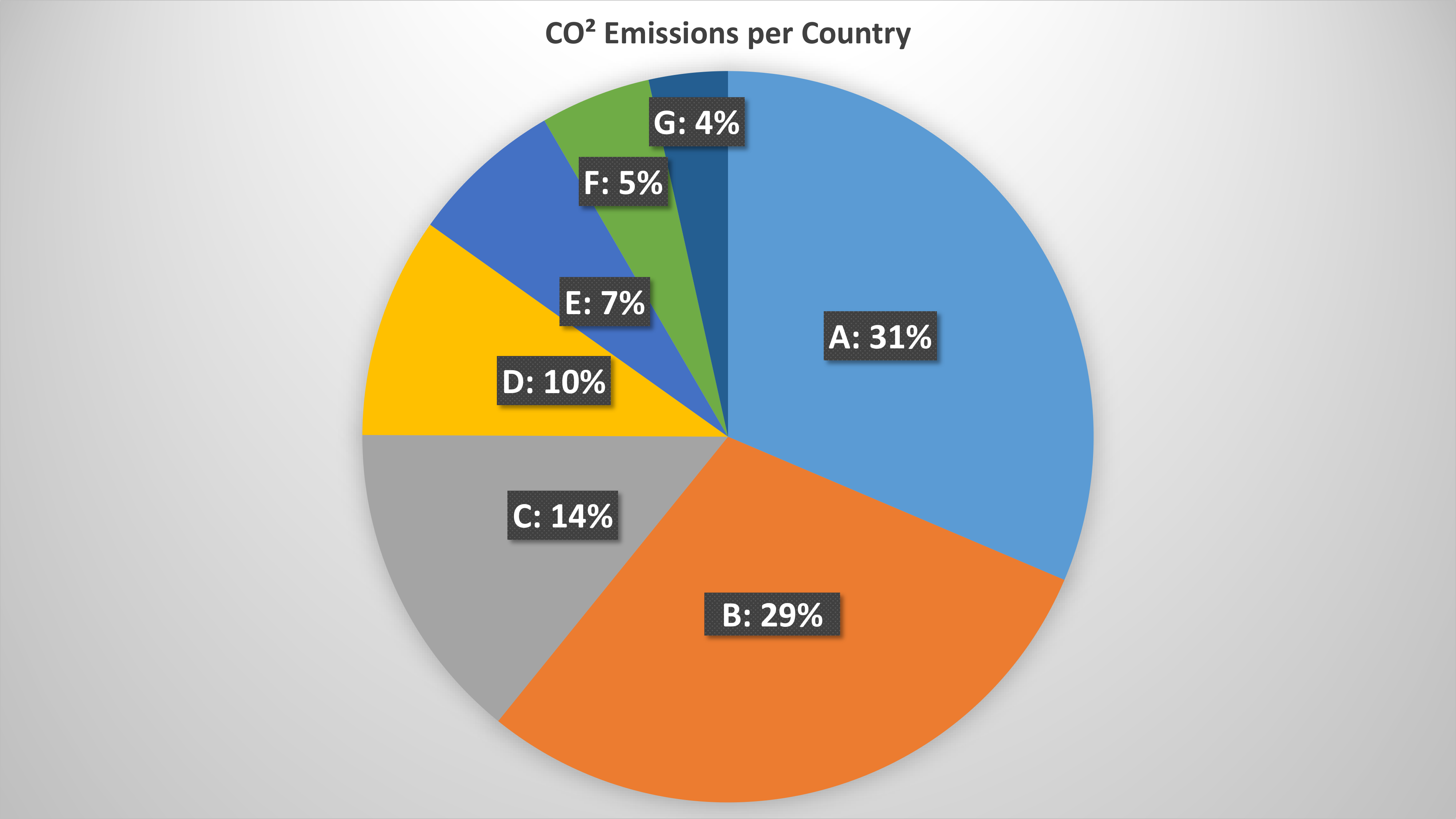
Who pollutes the most in the world? Below you have a pie chart of the CO² emissions per country in the world. Who do you think fits into each slice of the pie?
Match the following country chocies with the pie chart below (questions 5 - 11): "India" - "USA" - "Russia" - "Europe" - "China" - "Japan" - "Other"
Annually, __________ million tons of plastic are washed into our seas
A teenager has come up with the solution to cleanup the plastic in the oceans.
Boyan Slat says that plastic pollution is endangering our planet just as much as climate change and nuclear waste.
At least 1 million seabirds and ________________ marine mammals die each year due to plastic pollution.
"when these tiny pieces of plastic are ingested by fish, they bring toxic chemicals from the ocean into the __________ ______________.
plastic pollution ultimately increases the risk of .... (choose 3)
No single nation has responsibility for international waters.
Boyan Slat said, "the concept is really simple, we want to create an _____________ _________________. "
Boyan Slat, "this will be the longest ___________ structure ever deployed on the oceans."
From 2 kilometers in 2016, to _____ kilometers in 2020.
Boyan claims that the barrier will eventually collect all plastic in the North Pacific.
Boyan: "the great pacific garbage patch is really a symbol of how the negative ________ ___________ of technologies created such a world problem in the last century.
Boyan hopes that the Ocean Cleanup will become a symbol of how we use technology to make things better again.
Tens of thousands of “smog refugees” have reportedly fled China’s pollution-stricken north after the country was hit by its latest “airpocalyse” forcing almost half a billion people to live under a blanket of toxic fumes. North and central China have been living under a pollution "red alert" since last Friday when a dangerous cocktail of pollutants transformed the skies into a yellow haze.
Greenpeace claimed the calamity had affected a population equivalent to those of the United States, Canada and Mexico combined with some 460m people having to breathe either hazardous pollution or heavy levels of smog in recent days. Lauri Myllyvirta, a Beijing-based Greenpeace activist, said that in an attempt to shield his lungs he was avoiding going outside and using two air purifiers and an industrial grade dust mask “that makes me look like Darth Vader”.
Others have simply opted to flee. Flights to some pollution-free regions have been packed as a result of the smog. Ctrip, China’s leading online travel agent, said it expected 150,000 travellers to head abroad this month in a bid to outrun the smog. Top destinations include Australia, Indonesia, Japan and the Maldives.
Jiang Aoshuang, said she had skipped town with her husband and 10-year-old son in order to spare their lungs. They made for Chongli, a smog-free ski resort, only to find it packed with other fugitives seeking sanctuary from the pollution. “It really felt like a refugee camp”. Yang Xinglin, who also fled to Chongli, said she had requested time off from her job so she did not have to inhale the smog. “You ask me why I left Beijing? It’s because I want to live,” A third “smog refugee”, swapped her family home in Chengdu, also blighted by severe pollution, for a hotel in the province of Yunnan. “I finally saw the blue sky. It was wonderful!”
Fleeing the danger zone has not been completely straightforward for China’s environmental exiles. Smog had paralysed airports in Beijing and across the country’s northern industrial heartland, making escape impossible. Beijing’s domestic airport cancelled all flights on Tuesday while the Beijing Capital international airport cancelled at least 273 flights.
The Greenpeace activist, said his group had been warning of a winter smog crisis since July when it began noticing the government was pumping economic stimulus into heavily-polluting industries such as cement and steel.
But Myllyvirta said he was convinced the future looked brighter for China’s environment, despite its latest airpocalypse. A fall in the use of coal and air pollution were likely over the next three to five years as more urgent steps were taken to restructure the economy and preserve the environment. For now, however, some locals saw temporary or permanent exile as their only option while many outsiders refused to come at all. “People are definitely thinking about how to get out and companies are complaining that it is hard to recruit talent. People don’t want to live in places with terribly polluted air.”
TOM PHILLIPS - THE GUARDIAN, 21 DECEMBER 2016
des émanations toxiques
des polluants
respirer
le brouillard
un militant
une tentative
protéger
les poumons
choisir
s'enfuir
bondé
epargner, protéger
Une station de sport d’hiver
Ressembler à (physiquement)
Echanger contre
dégradé
annuler un vol (avion)
mettre en garde, avertir
un avenir radieux
se plaindre
remarquer
What did you think about the last video? Do you agree or disagree with the general message that the Earth is not in danger, but it is actually civilization which is in danger.
Before the Flood (Avant le Déluge), a documentary narrated by Leonardo Di Caprio, is probably the most comprehensive documentary to date which investigates climate change and shows how serious the risk is. Unfortunately, this video is not available on YouTube and therefore I cannot share it with you on this lesson. However, I highly recommend that you watch it if you are seriously interested in environmental issues. You can find it on Netflix and here:
https://vimeo.com/190012126
and
https://archive.org/details/youtube-90CkXVF-Q8M