-Choose the correct answer by clicking on your answer choice. Only one answer is correct. (2 pts. each)
Question 1
1.
Question 2
2.
Question 3
3.
Question 4
4.
Question 5
5.
Question 6
6.
Question 7
7.
Question 8
8.
Question 9
9.
Question 10
10.
Question 11
11.
Question 12
12.
Question 13
13.
Question 14
14.
Question 15
15.
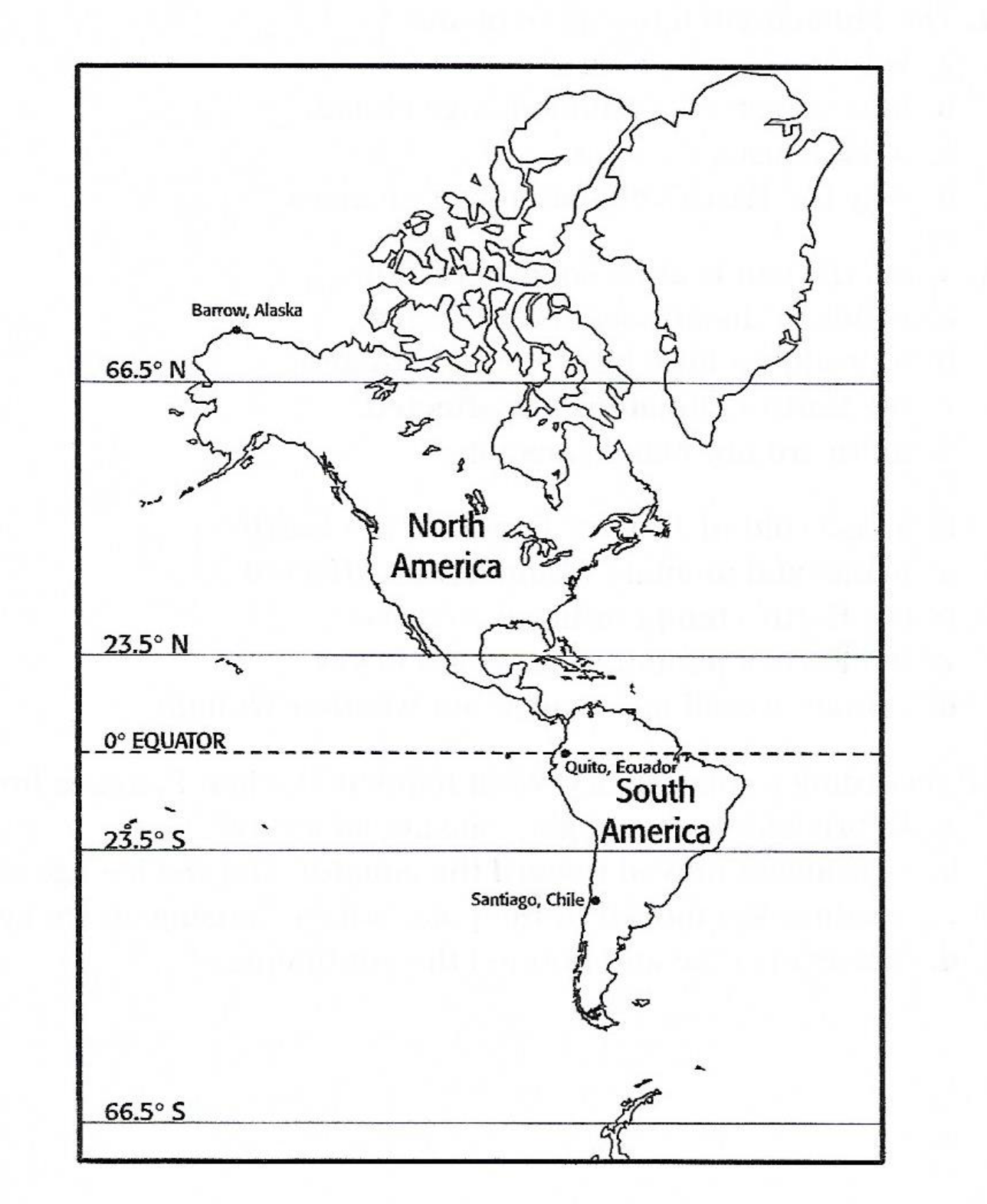
Refer to the map below to answer questions 19 - 21.
Question 16
16.
Question 17
17.
Question 18
18.
Question 19
19.
Question 20
20.
Question 21
21.
Question 22
22.
Question 23
23.
Question 24
24.
Question 25
25.
COMPLETION
-Complete the following questions by selecting the correct answer from the word bank. Misspelled words will be marked as incorrect. Some answers may be used more than once, others may not be used at all. (2 pts. each)
Word Bank
latitude longitude temperate prevailing winds surface currents climate deciduous tropical elevation weather evergreens temperate zone
Question 26
26.
The day-to-day change in temperature and precipitation makes up and areas ______________.
Word Bank
latitude longitude temperate prevailing winds surface currents climate deciduous tropical elevation weather evergreens temperate zone
Question 27
27.
An area's distance north or south of the Equator is the area's
Word Bank
latitude longitude temperate prevailing winds surface currents climate deciduous tropical elevation weather evergreens temperate zone
Question 28
28.
Large, grazing animals including bison, live in the _________________ grasslands of North America.
Word Bank
latitude longitude temperate prevailing winds surface currents climate deciduous tropical elevation weather evergreens temperate zone
Question 29
29.
At the end of the growing season ___________ trees lose their leaves.
Word Bank
latitude longitude temperate prevailing winds surface currents climate deciduous tropical elevation weather evergreens temperate zone
Question 30
30.
Blowing mainly from one direction, _____________ affect the amount of precipitation a region receives.
MATCHING
-Complete the following matching questions by clicking on the correct answer. Only one answer is correct. (2 pts. each)
Question 31
31.
Question 32
32.
Question 33
33.
Question 34
34.
Question 35
35.
Question 36
36.
Question 37
37.
Question 38
38.
Question 39
39.
Question 40
40.
Question 41
41.
Question 42
42.
Question 43
43.
Question 44
44.
Question 45
45.
Question 46
46.
Matching- Match the animal with the biome.
Question 47
47.
Question 48
48.
Question 49
49.
Question 50
50.
Do NOT forget to turn in this assignment after you have submitted it here! No credit will be awarded for unsubmitted assignments.
Which of the following biomes is always warm and wet?
A. tropical rain forest
B. temperate forest
C. savanna
D. chaparral
Prevailing winds affect a region's climate by
A. creating desert areas.
B. causing more precipitation on one side of a mountain.
C. affecting how much precipitation it receives.
D. controlling the amount of solar energy it receives.
Which human activity is NOT thought to be related to global warming?
A. burning forests for farmland
B. riding a bike
C. burning fossil fuels for transportation
D. cutting down trees for building materials
The main reason winter is colder in Washington, D.C., than in southern Texas is that
A. Washington is located at a higher elevation.
B. Washington is at a higher latitude.
C. The prevailing winds in Texas travel across water.
D. Southern Texas has many mountains.
What does the geologic record indicate about the Earth's climate?
A. It has always been about the same.
B. It is at its coldest now.
C. There has been one major ice age.
D. It was once much colder than it is today.
An important factor for plant growth in the tropical savanna is
A. grass fires.
B. year-round rain.
C. cold nights.
D. rapid decay of plants.
Conifers have adapted well to the taiga biome because
A. their needles make the soil acidic.
B. their flexible branches and needles shed snow quickly.
C. they lose their leaves at the end of each growing season.
D. their roots can grow above ground.
Why does the Equator experience about the same temperatures year round?
A. It tilts toward the sun and receives much more direct solar energy.
B. It has no prevailing winds.
C. It has no mountains to affect its climate.
D. The sun's rays strike the Equator at about the same angle all year.
The windward side of a mountain usually
A. is a desert.
B. has no precipitation.
C. is lush and green.
D. has warm, sinking air.
Which of the following is an example of a microclimate?
A. the polar zone
B. the rain forest
C. the savanna
D. the alpine biome
Which of the following biomes contains the greatest number of plant and animal species?
A. tropical rain forest
B. coniferous forest
C. savanna
D. tundra
Wind will generally carry the most moisture when it comes from
A. warm grasslands.
B. warm tropical seas.
C. polar icecaps.
D. mountainous regions.
The most abundant plants in the taiga are
A. deciduous trees.
B. evergreen shrubs.
C. bamboo.
D. conifers.
Which human activity is thought to be most responsible for global warming?
A. using aerosol hairspray
B. mowing grasslands for cattle feed
C. burning fossil fuels for transportation
D. planting deciduous forests for building materials
Seasons are caused by
A. the sun's cycle.
B. the greenhouse effect.
C. sunspots.
D. the tilt of the Earth's axis.
Climate zone located between 0o and 23.5o N
A. temperate
B. polar
C. tropical
Climate zone located between 23.5o S and 56.5o S
A. temperate
B. polar
C. tropical
Climate zone located north of 56.5o N
A. temperate
B. polar
C. tropical
Prevailing winds that travel to a region across a large body of water would probably make the region's climate
A. warmer.
B. wetter.
C. cooler.
D. dryer.
Which of the following explains why one side of a mountain usually has more precipitation than the other side?
A. Mountains force air to rise, and air cools and releases moisture as it rises.
B. The atmosphere gets denser as elevation increases.
C. Temperatures are higher on one side side of a mountainthan on the other.
D. The land on one side is more green and lush than the other.
What causes soil in rain forests to be nutrient poor?
A. Plants and animals decay rapidly.
B. There are not enough decaying plants and animals.
C. Many trees have above ground roots that do not nourish soil.
D. Nutrients are quickly used by plants or washed away.
What d all biomes in the temperate zone have in common?
A. four distinct seasons
B. moderate temperatures
C. similar animals
D. deciduous and evergreen trees
What is the main vegitation in chaparral regions?
A. deciduous trees
B. conifers
C. evergreen shrubs
D. grasses
The Milankovitch theory states that
A. ice ages are caused by volcanic eruptions.
B. continental drift causes ice ages.
C. changes in the Earth's orbit cause ice ages.
D. Earth's orbit never changes.
How would an asteroid most likely change the Earth's climate?
A. Debris from an asteroid hitting Earth could block sunlight.
B. TRhe asteroid would block the sun during its orbit, chilling the Earth.
C. Tthe asteroid would change the Earth's orbit, causing an ice age.
D. If the asteroid fell in the ocean, it would make the sea level rise.
Height of a landform, such as a mountain, above sea level.
A. biome
B. latitude
C. weather
D. surface current
E. elevation
F. climate
G. prevailing winds
A region with a specific type of climate and certain types of plant and animal communities.
A. biome
B. latitude
C. weather
D. surface current
E. elevation
F. climate
G. prevailing winds
The average weather conditions over a long time.
A. biome
B. latitude
C. weather
D. surface current
E. elevation
F. climate
G. prevailing winds
Winds that come mainly from one direction.
A. biome
B. latitude
C. weather
D. surface current
E. elevation
F. climate
G. prevailing winds
Distance north or south from the Equator.
A. biome
B. latitude
C. weather
D. surface current
E. elevation
F. climate
G. prevailing winds
Conditions that vary from day to day such as temperature and precipitation.
A. biome
B. latitude
C. weather
D. surface current
E. elevation
F. climate
G. prevailing winds
The movement of ocean water at or near the ocean's surface.
A. biome
B. latitude
C. weather
D. surface current
E. elevation
F. climate
G. prevailing winds
The biome that contains the most plant and animal species.
A. tropical savanna
B. tropical zone
C. tropical rain forest
D. tropical desert
The driest place on Earth.
A. tropical savanna
B. tropical zone
C. tropical rain forest
D. tropical desert
The region that receives the most solar radiation.
A. tropical savanna
B. tropical zone
C. tropical rain forest
D. tropical desert
The biome with a dry season followed by short periods of rain.
A. tropical savanna
B. tropical zone
C. tropical rain forest
D. tropical desert
A natural process in which gases in the atmosphere trap heat.
A. glacial period
B. interglacial period
C. ice age
D. greenhouse effect
E. global warming
A long period of cool climate.
A. glacial period
B. interglacial period
C. ice age
D. greenhouse effect
E. global warming
A global increase in Earth's temperature.
A. glacial period
B. interglacial period
C. ice age
D. greenhouse effect
E. global warming
A time during an ice age when ice melts and the sea level rises.
A. glacial period
B. interglacial period
C. ice age
D. greenhouse effect
E. global warming
A period during an ice age when ice sheets advance and the sea level drops.