Temperature, Thermal Energy and Heat
star
star
star
star
star
Last updated almost 7 years ago
14 Nsɛmmisa
Hyɛ no nsow a efi ɔkyerɛwfo no hɔ:
This quiz covers heat, temperature, and thermal energy
4
4
4
4
4
4
4
4
4
4
4
4
4
4
This quiz covers heat, temperature, and thermal energy
Please view the table above, and determine which material heated up faster., and choose the correct explanation.
The less massive something is, the more thermal energy it has, because the particles are moving faster.
A cooler at 35 degrees has _______ __________ energy than a soda can at the same temperature because it has more ________. Select the best answer(s).
Please place the items in the correct categories.
Does depend on mass
Does not depend on mass
Total kinetic energy of all particles
Average kinetic energy of all the particles
Thermal Energy
Temperature
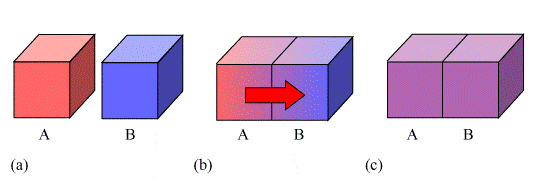
In part (a), describe the process of heat flow.
In part (b), describe the process of heat flow.
In part (c) above, describe the process of heat flow.
Place the items in the correct categories.
A material that allows heat to flow through it.
A material that allows heat to flow through it quickly.
A material that slows down heat flow.
Steel
Wool
Platinum
Rubber
Cotton
Aluminum
Wood
Plastic
Glass
Conductor
Insulator
Neither
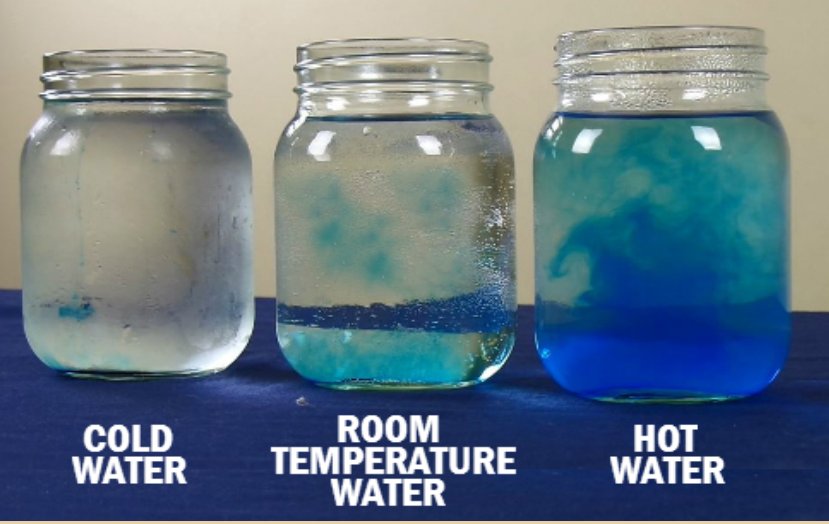
View the image below and use it to answer the following questions. In room temperature water, the food coloring dissolved slightly. Choose the best answer(s) to explain this process. There may be more than one correct answer.
Which description best explains why the food coloring dissolved completely in hot water? Choose the best answer.
Select the best answer. Which is an example of heat flow?
Select the best answer(s). How is an object's thermal energy affected by it's temperature?
This question is on the screen. Please ask for a piece of blank paper to complete this question.
Read the following statement, and decide if it is true or false. As a substance gains thermal energy, it's particles move more slowly, and have less interactions.