Log in
Sign up for FREE
arrow_back
Library

10_Phys Final Part 3

star
star
star
star
star
Last updated about 6 years ago
15 questions
Note from the author:
1
1
1
1
1
1
1
1
1
1
1
1
1
1
1
Physics
Question 1
1.

Question 2
2.

Question 3
3.

Question 4
4.

Question 5
5.

Question 6
6.

Question 7
7.

Question 8
8.

Question 9
9.

Question 10
10.

Question 11
11.

Question 12
12.

Question 13
13.

Question 14
14.

Question 15
15.

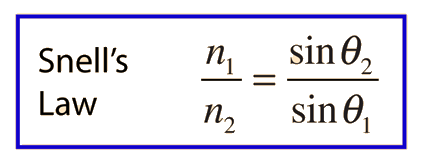
Snell's law is
when the sines of the incident and refractive angles are proportional (constant)
when the sines of the incident angle is proportional (constant)
when the sine of second angle is equal to the refractive index of the second
when the sine of first angle is equal to the refractive index of the second
Is the line that is perpendicular to the separation of the 2 media.
Boundary line
Normal Line
Incident angle line
refractive angle line
Speed of light is the
speed of electromagnetic wave in a light medium.
speed of electromagnetic wave in vacuum.
speed of electromagnetic wave in air.
We see objects because ...
light is hitting on them without bouncing off.
objects capture their own light and gets to our eyes.
all the objects are non-luminous
non-luminous objects reflect light and gets to our eyes.
Electromagnetic Spectrum is ...
A full range of all electromagnetic waves and their effects/applications
A full range of all electromagnetic waves and their origins
A full range of all electromagnetic waves and their limitations
Optical fibres are ...
Long, thin strands of glasses carrying digital signals in the form of pulses light emitted by an LED (light-emitting diode)
Long, thin strands of glasses carrying electrical signals in the form of pulses light emitted by an LED (light-emitting diode)
Longitudinal waves ...
Carry the energy backwards and forwards related to the wave propagation
Carry the energy backwards and upwards related to the wave propagation
Carry the energy perpendicular to the wave propagation
Difference of Frequency and Hertz (frequency unit) is
one is waves per unit time and the other is waves in one second.
one is waves per unit time and the other is 1 wave per unit time
one is waves per unit time and the other is waves in one meter.
one is waves per unit time and the other is 1 wave per distance time
Refraction of any wave is ...
just when any object slows down
just when any wave slows down and changes its velocity
When incident angle is reflected completely
When incident angle slows down
Sound waves are caused by vibrations, are longitudinal waves, need a material to travel through, can be diffracted, etc. These are some of the ...
nature of ocean waves
nature of longitudinal waves
nature of sound waves
Scanning the womb of a pregnant woman is one of the applications of:
reflection of sounds with frequency higher than 20,000 Hz
reflection of sounds with frequency lower than 20,000 Hz
Reflection of transverse waves
Diffraction of the sound
Photons are ...
energized particles that only makes the visible light waves.
energized particles that makes the electromagnetic waves.
energized particles that only makes the gamma rays.
energized particles that makes the longitudinal waves.
If we say that an Electromagnetic wave has high frequency means ...
their amplitude is larger
their wavelength is small
have greater distance between crest to crest.
According to this picture:
In a smaller gap, there is no much diffraction
in a samller gap, the wavelength decreases
in a smaller gap, the wavelength increases
in a smaller gap, there is a lot of diffraction.
This picture is an example of:
reflection of sound
diffraction of sound
refraction of sound