Does this table represent inverse variation?
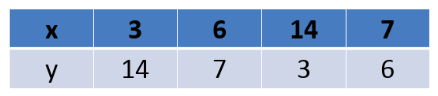
Does this table represent inverse variation?
What is the slope of a line parallel to the line formed by the equation?
What is the equation of the line parallel to the line formed by the equation and passes through the point (2, 4)?
What is the slope of the line perpendicular to the line formed by the equation?
What is the equation of the line perpendicular to the line formed by the equation that passes through the point (2, 4)?
Tell whether the equation represents direct variation, inverse variation, or neither.
Given that y varies directly with x, write a direct variation equation that relates x and y when x = 24 and y = 3
From the set of ordered pairs below, select all ordered pairs which 3 will create a direct variation?
From #7 above, write the direct variation equation.
Tell whether the equation represents direct variation, inverse variation, or neither.
Given that y varies inversely with x, write an inverse variation equation that relates x and y when x = 6 and y = 3
Does this table represent inverse variation?
If #11 showed inverse variation, write the inverse variation equation. If it didn't show any variation, write "n/a"
Tell whether the equation represents direct variation, inverse variation, or neither.
Describe the transformations from the parent function f(x) = x to the function below.
Describe the transformations from the parent function f(x) = x to the function below.
Describe the transformations from the parent function f(x) = x to the function below.
Describe the transformations from the parent function f(x) = x to the function below.