Sci. 8 Unit B: Section 1.0 Quiz
star
star
star
star
star
Last updated about 4 years ago
15 Nsɛmmisa
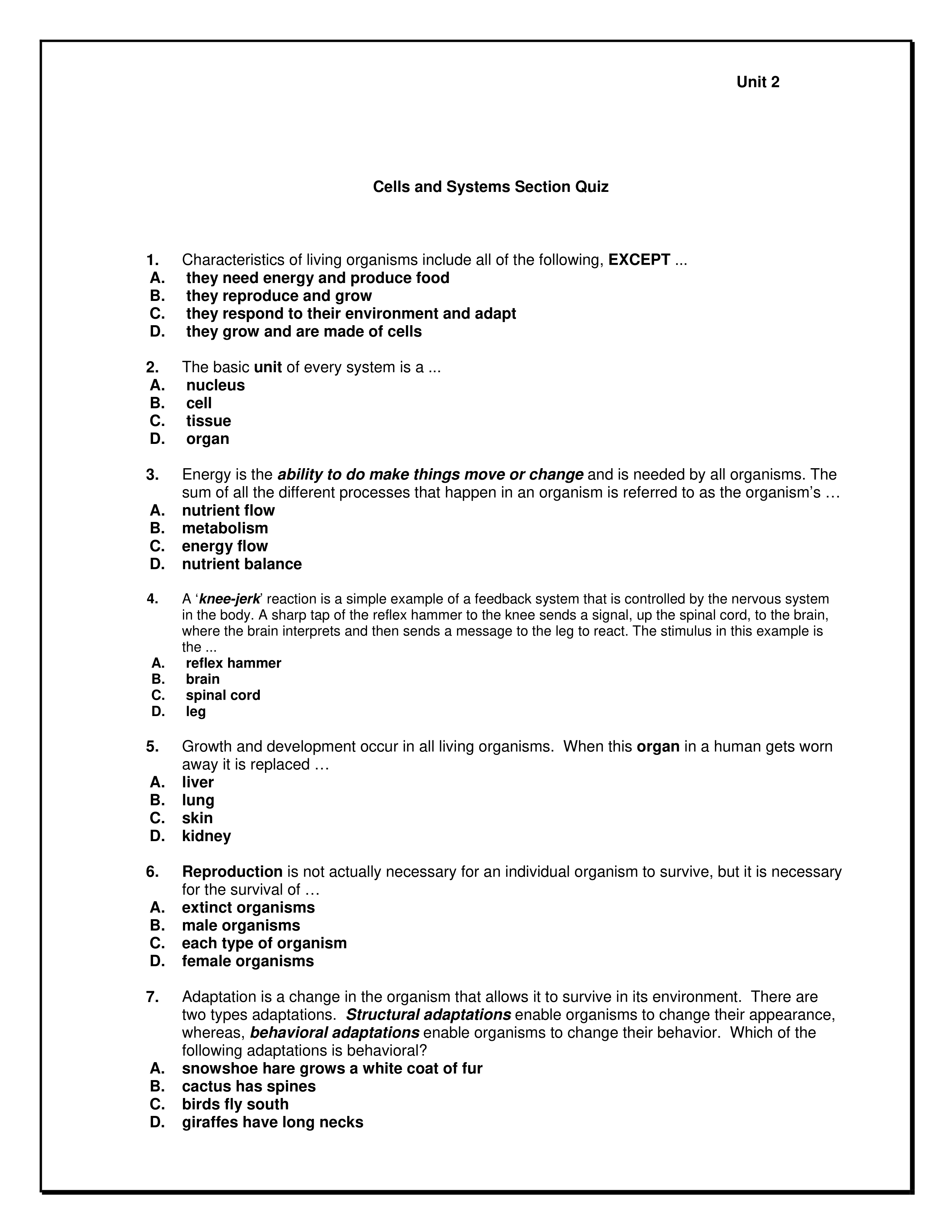
Characteristics of living organisms include all of the following, EXCEPT ...
The basic unit of every system is a ...
Energy is the ability to do make things move or change and is needed by all organisms. The sum of all the different processes that happen in an organism is referred to as the organism’s ...
A ‘knee-jerk’ reaction is a simple example of a feedback system that is controlled by the nervous system
in the body. A sharp tap of the reflex hammer to the knee sends a signal, up the spinal cord, to the brain,
where the brain interprets and then sends a message to the leg to react. The stimulus in this example is
the ...
Growth and development occur in all living organisms. When this organ in a human gets worn away it is replaced ...
Reproduction is not actually necessary for an individual organism to survive, but it is necessary for the survival of ...
Adaptation is a change in the organism that allows it to survive in its environment. There are two types adaptations. Structural adaptations enable organisms to change their appearance, whereas, behavioral adaptations enable organisms to change their behavior. Which of the
following adaptations is behavioral?
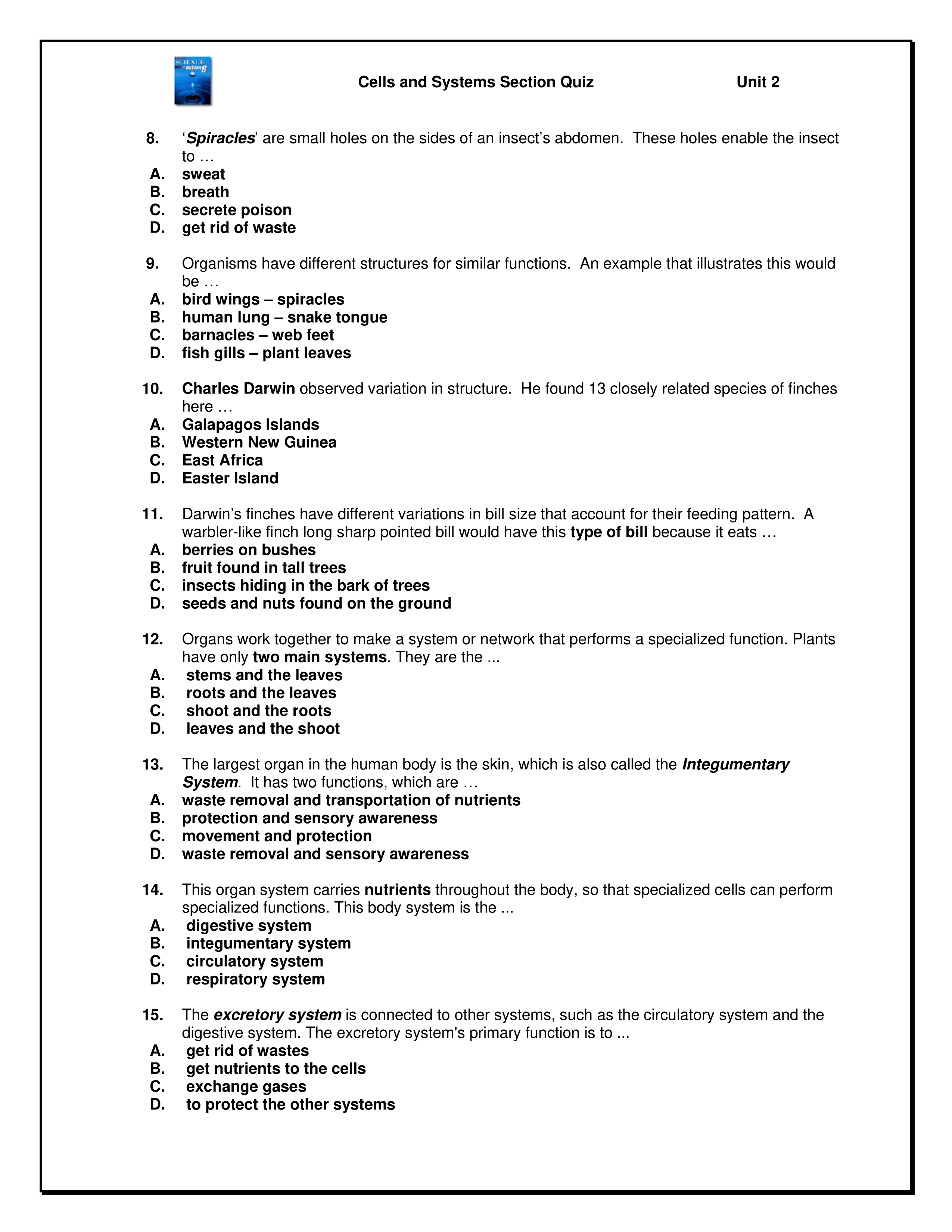
‘Spiracles’ are small holes on the sides of an insect’s abdomen. These holes enable the insect
to ...
Organisms have different structures for similar functions. An example that illustrates this would
be ...
Charles Darwin observed variation in structure. He found 13 closely related species of finches here ...
Darwin’s finches have different variations in bill size that account for their feeding pattern. A warbler-like finch long sharp pointed bill would have this type of bill because it eats ...
Organs work together to make a system or network that performs a specialized function. Plants have only two main systems. They are the ...
The largest organ in the human body is the skin, which is also called the Integumentary System. It has two functions, which are ...
This organ system carries nutrients throughout the body, so that specialized cells can perform specialized functions. This body system is the ...
The excretory system is connected to other systems, such as the circulatory system and the digestive system. The excretory system's primary function is to ...