The leadership styles in each illustration are:
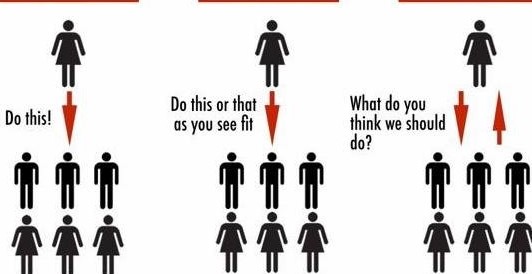
The leadership styles in each illustration are:
A _____helps the group define and achieve goals.
Groups often enforce _________ to maintain order and keep members in line.
A primary group is usually small in size, whereas a secondary group can have thousands of members.
A primary group has formal rules, but a secondary group has no set rules.
In a primary group, their main aim is to fulfil the needs of its members, provide care, support and security.
There is often emotional connections in the relationships between members of a secondary group.
Interaction in primary groups is intimate, informal and face to face.
Examples of a secondary group are family, people in the neighbourhood and friends.
Which leadership style is LEAST successful in achieving group goals?
A formal group:
Group cohesion requires good communication and ______________.
Group cohesion requires the same _____________ and interests
Group cohesion requires ___________________from the members.
Group cohesion requires ________________leadership.
Group cohesion requires plenty of opportunities to use new ______________.
Which of the functions below are carried out by Central Government and which by Local Government?
Collecting and disposing of garbage
Raising revenue (taxes)
Building of relationships with countries
Social services, health, education
Providing community services
Economic policies to help businesses
Land development activities
Law and order
Constructing major roads
National security and providing police
Building hospitals, roads, schools
Central Government
Local Government
The leadership styles in each illustration are:
List three things that can cause conflict in a group:
List six functions of government
Trinidad and Tobago Parliament is made up of which of the following (select more than one)
Use the words below to finish the sentences that follow (questions 21-30):
a.Breach, b.Veto, c.Judiciary, d.Constituency, e.Laws, f.Government, g.Parliament, h.Debate, i.Bill, j.Representatives, k.Legislative , l.Executive, j.Bicameral
A __________is debated in __________________before it goes to the President, who considers whether it will become a law.
Persons who are elected to control and direct the affairs of a country form the ____________________.
The ____________________is the institution which makes laws for a country.
A Parliamentary Representative looks after the interests of citizens in a particular area called a ___________________.
Fines and imprisonment are imposed on individuals who are guilty of any ___________________ of the law.
A ___________________ in Parliament brings out any issues with a proposed Bill.
A Parliament with two Houses is referred to as a ______________________ legislature.
A Minister belongs to the ____________________ arm of government and is responsible for setting policies for his Ministry.
The House of __________________, the Senate and the President together compromise the Parliament whose main function is to pass ___________________.
If the President disagrees with a Bill which was passed in both the House of Representatives and the Senate, he has the authority to ________________________ the Bill. 12 marks
A __________is debated in __________________before it goes to the President, who considers whether it will become a law.
Persons who are elected to control and direct the affairs of a country form the _________________.
The ___________________is the institution which makes laws for a country
A Parliamentary Representative looks after the interests of citizens in a particular area called a ___________________.
Fines and imprisonment are imposed on individuals who are guilty of any __________________ of the law.
A __________________ in Parliament brings out any issues with a proposed Bill.
A Parliament with two Houses is referred to as a ______________________ legislature.
A Minister belongs to the ____________________ arm of government and is responsible for setting policies for his Ministry.
The House of __________________, the Senate and the President together compromise the Parliament whose main function is to pass ___________________.
If the President disagrees with a Bill which was passed in both the House of Representatives and the Senate, he has the authority to ________________________ the Bill.