The following capnographic tracing is noted for a patient receiving mechanical ventilation:
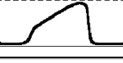
The RT should:
The following capnographic tracing is noted for a patient receiving mechanical ventilation:
The RT should:
1. A 55 y/o patient with dyspnea and a non-productive cough has the following noted examination results over the right lower lung field:
- dullness to percussion
- decreased tactile fremitus
- diminished breath sounds
Which of the following is most likely to produce these findings?
Which of the following is associated with an optimally exposed chest radiograph?
The use of respiratory accessory muscles is frequently the result of an increase in:
A 30 y/o patient has been receiving mechanical ventilation for 24 hours following admission for a
drug overdose. The patient is alert, oriented, and stable, and has been weaned to PSV of 5 cmH20 and
an Fi02 of 0.40. The following data are collected after 30 minutes:
ph 7.45 Vt: 485 ml
C02: 34 torr MIP: -38 cmH20
Pa02: 125 torr RR: 16
HC03: 23 mEq/L
Which of the following should a RT recommend?
A physician orders 1 mg of medication to be administered by aerosol. If the concentration of a stock
solution is 0.04%, how many ml of the solution must be administered?
6. A pulse oximeter provides an accurate indication of a patient’s oxyhemoglobin saturation in which of the following clinical conditions?
Polycythemia pulmonary HTN CHF CO poisoning
A 70 kg (154lb), (6ft 3in) male postoperative patient is receiving VC, A/C ventilation. Pertinent data are below:
Fi02: 0.30 pH 7.29
Mandatory Rate: 12 PaC02: 51 torr
Total Rate: 14 Pa02: 86 torr
VT: 500 ml Hc03: 24 mEq/L
Inspiratory time: 1.0 sec B.E.: -2 mEq/L
PEEP: 5 cmH20
Which of the following should the RT recommend?
If a RT chooses to use a portable ventilator to transport a patient within a hospital, the ventilator should have the ability to:
Auscultation immediately following intubation reveals absent breath sounds on the left. Which of the following is the most likely explanation for this finding?
A patient with CHF tells a RT that he feels like he can breathe better when he sleeps sitting in a chair. This is most indicative of:
Which of the following can a RT use to determine a patient’s RSBI?
A pt. involved in a MVA presents with respiratory distress. A chest radiograph confirms the presence of multiple fractures to five adjacent ribs on the left side. Which of the following physical findings should be expected during assessment of the chest?
A patient with OSA reports he continues to experience significant daytime sleepiness. He states he uses his nasal CPAP at the prescribed level of 12 cmH20 every night, determined by previous polysomnographic testing. A repeat sleep study indicates multiple periods of absent airflow, without chest or abdominal movement. Which of the following should a RT recommend?
Which of the following masks should be used to deliver a 70/30 heliox mixture most
effectively to a patient?
Which of the following should a RT use to assess the severity of possible CO poisoning?
When reviewing the chart of a newly admitted patient, a RT finds the pt. has COPD and a 70 pk/yr smoking history. The pt. was admitted for dyspnea. The pt. is somnolent and can protect his airway. Which of the following should the therapist recommend FIRST?
A pt. with a 50 pk/yr history of smoking has a cough and an infiltrate on a CXR that persists despite a 1 month course of antibiotic therapy. Which of the following should a RT recommend?
Short acting and long acting bronchodilator aerosols have been ordered at inconsistent frequencies, and occasionally for patients who do not require bronchodilator therapy. To address these concerns, a RT should recommend:
Which of the following drugs is a beta 2 agonist?
A RT observes the following data while monitoring mechanical ventilation:
8:00 am 9:00 am 10:00 am
peak pressure (cmH20) 35 40 43
Plateau pressure (cmH20) 30 28 24
Set PEEP was constant. Which of the following is present?
A RT is asked to review a newborn's history. The following information is available:
1 minute 5 minutes
color acrocyanosis pink
pulse 70 110
reflex cough cough
tone weak active motion
RR 20 40
Which of the following APGAR scores do you expect to see?
The primary purpose of cleaning and sterilizing nondisposable respiratory care equipment after each use is to:
Chest physiotherapy is initiated for a patient who is alert and oriented. As therapy progresses, a RT notices the patient is no longer responsive to verbal stimuli. The therapist checks the patient's pulse and finds that the HR is 30. The patient has a RR of 6. Which of the following should the therapist do NEXT?
Which of the following information may be obtained from a forced expiratory spirogram?
A 20 y/o female with asthma presents in severe respiratory distress. The patient is tachypneic with accessory muscle use. BS reveal bilateral expiratory wheezes and Sp02 is 87% on air. A RT should recommend initiating:
A RT examines a pt and notes coarse crackles over both lung fields. Which of the following does this most likely indicate?
A pt. had a tracheostomy for several weeks and was recently weaned form ventilatory support. Which of the following devices will allow decannulaiton of the trachea and maintain the patency of the stoma?
A 34 y/o with bronchiectasis pt. with a significant amount of daily secretions wishes to continue an appropriate pulmonary hygiene program while maintaining full-time employment. Which of the following will best assist this patient in attaining this goal?
A RT notes a patient who is receiving VC, A/C ventilation has thick mucoid secretions. The therapist observes that the servo-controlled humidifier is set at 31 C (88 F). Which of the following should the therapist do?
Following insertion of a central venous pressure catheter, a chest radiograph is taken to evaluate the position of the catheter. When viewing the radiograph, a RT notes the tip of the catheter is in the superior vena cava The therapist should conclude the catheter:
A 39 y/o who is morbidly obese is admitted to teh ED with fever, productive cough, and SOB. The patient's vital signs are stable and he is awake and alert. After initiation of bronchodilator therapy and antibiotics, serial blood gas results reveal:
10 am 11 am
Fi02 0.21 0.50
pH 7.28 7.22
PaC02 72 85
Pa02 45 56
HC03 34 35
Sa02 78% 89%
The patient's clinical condition remains unchanged. Which of the following should a RT do NEXT?
A pt. with a history of chronic bronchitis complains of SOB following thoracic surgery. The pt. is receiving 30% 02 by aerosol mask. Rhonchi in the right lower lobe are heard on auscultation. Which of the following should a RT recommend?
Initiation of an expiratory hold just prior to the next ventilator delivered breath facilitates the measurement of:
A 65 y/o who is post CABG was extubated 4 hours ago and complains of increasing SOB. BS are decreased over the right lung field. The following data are available:
RR 25
HR 105
BP 155/90
Sp02 90% on 4LPM BNC
Which of the following studies should a RT recommend NEXT?
A RT is called to see a 59 y/o patient who has been in a persistent vegetative state for several months following a stroke. He is diaphoretic and has a pulse of 120 and an sp02 of 81% with a 28% tracheostomy collar. The therapist is unable to pass a suction catheter. Which of the following should the therapist do FIRST?
A patient's C(a-v)02 increased from 4.0 to 6.2 vol% after PEEP was increased. Which of the following best explains these results?
A previously healthy 30 y/o patient is hospitalized with chills and fever. A chest radiograph is consistent with right upper lobe pneumonia. Which of the following is most likely to aid in the patient's management
Which of the following is the most appropriate device to administer a controlled oxygen concentration for a patient with a variable respiratory pattern?
A 168 cm (5ft 6in) 62 kg (135 lb) patient is receiving PC, A/C ventilation. The following data are available:
Fi02: 0.40 pH: 7.52
Mandatory rate: 15 PaC02: 26 torr
Total rate: 15 Pa02: 110 torr
PEEP 10 cmH20 HC03: 21 mEq/L
Set inspiratory pressure: 20 cmH20
I:E 1:4
Exhaled Vt 700 mL
A RT should recommend decreasing the:
Which of the following is the primary benefit of respiratory care protocols?
Which of the following is most effective for destroying microorganisms on patient care equipment?
If the reservoir bag of a NRB mask collapses during inspiration, the RT should:
A pt. presents with a 3 month history of episodic SOB with exercise. A CXR, ECG, and echocardiogram are normal. The following spirometry results are obtained:
Pre-bronchodilator Post-bronchodilator
FEV1 2.9 L 3.1 L
FVC 3.2 L 3.4 L
Which of the following should a RT recommend NEXT?
When explaining the purpose of incentive spirometry to a patient after abdominal surgery, a RT should tell the patient the procedure is performed to:
The following capnographic tracing is noted for a patient receiving mechanical ventilation:
The RT should:
A pt. with asthma is receiving a treatment with 2.5 mg of albuterol. During the treatment, the patient's HR increases from 80 to 138. A RT should recommend:
Five minutes after extubating a patient, a RT observes marked stridor, labored breathing, intercostal retractions, and an Sp02 of 85%. Aerosolized racemic epi has been delivered without benefit. Which of the following should the therapist recommend at this time?
A pt has a VT of 450 mL and a RR of 15. What is the minute ventilation (L/min)?
A pt. who is receiving mechanical ventilation is scheduled for a fiberoptic bronchoscopy. Which of the following is the primary threat to adequate ventilation during the procedure?
While administering a hyperinflation treatment at 20 cmH20 to a patient with CF, a RT notes the patient has suddenly become very short of breath and cyanotic. The RT's most appropriate action is to:
A pt. with COPD is receiving oxygen by a nasal cannula at 1 L/min. The target Sp02 is 90%. The following data are obtained:
pH 7.35 RR 18
PaC02: 64 torr HR 100
Pa02: 52 torr BP 145/90 mmHg
HC03: 34 meq/L Sp02 85%
Which of the following should the RT recommend FIRST?
While counseling a pt. during a smoking cessation session, the pt. expresses concern about weight gain. A RT should address the patient's concern by explaining that this is partially the result of:
A patient's chest radiograph shows diffuse alveolar infiltrates. The following data are available:
CVP 12 mmHg
RAP 14 mmHg
Mean PAP 30 mmHg
PCWP: 26 mmHg
C.I. 1.6 L/min/m2
A RT should recommend administering:
An ABG sample is requested for an adult pt. who is undergoing dialysis. The pt. has a surgical shunt in his left arm. Blood flow through the right ulnar artery is absent. A RT should obtain the sample from which of the following arteries?
A pt. is receiving VC, SIMV with the following settings:
Fi02 0.50
VT 400 mL
Mandatory rate: 12
A RT hears the low volume alarm and observes that the system pressure manometer reaches only 4-5 cmH20 during the inspiratory phase. The RT should:
Fi02 0.40 an who weighs 65 kg (143 lb) is receiving VC ventilation after abdominal surgery. Vent settings & ABG results are below:
Fi02 0.40 pH 7.47
Mandatory rate: 14 PaC02: 31
Total rate: 14 Pa02 117 torr
Tidal Volume: 700 mL HC03: 22 mEq/L
The RT should:
Which of the following is a side effect of inhaled nitric oxide?
A RT instructs a pt. to take a deep breath and then exhale as quickly as possible. The RT observes a recording of the fastest air movement. Which of the following was measured?
A 28 y/o pt. is being evaluated by a RT after a trauma. The pt. is receiving PC ventilation with the following settings:
Fi02: 0.65
Mandatory rate: 14
PEEP: 8 cm H20
Set inspiratory pressure: 36 cmH20
The therapist notes the following pressure-volume tracing:
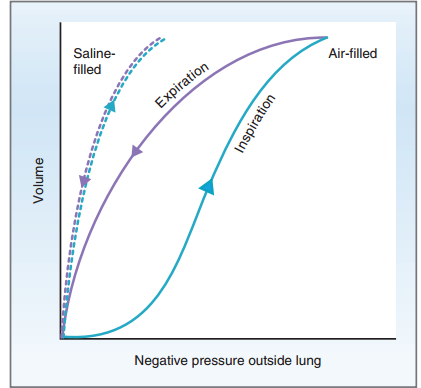
The therapist should recommend decreasing the:
The best way to check the accuracy of a spirometer is to use a:
A pt. receiving oxygen at 2 L/min through a transtracheal catheter complains that the supply tubing keeps popping off of the catheter. To correct this problem, a RT should:
A wait of a few minutes should be expected after application of a transcutaneous electrode before values stabilize. This is associated with:
For a pt. receiving noninvasive ventilation through a dual-limb circuit, an increase in which of the following will most likely reduce the respiratory effort associated with spontaneous breathing?
A RT on a Medical Emergency Team is directed to maximize Fi02 for a pt. who is not intubated. Which of the following should the therapist select?
The following data are available for a pt. receiving VC, A/C ventilation:
Fi02: 0.50
VT: 500 mL
PEEP: 10 cmH20
Lab results are as follows:
Pv02: 30 mmHg
Pa02: 75 mmHg
Sp02: 91%
Which of the following should a RT recommend?
A RT is reviewing the medical record of an infant to determine whether any respiratory care is indicated in the home. Which of the following suggests the need for home apnea monitoring?
Which of the following is the most common side effect of aerosolized albuterol?
Which of the following should a RT emphasize as a critical infection control step to a pt. who will administer aerosol therapy at home?
A pt. who is a victim of a residential fire is brought to the ED and is receiving oxygen by nasal cannula at 8 lpm. The Sp02 is 100%. ABG results are as follows:
pH 7.30
PaC02: 30 torr
Pa02: 200 torr
HC03: 14 mEq/L
Sa02: 100%
O2Hb: 78%
C02Hb: 21%
HB 14.5 g/dL
A RT should recommend:
The most commonly ised bedside measurement to monitor the progression of ventilatory impairment in a patient with Guillain-Barre syndrome is:
A pt. complains of a productive cough that started approximately 4 months ago. The pt. most likely has:
Which of the following should be used to most accurately assess oxygen saturation in a pt. with suspected smoke inhalation?
Given a normal pH, a Sp02 of 90% should be associated with a Pa02 of approximately:
A RT is unable to pass a 14 Fr. suction catheter through a 7.0 mm ID nasotracheal tube. Repositioning the head of the pt. does not allow passage of the catheter. Which of the following should the RT do?
A pt. is suspected of having an upper airway obstruction. Which of the following tests should a RT recommend to detect this abnormality?
A pt. with an IBW of 55 kg is receiving mechanical ventilation. The patient's blood gas results and parameters during VC, A/C ventilation are below:
Fi02: 0.70 pH: 7.35
Mandatory rate: 14 C02: 35 torr
VT: 500 mL Pa02: 40 torr
PEEP: 5 cmH20 HC03: 19 mEq/L
The RT should recommend:
Home overnight oximetry is used to assess the need for:
While testing the proper function of a flow-inflating bag, a RT notes the bag does not fully inflate with occlusion of the patient connector. Which of the following may be the cause of the problem?
Three liters of air are injected into a spirometer from a certified volume standard syringe. The measured value is 2.6 L. Which of the following should the RT conclude?
A 65 y/o pt. with congestive heart failure is receiving 10 cmH20 CPAP and an Fi02 of 0.60. ABG results are:
pH: 7.41
PaC02: 40 torr
P02: 150 torr
HC03: 25 mEq/L
Which of the following should a RT conclude?
A RTcollects the following data on a 58 y/o male who has been receivin VC, A/C ventilation for the past 24 hours following thoracic surgery:
MIP -32 cmH20
Exhaled VT: 420 mL
The pt. is alert and oriented. He has a Sp02 of 98% while receiving ventilation with the following settings:
Fi02: 0.40
Mandatory rate: 12
VT: 600 mL
The best weaning method for this patient is:
A 26 y/o pt. who weighs 80 kg (176 lbs) was injured in a motor vehical crash. The pt. was intubated with a 6.0 mmID ETT by EMS. Upon admission to teh ED, VC, A/C ventilation is started. The pt. has peak airway pressures of 40 cmH20, increased work of breathing, and is dyssynchronous with the vent. A RT should recommend:
A 24 y/o female presents with a history of nasal stuffiness, episodes of daytime dyspnea, and a cough that occurs every summer. Which of the following drug classifications should a RT recommend to control the patient's symptoms?
An adult victim of a burn injury is being monitored in the ICU. Pt. data are as follows:
Pv02: 45 torr
PCWP: 4 mmHg
Mean PAP: 11 mmHg
CVP: 4 cmH20
Urine output: 5 ml/hr
A RT should conclude the pt. is:
A RT is assisting a physician perform a tracheotomy on a pt. who is receiving PC ventilation. The therapist observes an increased HR, decreased exhaled VT, and distant BS over the right chest. This information is most indicative of a:
A RT is called to deliver a 2nd dose of 5 mg albuterol to a pt. with acute asthma. The pt. had audible wheezing after the first treatment 20 minutes ago. After the 2nd treatment, auscultation reveals markedly diminished BS. Which of the following should a RT recommend?
A RT observes the following chest radiograph:
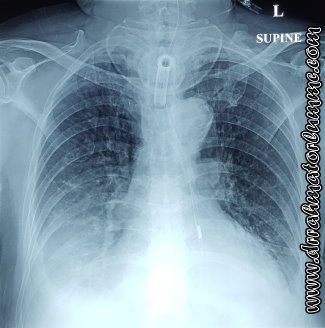
Which of the following are evident:
trach tube pneumothorax pleural effusion chest tube
The diagram below show the results of FVC maneuvers by a patient before and after an albuterol treatment:
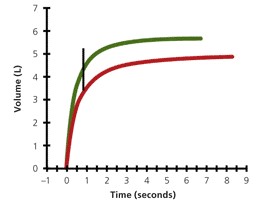
Which of the following should a RT recommend NEXT?
A pt. was diagnosed wtih bronchiectasis 3 years ago. The pt. reports increased cough and difficulty clearing secretions for the past 4 weeks. A chest radiograph shows cavitary disease. Which of the following should the RT recommend?
At the beginning of exhalation, the sharp rise in exhaled C02 on a capnographic tracing represents:
Which of the following is the most effective aerosolized bronchodilator for a pt. with an acute asthma exacerbation?
The following pt. data are obtained:
Ca02: 12 vol%
Pv02: 30 torr
Sv02: 60%
Hb: 10 g/dL
The patient's C(a-v)02 is approximately:
A RT determined a pt. receiving mechanical ventilation developed auto-PEEP due to dynamic airflow obstruction. Which of the following should the therapist do?
A 59 y/o pt. with COPD is seen in the pulmonary clnical for a routine appointment. The results of an ABG drawn while the pt. is breathing room air are below:
pH 7.41
PaCo2: 55 torr
Pa02: 41 torr
HC03: 35 mEq/L
Which of the following is the most appropriate NEXT step?
The following data are collected for a pediatric pt. receiving VC ventilation:
VT: 200 mL
plateau pressure: 10 cmH20
Peak pressure: 20 cmH20
PEEP: 5 cmH20
What is the static compliance in mL/cmH20?
The following pulmonary function results are obtained for a patient:
Predicted Observed % Predicted
FVC: 5.90 3.40 57.6
FEV1: 4.00 0.50 12.5
FEV1/FVC: 70 14 --------
FEF 25-75%: 4.50 0.77 17.0
TLC: 7.30 8.40 115.0
A RT should recommend a treatment plan for:
While receiving postural drainage in the head-down position, a pt. becomes dyspneic due to severe prolonged coughing. A RT should:
A 20 y/o pt. with an acute asthma exacerbation is receiving 2.5 mg of albuterol by hand held nebulizer. During the treatment, the pt. complains of palpitations and has a HR of 140. Which of the following should the RT recommend for the next treatment?
Which of the following medications should a RT use to anesthetize a patient's airway prior to a flexible bronchoscopy procedure?
A pt. in the ICU who is receiving VC ventilation has a steady increase in the peak inspiratory pressure over a 12 hour shift. The pt. has developed a fever and purulent pulmonary secretions. Which of the following should a RT recommend FIRST?
A 22 y/o pt. with a history of intermittent wheezing has the following pulmonary function test results:
Pre-bronchodilator Post-bronchodilator
FEV1 (% predicted) 84 88
FVC (% predicted) 85 86
FEV1/FVC (%) 84 86
Peak flow (% predicted) 98 96
Which of the following should a RT recommend?
Spontaneous breathing trials with a T-piece have been initiated for a 50 y/o pt. who has been receiving mechanical ventilation for 4 weeks. With each trial, the pt. becomes agitated, dyspneic, and tachypneic, and must be returned to the ventilator. Which of the following should the RT recommend?
A premature neonate with respiratory distress syndrome receives the first dose of surfactant replacement therapy. Two hours later, the neonate's Fi02 requirements have increased from 0.35 to 0.70. Which of the following should a RT recommend FIRST?
Which of the following should be recommended to determine the site of bleeding in a pt. with hemoptysis?
Data belwo were obtained while an adult pt. was receiving VC ventilation with an Fi02 of 0.50:
1300 1315 1330 1345
PEEP: 5 10 15 20
Sp02: 75 90 94 95
Staic compliance: 20 40 60 55
BP: 140/90 130/90 120/80 110/80
Which of the following levels of PEEP should a RT choose?
Monitoring serum electrolytes is indicated in patients who are receiving:
While breathing spontaneously, a 54 kg (120 lb) female has a RR of 30 and a VT of 200 mL. After a sedative was administered, her RR decreased to 10 and her VT increased to 600 mL. Which of the following ventilatory parameters increased?
For a spontaneously breathing pt. , which of the following will provide an elevated baseline pressure during inspiration and expiration?
After obtaining an ABG sample, a RT should handle the sample by:
A 77 y/o male pt. is scheduled to undergo open heart surgery. Preoperative spirometry results show the patient's FEV1 is 80% of predicted and the FEV1/FVC is 83%, indicating:
A gas is saturated with 100% relative humidity at 32.3 C (90F). As the gas cools to 26.7 C (80F), the relative humidity will:
Following placement of an 8.0 mm ID trach tube, how much air should be placed into the cuff?
An adult pt. is receiving mechancial ventilation. Which of the following should be recommended to improve oxygenation and recruit collapsed alveoli?
When administering dornase alfa (Pulmozyme) with a hand-held nebulizer, a RT notes a pt. is developing marked congestion with copious sputum production. The therapist's most appropriate action is to pause the treatment and:
An adult pt. has a pulse of 142, a RR of 24, and a BP of 78/55. When examining the patient's chest, the RT notes an absence of BS in the left chest with a hyperresonant percussion note. Which of the following should the RT recommend FIRST?
After SIMV is initiated, the following pt. data are obtained:
Fi02: 0.40 pH: 7.27
Mandatory rate: 8 PaC02: 55 torr
Total rate: 8 Pa02: 94 torr
Tidal Volume: 550 mL HC03: 24 mEq/L
PEEP: 8 cmH20
Which of the following should a RT recommend?
A pt. is receiving mechanical ventilation with 5 cmH20 PEEP. The PEEP is increased to 15 cmH20. Which of the following indicates an adverse effect of the PEEP change?
The following data are obtained for a pt. who is receiving VC ventilation with a VT of 600 mL:
10 am 12 pm
Peak airway pressure 38 cmH20 45 cmH20
Plateau pressure 34 cmH20 34 cmH20
This information indicates:
During nasotracheal suctioning, a patient exhibits a gag reflex but does not cough. Watery secretions
are aspirated through the catheter. Which of the following should the RT do before repeating the
procedure?
Which of the following should a RT use to determine a neonate’s gestational age?
A pt. receiving mechanical ventilation by a portable ventilator is being transported from the ED to
radiology. Which of the following is required during transport?
A RT is calibrating a helium analyzer. What should the analyzer read when calibrated on air?
Which of the following drugs is appropriate for the sedation of a 30 y/o patient with status
asthmaticus and hypotension who is receiving mechanical ventilation?
A physician will be sedating a patient for a procedure and asks a RT to monitor the patient’s
ventilation. The therapist should select a:
The standard frequency for dosing of inhaled tiotropium (spiriva) is every:
A pt. with severe COPD is receiving PC, A/C ventilation on 0.30. The pt. becomes
tachypneic and is apprehensive, mottled, and hypertensive. Auscultation reveals distant breath sounds
on the right as compared to the left. Tracheal deviation to the left is observed. A RT should
recommend evaluation for a potential:
A RT intends to change the I:E during VC ventilation. Flow is constant during inspiration. Which of
the following can be adjusted to accomplish this change?
Volume RR sensitivity inspiratory flow
When reviewing progress notes for a pt. a RT notes that a provider has recommended changes to the
patient’s treatment plan. Which of the following should the RT do NEXT?
What is the approximate total flow that will be delivered from a 40% air-entrainment mask receiving
12 L/min of oxygen?
A RT is asked to position a pt. for orotracheal intubation. The RT should place the patient’s head:
A pt. has been receiving mechanical ventilation through a tracheostomy tube for 16 days. The
patient begins to thrash about in the bed following withdrawal of a drug-induced coma. The
patient’s tracheostomy tube has become dislodged. Following appropriate sedation, the RT should:
A pt.’s BP is monitored by an appropriately positioned arterial catheter transducer. The transducer is
mounted on an IV pole that is not attached to the bed. The bed is lowered to permit routine patient
care. How will this affect the measured BP?
A 21 y/o male patient experiencing a acute asthma exacerbation is intubated and receiving
mechanical ventilation. There is a sudden increase in airway pressures. The pt. is hemodynamically
stable and breath sounds are clear, but significantly decreased on the right. Which of the following
should the RT recommend?
Which of the following values for arterial carbon dioxide tension is consistent with alveolar
hyperventilation?
Which of the following drugs is most appropriate to paralyze a sedated 30 y/o pt. with status
asthmaticus who is receiving continuous mechanical ventilation?
A 21 y/o man arrives in the ED after rescue from a house fire. Physical examination reveals burns on
the upper chest and face, and marked edema of the face and oropharynx. Results on an ABG sample
obtained while the pt. was breathing air are as follows:
Ph 7.55 PaC02 26 torr Pa02 105 torr HC03 22 mEq/L
Which of the following should a RT recommend?
Moderate stridor with retraction sis noted immediately after extubation of a pt. A RT should
recommend:
For which of the following are peak expiratory flow measurements indicated?
A pt.’s V/Q scan indicates an excess of ventilation compared to perfusion in the left lower lobe. These results suggest:
Which of the following is characteristic during VC ventilation?