Log in
Sign up for FREE
arrow_back
Library
10_Phys U1 Summative (45MC)
By Lester Orellana
star
star
star
star
star
Share
share
Last updated almost 6 years ago
45 questions
Add this activity
1
1
1
1
1
1
1
1
1
1
1
1
1
1
1
1
1
1
1
1
1
1
1
1
1
1
1
1
1
1
1
1
1
1
1
1
1
1
1
1
1
1
1
1
1
Question 1
1.
Acceleration is ...
the rate of change of velocity
the change in time over velocity
the change in speed over time
the rate of change of speed
Question 2
2.
The formula for average speed is
total acceleration divided by time
total velocity divided by time
total displacement divided by time
total distance divided by time
Question 3
3.
In velocity time graphs, the area under the line represents ...
acceleration
change in displacement
change in speed
change in acceleration
Question 4
4.
In displacement-time graphs, the gradient of the line represents...
change in velocity
change in acceleration
speed
velocity
acceleration
Question 5
5.
The magnitude acceleration due to Earth's gravity is
9.81 m/s^2
-9.81 ms^2
-9.81 m/s^2
9.81 ms^2
Question 6
6.
The 1st Newton's Law states that every object remains resting or moving with constant ___________ until external __________ is applied
velocity, mass
speed, mass
speed, force
velocity, force
Question 7
7.
The main reason why we don't have acceleration according to one of the Newton's Law is...
The vector addition of all the forces related to object is zero
The vector addition of the forces on the vertical is zero
The vector addition of the forces on the horizontal is zero
Question 8
8.
The terminal velocity is reached when ...
there is air resistance and magnitude of the mass equals the weight.
there is air resistance and magnitude of the force equals the weight.
there is air resistance and magnitude of the friction equals the weight.
Question 9
9.
Is the measurement of the resistance of an object to change its state of motion. (start moving or stopping)
Inertia
Friction in general
Static Friciton
Dynamic Friction
Question 10
10.
When an unbalanced force moves the object with acceleration is part of ...
2nd Newton's Law
1st Newton's Law
3rd Newton's Law
Question 11
11.
Is the force that is opposed to the motion or to start moving.
Static Friction
Friction
Dynamic Friction
Normal Force
Question 12
12.
Is the force that is perpendicular to the surface and is related to friction.
Static Friction
Friction
Normal Force
Dynamic Friction
Question 13
13.
Choose the only true statement.
Stopping distance is the addition of the reaction distance and braking distance.
Stopping distance is the addition of all the braking distance.
Reaction distance is the addition of the stopping distance and braking distance.
Braking distance is the addition of the reaction distance and stopping distance.
Question 14
14.
The formula for Earth's gravitational force is ...
W = mg
F = mg
W = ma
F = ma
Question 15
15.
Mass and weight ....
Are the same because both are measured in Newtons.
Are the same because both are measured in kilograms.
are not the same because mass is always constant.
are not the same because weight is always constant.
Question 16
16.
Third Newton's Law says that for every actions there is a reaction in ...
same direction but opposite in magnitude.
same magnitude but opposite in direction.
Question 17
17.
A vector is a physical quanity with
direction
mass
unit
Question 18
18.
The letter "u" represents
initial velocity or initial speed
initial speed
initial velocity
Question 19
19.
The unit for gravity is
ms
-2
m/s
-2
ms
2
Question 20
20.
In a projectile motion, the horizontal velocity is _______________.
changing due to gravity 9.81
constant because there is no air resistance affecting the projectile.
constant because mass is constant.
changing due to acceleration of 9.81
Question 21
21.
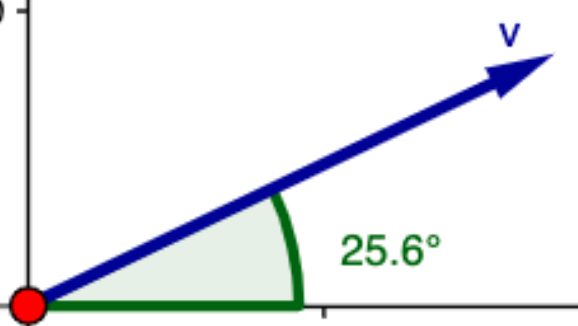
If velocity 28.28 m/s, find the horizontal velocity
= 28.28 x cos25.6º = 25.51 m/s
= 28.28 x sin25.6º = 12.22 m/s
= 28.28 x cos25.6º = 12.22 m/s
= 28.28 x sin25.6º = 25.51 m/s
Question 22
22.
If velocity 28.28 m/s, to find the highest altitude ...
consider v = 28.28 x sin25.6 in vertical "suvat"
consider v = zero in horizontal "suvat"
consider v = 28.28 x sin25.6 in horizontal "suvat"
consider v = zero in vertical "suvat"
Question 23
23.
If velocity 28.28 m/s, to find the range we should consider ...
The velocity is the cos of 25.6º
The velocity is the sin of 25.6º
the time is exactly what takes to reach the highest altitude.
the time is double of what takes to reach the highest altitude.
Question 24
24.
The final velocity reaching the starting point is
20 m/s
20 x cos90º
-20 m/s
-20 x cos90º
Question 25
25.
The acceleration in this motion is
9.81 m/s^2
-9.81 m/s^-2
-9.81 m/s^2
9.81 m/s^-2
Question 26
26.
A car is traveling at +20m/s for 30 seconds, then returns decreasing the velocity until it stops in 20 seconds.
Find the total displacement.
+400 m
+800 m
+600 m
+1,000 m
Question 27
27.
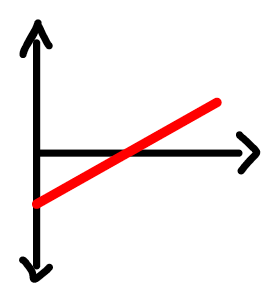
This displacement-time graph represents...
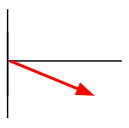
negative acceleration when velocity starts in the negative region.
positive acceleration when velocity starts in the negative region.
negative acceleration when velocity starts in the positive region.
positive acceleration when velocity starts in the positive region.
Question 28
28.
This displacement time graph represents
positve acceleration and positive constant velocity
no acceleration and negative constant velocity
no acceleration and positive constant velocity
positve acceleration and negative constant velocity
Question 29
29.
This velocity time graph represents
zero acceleration
negative acceleration
positive acceleration
Question 30
30.
Choose the only true statement
This is velocity-time graph when acceleration is negative
This is displacement time graph when acceleration is negative and velocity is constant.
This is displacement time graph when acceleration is positive and velocity is constant.
This is velocity-time graph when acceleration is positive
Question 31
31.
This is the area when the object is moving with acceleration zero.
C
B
A
Question 32
32.
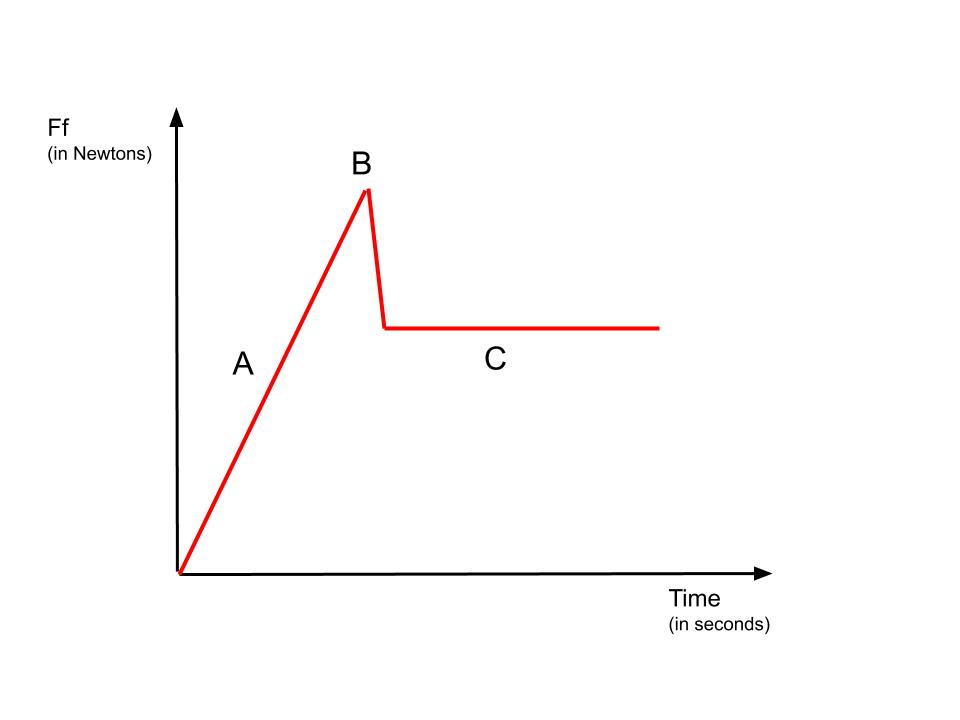
This is the area when use µ
d
C
A
B
Question 33
33.
What is the velocity when t=10s
25 m/s
50 m/s
75 m/s
100 m/s
Question 34
34.
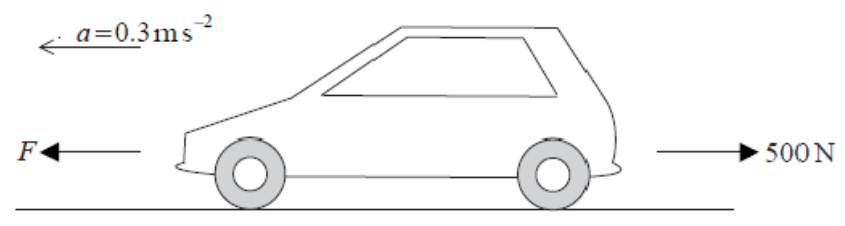
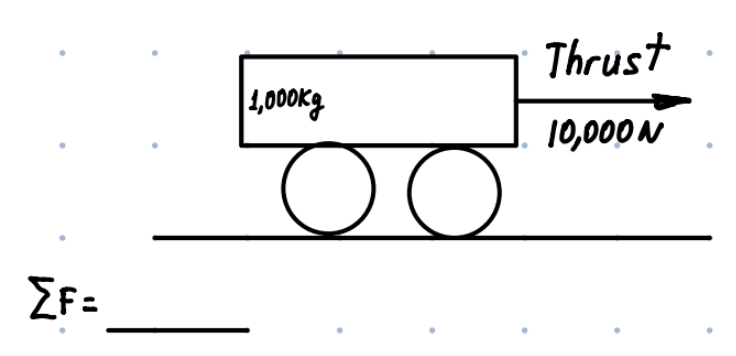
What is the net force if the weight is 10,000 N? (g = 10)
30,000 N
300 N
3,000 N
Question 35
35.
If the net force is -400 N in this problem, How much is the applied force?
-1000 N
900 N
1,000 N
-900 N
Question 36
36.
How much is the weight of the ball? (g=10)
300
10
30
100
Question 37
37.
How much is the weight of the crate? (g=10)
60
5
500
50
Question 38
38.
How much is the mass of the crate? (g=10)
5 kg
50 kg
15 kg
10.5 kg
Question 39
39.
How much is the maximum static friction of the crate? (g=10)
30 N
26.4 N
22 N
50.44 N
2.2 N
Question 40
40.
What is the force of impact of the ball on the crate? (g=10)
22 N
13 N
4.4 N
30 N
Question 41
41.
Is it going to be moved after the impact of the ball on the crate? (g=10)
No, because impact force is smaller than maximum coefficient static friction.
No, because impact force is smaller than maximum static friction.
Yes, because impact force is greater than maximum coefficient static friction.
Yes, because impact force is greater than maximum static friction.
Question 42
42.
If g=10. How much is the normal force?
-10,000 N
-1,000 N
+1,000 N
+10,000 N
Question 43
43.
If g=10. How much is the friction force is net force is 3,000 N?
3,000 N
30,000 N
-30,000 N
-3,000 N
Question 44
44.
If g=10. How much is the net force is frictional forces are 4,000 N?
+14,000 N
-6,000 N
-14,000 N
+6,000 N
Question 45
45.
If g=10. How much is the mass if frictional forces are -2,000 N?
8 kg
12 kg
18 kg
2 kg