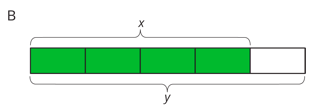
a. For each diagram, decide if is an increase or a decrease relative to . Then determine the percent increase or decrease.
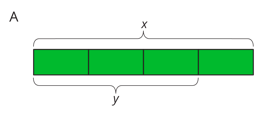
a. For each diagram, decide if is an increase or a decrease relative to . Then determine the percent increase or decrease.
a. Match each diagram with a description and an equation. Some equations and fractions won't work.
b. Draw a diagram for one of the unmatched equations
a. For each diagram, decide if is an increase or a decrease relative to . Then determine the percent increase or decrease.
b.
At the beginning of the month, there were 80 ounces of peanut butter in the pantry. Since then, the family ate 0.3 of the peanut butter. How many ounces of peanut butter are in the pantry now?
On a hot day, a football team drank an entire 50-gallon cooler of water and half as much again. How much water did they drink?
The amount of flour that the bakery used this month was a 40% increase relative to last month.
The amount of milk that the bakery used this month was a 75% decrease relative to last month.
Jada has 12 library books checked out and Han has 1/4 less than that. How many books does Han have checked out?
If x represents a positive number, select all expressions whose value is greater than x.
Write an initial percentage of the given scenario:
This year, there were 25% fewer sunny days than last year.
Write an initial percentage of the given scenario:
Compared to last month, there was a 50% increase in the number of houses sold this month.
Write an initial percentage of the given scenario:
The runner’s time to complete this marathon was 10% less than the time to complete the last marathon.
A person's resting heart rate is typically between 60 and 100 beats per minute. Noah looks at his watch, and counts 8 heartbeats in 10 seconds.
Is Noah's heart rate typical? Explain how you know.
Write an equation for the number of times Noah's heart beats.
Let "h" represent the number of heart beats, and let "m" represent minutes.