A nebula is held together by the balance of
After the solar nebula collapsed, its center became very hot and
Planets began to form as
The extra matter at the center of the solar nebula became the
Earth's layers formed as rocks melted and
The middle layer of Earth is the
The layer of Earth that has the lightest materials is the
Early life forms released oxygen into Earth's atmosphere through the process of
Scientists think that Earth's early atmosphere was made up of
The closer a planet is to the sun,
The gravitational attraction between two objects increases if
What is an object's resistance to changes in speed or direction called?
Earth's early continents formed as rocks melted and
The planets of the solar system formed as
How might Earth be affected by the activity ofsunspots on the sun's surface?
A planet with a large orbit has a
The dense layer of the sun that blocks light and energy is the
What might sunspots affect on Earth?
What happens if objects have more mass and move closer together?
What made the solar system form?
What happened as light rocks rose to Earth's surface?
How do planets move if they are closer to the sun?
What process gives the sun its energy?
The famous scientist who made important discoveries about the motion of planets around the sun was
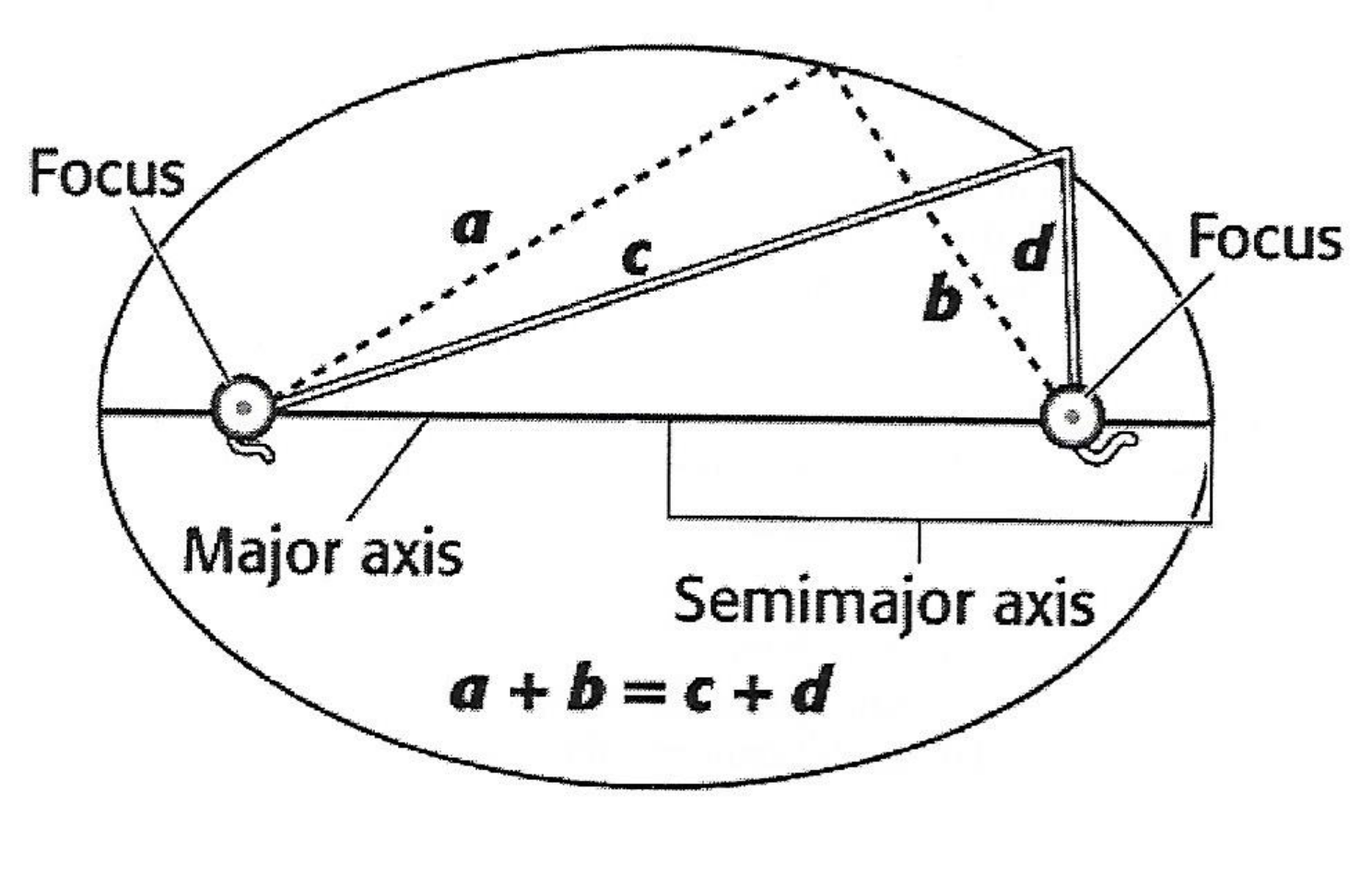
The length of the semimajor axiscan be used to describe
Word Bank
planetesimals orbit crust mantle solar flare rotation core corona solar nebula(s) globule(s) temperature major axis nebula(s) ellipse semimajor axis pressure sunspot(s) nuclear fusion period of revolution photosphere photosynthesis revolution law of universal gravitation radiative zone convective zone fusion
The layer of Earth that extends 2,900 km below the surface and is made of elements such as magnesium and iron is the ______________________.
Word Bank
planetesimals orbit crust mantle solar flare rotation core corona solar nebula(s) globule(s) temperature major axis nebula(s) ellipse semimajor axis pressure sunspot(s) nuclear fusion period of revolution photosphere photosynthesis revolution law of universal gravitation radiative zone convective zone fusion
Earth started to become round as gravity crushed the rock at its _______________.
Word Bank
planetesimals orbit crust mantle solar flare rotation core corona solar nebula(s) globule(s) temperature major axis nebula(s) ellipse semimajor axis pressure sunspot(s) nuclear fusion period of revolution photosphere photosynthesis revolution law of universal gravitation radiative zone convective zone fusion
A star may form after two ______________ collide.
Word Bank
planetesimals orbit crust mantle solar flare rotation core corona solar nebula(s) globule(s) temperature major axis nebula(s) ellipse semimajor axis pressure sunspot(s) nuclear fusion period of revolution photosphere photosynthesis revolution law of universal gravitation radiative zone convective zone fusion
The sum of the distances from the edge of the curve to two points inside a(n) ________________ is always the same.
Word Bank
planetesimals orbit crust mantle solar flare rotation core corona solar nebula(s) globule(s) temperature major axis nebula(s) ellipse semimajor axis pressure sunspot(s) nuclear fusion period of revolution photosphere photosynthesis revolution law of universal gravitation radiative zone convective zone fusion
Nuclear fusion occurs in the sun as a result of very high pressure and ________________.
Word Bank
planetesimals orbit crust mantle solar flare rotation core corona solar nebula(s) globule(s) temperature major axis nebula(s) ellipse semimajor axis pressure sunspot(s) nuclear fusion period of revolution photosphere photosynthesis revolution law of universal gravitation radiative zone convective zone fusion
Gravity changes the straight line motion of a body in space into a curved ___________________.
Word Bank
planetesimals orbit crust mantle solar flare rotation core corona solar nebula(s) globule(s) temperature major axis nebula(s) ellipse semimajor axis pressure sunspot(s) nuclear fusion period of revolution photosphere photosynthesis revolution law of universal gravitation radiative zone convective zone fusion
Activity on the sun's ______________ can affect Earth's atmosphere.
Word Bank
planetesimals orbit crust mantle solar flare rotation core corona solar nebula(s) globule(s) temperature major axis nebula(s) ellipse semimajor axis pressure sunspot(s) nuclear fusion period of revolution photosphere photosynthesis revolution law of universal gravitation radiative zone convective zone fusion
Sir Isaac Newton used the ______________ to explain why planets closest to the sun move faster.
Word Bank
planetesimals orbit crust mantle solar flare rotation core corona solar nebula(s) globule(s) temperature major axis nebula(s) ellipse semimajor axis pressure sunspot(s) nuclear fusion period of revolution photosphere photosynthesis revolution law of universal gravitation radiative zone convective zone fusion
As gas clouds collapse and temperature increases, a _______________ may form.
Word Bank
planetesimals orbit crust mantle solar flare rotation core corona solar nebula(s) globule(s) temperature major axis nebula(s) ellipse semimajor axis pressure sunspot(s) nuclear fusion period of revolution photosphere photosynthesis revolution law of universal gravitation radiative zone convective zone fusion
Thermal energy moves from the sun's interior by the circulation of gases in the _____________________.
Word Bank
planetesimals orbit crust mantle solar flare rotation core corona solar nebula(s) globule(s) temperature major axis nebula(s) ellipse semimajor axis pressure sunspot(s) nuclear fusion period of revolution photosphere photosynthesis revolution law of universal gravitation radiative zone convective zone fusion
A cooler area of the photosphere that may affect climate on Earth is a ______________________.
Word Bank
planetesimals orbit crust mantle solar flare rotation core corona solar nebula(s) globule(s) temperature major axis nebula(s) ellipse semimajor axis pressure sunspot(s) nuclear fusion period of revolution photosphere photosynthesis revolution law of universal gravitation radiative zone convective zone fusion
Gravity and ____________ must balance each other to hold a nebula together.
Word Bank
planetesimals orbit crust mantle solar flare rotation core corona solar nebula(s) globule(s) temperature major axis nebula(s) ellipse semimajor axis pressure sunspot(s) nuclear fusion period of revolution photosphere photosynthesis revolution law of universal gravitation radiative zone convective zone fusion
The solar system was formed from a cloud called the ________________.
Word Bank
planetesimals orbit crust mantle solar flare rotation core corona solar nebula(s) globule(s) temperature major axis nebula(s) ellipse semimajor axis pressure sunspot(s) nuclear fusion period of revolution photosphere photosynthesis revolution law of universal gravitation radiative zone convective zone fusion
Gases circulate and carry energy to the sun's surface from the __________________.
Word Bank
planetesimals orbit crust mantle solar flare rotation core corona solar nebula(s) globule(s) temperature major axis nebula(s) ellipse semimajor axis pressure sunspot(s) nuclear fusion period of revolution photosphere photosynthesis revolution law of universal gravitation radiative zone convective zone fusion
Energy leaves the sun from the layer we see called the ____________________.
Giant eruptions on the sun's surface.
Caused by the rotation and movement of energy of the sun, and reach far out into space.
The visible surface of the sun.
A dense layer of the sun where light and energy are blocked and sent into different directions.
When two or more nuclei fuse to form another nucleus; the source of the sun's energy.
May be affected on Earth by the surface activity of the sun.
Cooler, dark areas of the photosphere of the sun.
The layer of the sun where gases circulate and carry energy to the visible surface of the sun.
The outermost layer of the sun.
Where the suns' energy is made; the innermost layer of the sun.