Log in
Sign up for FREE
arrow_back
Library
Rock Cycle Quiz
By Elizabeth Mendez
star
star
star
star
star
Share
share
Last updated about 6 years ago
25 questions
Add this activity
1
MS-ESS2-1
1
MS-ESS2-1
1
MS-ESS2-1
1
MS-ESS2-1
1
MS-ESS2-1
1
MS-ESS2-1
1
MS-ESS2-1
1
MS-ESS2-1
1
MS-ESS2-1
1
MS-ESS2-1
1
MS-ESS2-1
1
MS-ESS2-1
1
MS-ESS2-1
1
MS-ESS2-1
1
MS-ESS2-1
1
MS-ESS2-1
1
MS-ESS2-1
1
MS-ESS2-1
1
MS-ESS2-1
1
MS-ESS2-1
1
MS-ESS2-1
1
MS-ESS2-1
1
MS-ESS2-1
1
MS-ESS2-1
1
MS-ESS2-1
Question 1
1.
Which of the following is NOT a rapid (fast) change in Earth's surface?
erosion
landslides
volcanoes
earthquakes
Question 2
2.
Weathering is the breaking down of rock into ___________.
boulders
sediments
ice
mountains
Question 3
3.
Weathering is the breaking down of rock into ___________.
sediments
ice
mountains
boulders
Question 4
4.
Weathering is the breaking down of rock into ___________.
boulders
ice
sediments
mountains
Question 5
5.
_________is the movement of sediment from one place to another.
deposition
erosion
weathering
all of the above
Question 6
6.
_________is the movement of sediment from one place to another.
deposition
erosion
all of the above
weathering
Question 7
7.
The dropping off of sediments in a new place is called __________.
deposition
departing
erosion
weathering
Question 8
8.
Weathering, Erosion, and Deposition are examples of ________ changes in the Earth's surface.
rapid
slow
no
new
Question 9
9.
Weathering, Erosion, and Deposition are examples of ________ changes in the Earth's surface.
slow
new
no
rapid
Question 10
10.
Which of the following is NOT a cause of weathering, erosion, and deposition?
fire
ice
water
wind
Question 11
11.
Which of the following is NOT a cause of weathering, erosion, and deposition?
water
ice
fire
wind
Question 12
12.
How does freezing water cause the weathering of rocks? The freezing water—
makes the rocks last longer
keeps the rocks in place
expands cracks and breaks rocks
causes rocks to fall in landslides
Question 13
13.
The process of breaking up, wearing away of rocks on Earth's surface by force is called...
deposition
chemical weathering
erosion
physical weathering
Question 14
14.
What type of weathering is it when acid rain breaks down and changes the rock?
deposition
chemical weathering
erosion
physical weathering
Question 15
15.
How do plants weather rocks?
when roots grow into cracks of rocks and expand the rock
when the leaves dissolve the rocks
when the plant moves water from the roots to the leaves
Question 16
16.
Which type of rock results from melting and cooling of magma?
metamorphic
sedimentary
igneous
Question 17
17.
Which type of rock forms from extreme heat and pressure?
sedimentary
metamorphic
igneous
Question 18
18.
A metamorphic rock changes into an igneous rock by what two processes?
Melting and cooling
Extreme heat and pressure
Compaction and cementation
Weathering and erosion
Question 19
19.
A metamorphic rock changes into an igneous rock by what two processes?
Melting and cooling
Weathering and erosion
Compaction and cementation
Extreme heat and pressure
Question 20
20.
Wind, water, and ice breaking down rock is called
erosion
compaction
deposition
weathering
Question 21
21.
What is the MAIN way rocks are classified?
How they form
Where they form
Their color and shapes
Mineral bands
Question 22
22.
What is the MAIN way rocks are classified?
Where they form
Their color and shapes
How they form
Mineral bands
Question 23
23.
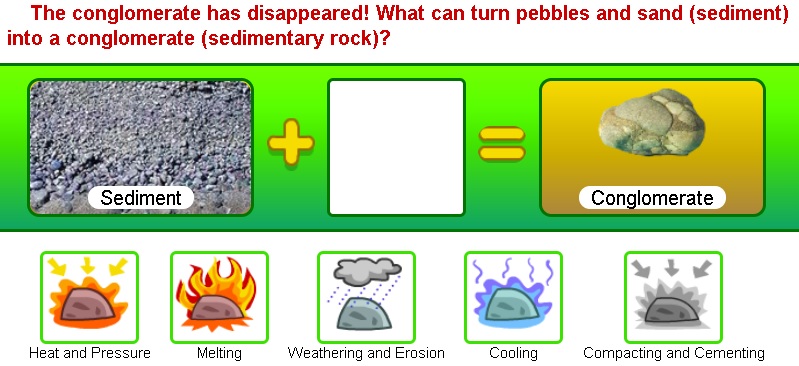
What process turns pebbles and sand into a conglomerate? Refer to above photo.
compacting and cementing
weathering and erosion
cooling
heat and pressure
melting
Question 24
24.
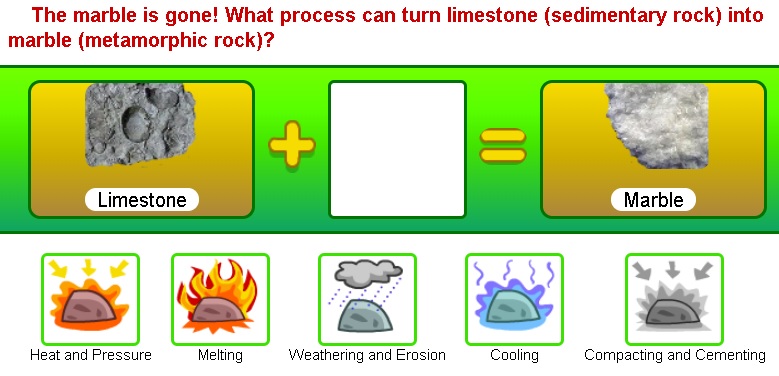
The marble is gone! What process can turn limestone (sedimentary rock) into marble (metamorphic rock)? Refer to above photo.
cooling
weathering and erosion
heat and pressure
compacting
melting
Question 25
25.
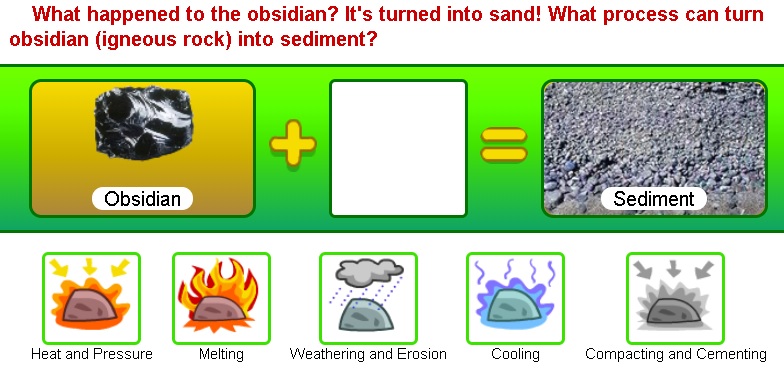
What process can turn obsidian into sediment? Refer to above photo.
weathering and erosion
cooling
melting
compacting and cementing
heat and pressure