10
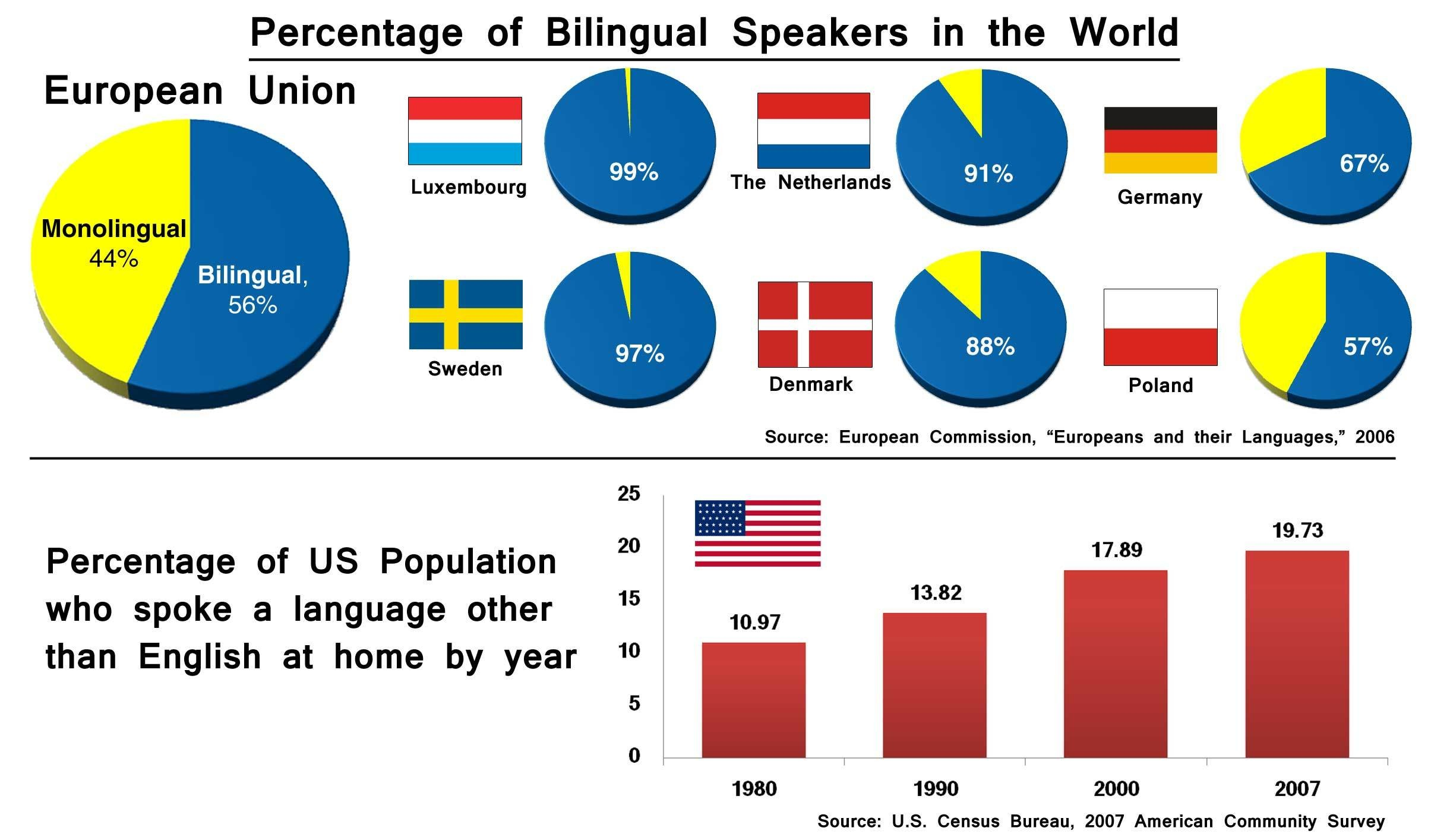
What is the percentage of Bilingual speakers in the European Union
What is the percentage of Bilingual speakers in the European Union
10
10
10
What is the percentage of Bilingual speakers in the European Union
Read the following texts and answer the questions:
Text A:
Depending on their situation and how they acquired each language, bilinguals can be classified into three general types of brains: compound bilingual, coordinate bilingual, and subordinate bilingual. Those who are compound bilingual developed two linguistic codes simultaneously with a single set of concepts (e.g., learning English and Spanish has you begin to process the world). In coordinate bilingual, the person works with two sets of concepts (e.g., learning English in school while continuing to speak their native tongue at home and with their friends). Lastly, there are subordinate bilinguals who learn a secondary language by filtering it through their primary language.
Text B:
By the 1990s, thousands of Hispanic children in California heard little or no English during the school day — and many of their parents began to question whether this was a good idea. In 1996, a group of them in the garment district of Los Angeles boycotted school for two weeks. “I want my children to learn English so they won’t have the problems which I’ve had,” said Lenin Lopez, one of their spokesmen.
The coverage of their protest caught the attention of Ron K. Unz, a software entrepreneur in Silicon Valley. He came up with a political response: a ballot initiative to require schools to teach children in English. Known as Proposition 227, it faced fierce opposition from teachers’ unions and their allies, who outspent its backers by a five-to-one margin. Yet its message was simple — “English for the children” — and it won support from the likes of Jaime Escalante, the East Los Angeles calculus teacher who was at the time possibly the most famous instructor in America, his story having been immortalized in the film Stand and Deliver. Prop 227 coasted to victory in 1998, carrying 61 percent of the vote.
Which is the main idea in Text A?
According to text B, which of the following claims is an opinion?
The purpose of text A is...
In text B, which is the correct sequence of events?
In text B, which of the following are evidence for the claim "Proposition 227 was a controversial initiative" Choose all that apply.
According to text A, which of the following pairs of terms are connected correctly?
According to the graph,which is the country with the highest percentage of bilingual speakers?
Based on the graph about the US, which of the following statements is true?
You want more information about bilingual speakers. Which data source would be the best one to use?