Earth In Space Final 2/21/2020
star
star
star
star
star
Last updated almost 4 years ago
23 Nsɛmmisa
1
1
1
1
1
1
1
1
1
0
1
1
1
1
1
1
1
1
1
1
3

4
8
Any representation of a system, or its components, to help one study and understand how it works.
An investigation that can be repeated to give the same or similar results.
Information gathered from an experiment. Firsthand evidence from the five senses or from machines that
extend our senses.
Which of the following is one day on Earth? The time it takes for
If the time in New York City (East Coast) is 8pm, what time is it in Portland (West Coast)?
If your family is going to call you from Hawaii at 1pm (Hawaiian time), and you are in Portland (Weast coast), what time should you expect the phonecall in your time zone?
A planet has a shorter day than Earth does. Which of the following is most likely to explain why?
About how long does one cycle of the Moon’s phases last?
There is a full moon on October 9 and November 6. What phase is the Moon in on October 23? You can use the Calendar below.
You can use the Calendar for question 9. You don't have to if you don't want to.
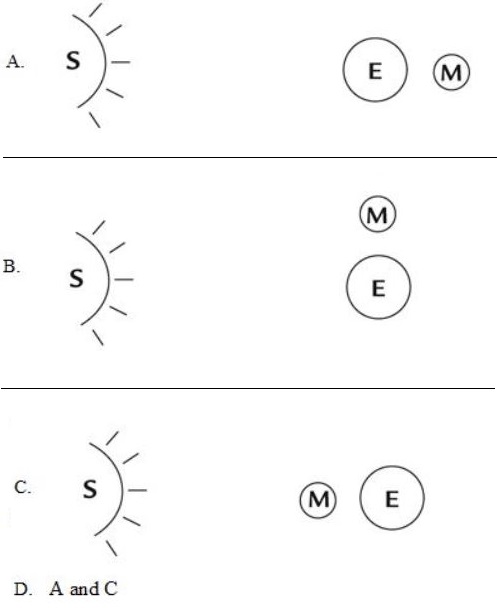
Which diagram(s) below best represent(s) the position of the Moon during a Quarter Moon? Note that S represents the Sun, E is Earth, and M is the Moon.
Which diagram(s) below best represent(s) the position of the Moon during a New Moon? Note that S represents the Sun, E is Earth, and M is the Moon.
Which diagram(s) below best represent(s) the position of the Moon during a Full Moon? Note that S represents the Sun, E is Earth, and M is the Moon.
If we ignore eclipses, what percentage of the Moon is always lit by the Sun? Explain your answer below.
Explain your answer to question 14. (Hint: Why don't we see this percentage all the time)
The phases of the Moon are caused by which of the following?
Which of the following results from the tilt of Earth?
Changing seasons are caused by which of the following?
If Earth’s axis were tilted 50°, which of the following would result?
If Earth revolved more slowly in its orbit around the Sun, which of the following would be likely to result?
Which of the diagrams below correctly represents the position of Earth during winter in the United States? Explain how you decided which answer is correct.
Your friend went outside and sat in the shade of a tree for two hours. While she was there, the shade from the tree got smaller and smaller. Was it morning or afternoon and why did the shade get smaller at that time of day? CLAIM EVIDENCE REASONING
Describe your perfect planet. What would the tilt be? How would that affect your climate? How much time would a rotation and revolution take to complete. How would these affect the measurement of time on your planet and the length of a day and year? Compare these lengths of time to Earth. CLAIM EVIDENCE REASONING