Moon Final
star
star
star
star
star
Last updated almost 4 years ago
25 Nsɛmmisa
1
1
1
1
1
1
0
1
1
1
1
1
1
1
1
1
1
1
1
1
1
1
3

3
1

To travel around another object in a circular or elliptical path.

Which of the following is one day on Earth? The time it takes for

If your family is going to call you from Hawaii at 1pm (Hawaiian time), and you are in Portland (Weast coast), what time should you expect the phonecall in your time zone?

A planet has a shorter day than Earth does. Which of the following is most likely to explain why?

About how long does one cycle of the Moon’s phases last?

There is a full moon on October 9 and November 6. What phase is the Moon in on October 23? You can use the Calendar below.
You can use the Calendar for question 9. You don't have to if you don't want to.


Identify phase of the moon pictured above.


Identify phase of the moon pictured above.


Identify phase of the moon the red arrow is pointing at (pictured above).


Identify phase of the moon pictured above.

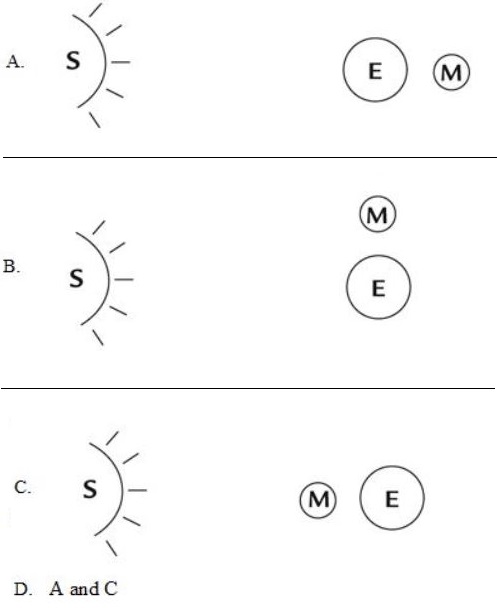
Which diagram(s) below best represent(s) the position of the Moon during a Quarter Moon? Note that S represents the Sun, E is Earth, and M is the Moon.

Which diagram(s) below best represent(s) the position of the Moon during a New Moon? Note that S represents the Sun, E is Earth, and M is the Moon.

Which diagram(s) below best represent(s) the position of the Moon during a Full Moon? Note that S represents the Sun, E is Earth, and M is the Moon.

If we ignore eclipses, what percentage of the Moon is always lit by the Sun? Explain your answer below.

The phases of the Moon are caused by which of the following?

Which of the following results from the tilt of Earth?

Changing seasons are caused by which of the following?

Which month has the most hours of sunlight?

Which month has the least hours of sunlight?

If Earth took more time to orbit the Sun, which of the following would be likely to result?

If Earth took less time to rotate, which of the following would be likely to result?

Which of the diagrams below correctly represents the position of Earth during winter in the United States (N stands for North on the diagram)?

Which of the diagrams below correctly represents the position of Earth during summer in the United States (N stands for North on the diagram)? Explain why the weather is warmer during the summer.

What do we call our star?