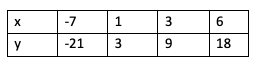
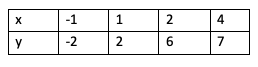
Inverse and direct variation can be easy to mix up.
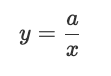
With inverse variation, the x times the y is always the same number. That is the constant of variation (a), so the equation that represents the relationship looks like:
With direct variation, the y divided by the x is always the same number. That is the constant of variation (a), so the equation that represents the relationship looks like:
If the relationship between the x- and y-values is anything else, it does not represent direct or inverse variation!
1 point
1
Question 1
1.
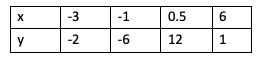
Tell whether the table represents direct variation, inverse variation, or neither. If it is direct or inverse variation, write the equation.
1 point
1
Question 2
2.
If it is direct or inverse variation, write the equation. If it is neither, just type neither.
1 point
1
Question 3
3.
Tell whether the table represents direct variation, inverse variation, or neither. If it is direct or inverse variation, write the equation.
1 point
1
Question 4
4.
If it is direct or inverse variation, write the equation. If it is neither, just type neither.
1 point
1
Question 5
5.
Tell whether the table represents direct variation, inverse variation, or neither. If it is direct or inverse variation, write the equation.
1 point
1
Question 6
6.
If it is direct or inverse variation, write the equation. If it is neither, just type neither.
1 point
1
Question 7
7.
Select the three points that will create a relation that has inverse variation.
1 point
1
Question 8
8.
Which of the following tables indicates that x and y vary inversely?
1 point
1
Question 9
9.
Which of the following tables indicates that x and y vary inversely?