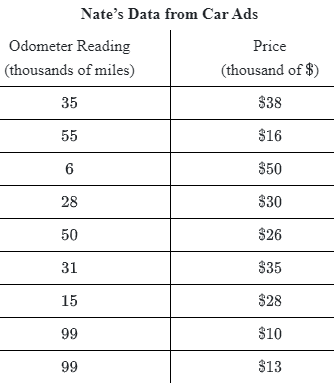
Problem 7-15a Follow the directions below to create a scatterplot of the data for Melissa.
The Odometer Reading will be on the x‑axis and Price on the y‑axis.
Move and resize your window so you see the first quadrant only.
Plot the data points from the table. Type in each point to graph in (x,y) form.
Now use your graph you created to create a copy on your notecatcher.
We have released a new and improved Graphing question type! Students will no longer be able to answer this question.
1 point
1
Question 2
2.
Problem 7-15b Describe the scatterplot you just created. What do you notice about how the points are placed on the graph? Do you see any patterns?
1 point
1
Question 3
3.
Problem 7-15c Place an additional point on your graph for Nate’s car that has an odometer reading of 23,000 miles. Explain your strategy for deciding where to put the point.
1 point
1
Question 4
4.
Problem 7-15d When a relationship exists, one way to help show a trend in the data is to place a line or curve that, in general, represents where the data falls. This line, sometimes called a line of best fit, does not need to touch any of the actual data points. Instead, it shows where the data generally falls. The line is a mathematical model of the data. Models of data help you describe the data more easily and help you make predictions for other cars with different mileages.
Decide where a line of best fit could be placed that would best model the data points and add the line. Are there any limits to where your line makes sense?Problem 7-15
1 point
1
Question 5
5.
Problem 7-15e Using the line of best fit, can you predict the price of a car with an odometer reading of 80,000 miles? If so, explain how the line of best fit helps. If not, explain why it is not helpful.
1 point
1
Question 6
6.
Problem 7-15f Based on the scatterplot, would you agree with Nate’s claim that cars with a higher odometer reading cost less? Use the scatterplot to justify your answer.