The second part of the triathlon is a bicycle race. Since participants do not start the bicycle race until they complete the swimming portion, the bicyclists have varying starting times.
The graph below shows information about four bicyclists during a 20-minute portion of a race.
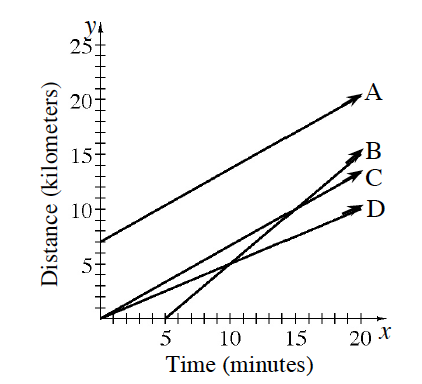
Based on the graph above, list the bicyclists from slowest to fastest. How can you tell?
D
C
A
B
1 point
1
Question 2
2.
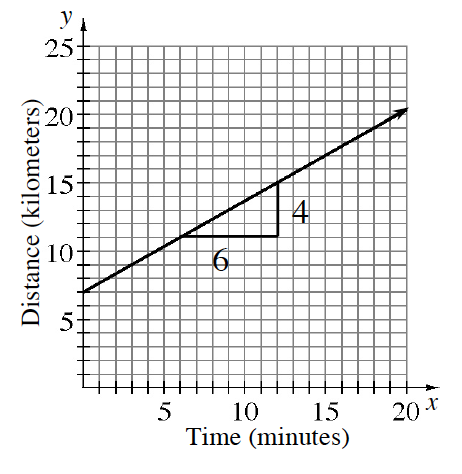
Lydia wants to describe each bicyclist’s rate in kilometers per minute for an article in the school paper. To do this, she sketched triangles like the one for line A on the graph below.
Where do the 4 and 6 come from on Racer A’s triangle? What do they represent?
1 point
1
Question 3
3.
These numbers can be written as a rate in kilometers per minute to describe the distance the bicyclist rides as time passes. The fraction 4/6 represents how the graph of the line goes up 4 units for every 6 units that it moves to the right. The number 4/6 is called the slope of the line.
Using your etool, find the slope of Racer B.
1 point
1
Question 4
4.
These numbers can be written as a rate in kilometers per minute to describe the distance the bicyclist rides as time passes. The fraction 4/6 represents how the graph of the line goes up 4 units for every 6 units that it moves to the right. The number 4/6 is called the slope of the line.
Using your etool, find the slope of Racer C.
1 point
1
Question 5
5.
These numbers can be written as a rate in kilometers per minute to describe the distance the bicyclist rides as time passes. The fraction 4/6 represents how the graph of the line goes up 4 units for every 6 units that it moves to the right. The number 4/6 is called the slope of the line.
Using your etool, find the slope of Racer D.
1 point
1
Question 6
6.
Did the slopes in part (c) confirm your ranking from slowest to fastest in part (a)? If not, review your slopes and your comparison of rates based on the graph to find any mistakes.