Types of Sampling - 7th data & statistics
star
star
star
star
star
Last updated over 2 years ago
30 questions
1
As the social director of the Class Council, Ramin would like to survey a few students about their interests.When Ramin analyzes the results from the survey, he wants to make claims about the interests of all of the students in his school.Â
If he were to survey only students on the Class Council, for example, it might be hard to make claims about what all students think. Students who are on the Class Council may not have the same social interests as other students. Consider this idea as you think about the samples described below.
If Ramin wanted to generalize the opinions of all students at his school, would it make sense to go to the grocery store and survey the people there? Why or why not?
As the social director of the Class Council, Ramin would like to survey a few students about their interests.
When Ramin analyzes the results from the survey, he wants to make claims about the interests of all of the students in his school.Â
If he were to survey only students on the Class Council, for example, it might be hard to make claims about what all students think. Students who are on the Class Council may not have the same social interests as other students. Consider this idea as you think about the samples described below.
If Ramin wanted to generalize the opinions of all students at his school, would it make sense to go to the grocery store and survey the people there? Why or why not?
1
As the social director of the Class Council, Ramin would like to survey a few students about their interests.When Ramin analyzes the results from the survey, he wants to make claims about the interests of all of the students in his school.Â
If he were to survey only students on the Class Council, for example, it might be hard to make claims about what all students think. Students who are on the Class Council may not have the same social interests as other students. Consider this idea as you think about the samples described below.
If he wanted to generalize the opinions of all students at his school, would it make sense to ask all of his friends at school? Why or why not?
As the social director of the Class Council, Ramin would like to survey a few students about their interests.
When Ramin analyzes the results from the survey, he wants to make claims about the interests of all of the students in his school.Â
If he were to survey only students on the Class Council, for example, it might be hard to make claims about what all students think. Students who are on the Class Council may not have the same social interests as other students. Consider this idea as you think about the samples described below.
If he wanted to generalize the opinions of all students at his school, would it make sense to ask all of his friends at school? Why or why not?
1
As the social director of the Class Council, Ramin would like to survey a few students about their interests.When Ramin analyzes the results from the survey, he wants to make claims about the interests of all of the students in his school.Â
If he were to survey only students on the Class Council, for example, it might be hard to make claims about what all students think. Students who are on the Class Council may not have the same social interests as other students. Consider this idea as you think about the samples described below.
If he wanted to generalize the opinions of all students at his school, would it make sense to ask every third person who entered the cafeteria at lunch? Why or why not?
As the social director of the Class Council, Ramin would like to survey a few students about their interests.
When Ramin analyzes the results from the survey, he wants to make claims about the interests of all of the students in his school.Â
If he were to survey only students on the Class Council, for example, it might be hard to make claims about what all students think. Students who are on the Class Council may not have the same social interests as other students. Consider this idea as you think about the samples described below.
If he wanted to generalize the opinions of all students at his school, would it make sense to ask every third person who entered the cafeteria at lunch? Why or why not?
1
If you ask the opinion of the people around you, then you have used a convenience sample.
Would you expect a convenience sample to represent the entire student population at your school? Why or why not?
If you ask the opinion of the people around you, then you have used a convenience sample.
Would you expect a convenience sample to represent the entire student population at your school? Why or why not?
1
If you email or create an online questionnaire then you have used a voluntary response sample.Â
What are some features of the people in a volunteer response sample? Could it represent the sample of all of the students at school accurately?
If you email or create an online questionnaire then you have used a voluntary response sample.Â
What are some features of the people in a volunteer response sample? Could it represent the sample of all of the students at school accurately?
1
You use a cluster sample if you first divide the students into smaller groups so that each of the smaller groups represents all of the students at your school. Then you randomly select one or more of these groups to sample.Â
How might you divide the students at your school into groups that each represent the whole school? Explain.Â
You use a cluster sample if you first divide the students into smaller groups so that each of the smaller groups represents all of the students at your school. Then you randomly select one or more of these groups to sample.Â
How might you divide the students at your school into groups that each represent the whole school? Explain.Â
1
Are there any reasons that these clusters might not be fully representative of all the students at your school?

1
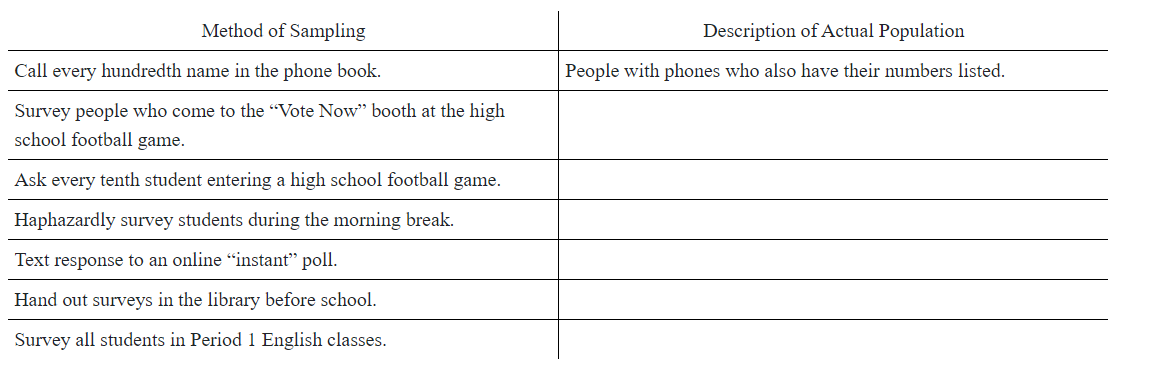
From what population is each of these samples taken? Write down the actual population for each of these sampling techniques.
1
From what population is each of these samples taken? Write down the actual population for each of these sampling techniques.
1
From what population is each of these samples taken? Write down the actual population for each of these sampling techniques.
1
From what population is each of these samples taken? Write down the actual population for each of these sampling techniques.
1
From what population is each of these samples taken? Write down the actual population for each of these sampling techniques.
1
From what population is each of these samples taken? Write down the actual population for each of these sampling techniques.
1
A study at the University of Iowa in 2008 concluded that children that play violent video games are more aggressive in real life. Children ages 9 to 12 were studied to determine how much they played violent video games; peers and teachers were asked how much these students hit, kicked, and got into fights with other students.- Can you legitimately conclude from this study that teenagers who play violent video games tend to be more aggressive? Why or why not?
A study at the University of Iowa in 2008 concluded that children that play violent video games are more aggressive in real life. Children ages 9 to 12 were studied to determine how much they played violent video games; peers and teachers were asked how much these students hit, kicked, and got into fights with other students.
- Can you legitimately conclude from this study that teenagers who play violent video games tend to be more aggressive? Why or why not?
1
A study at the University of Iowa in 2008 concluded that children that play violent video games are more aggressive in real life. Children ages 9 to 12 were studied to determine how much they played violent video games; peers and teachers were asked how much these students hit, kicked, and got into fights with other students.
2. Can you legitimately conclude from this study that children ages 9 to 12 who play violent video games are more likely to commit violent crimes? Why or why not?
A study at the University of Iowa in 2008 concluded that children that play violent video games are more aggressive in real life. Children ages 9 to 12 were studied to determine how much they played violent video games; peers and teachers were asked how much these students hit, kicked, and got into fights with other students.
2. Can you legitimately conclude from this study that children ages 9 to 12 who play violent video games are more likely to commit violent crimes? Why or why not?
1
A study at the University of Iowa in 2008 concluded that children that play violent video games are more aggressive in real life. Children ages 9 to 12 were studied to determine how much they played violent video games; peers and teachers were asked how much these students hit, kicked, and got into fights with other students.
3. Can you legitimately conclude from this study that children ages 9 to 12 who play violent video games tend to hit and kick more in school?
A study at the University of Iowa in 2008 concluded that children that play violent video games are more aggressive in real life. Children ages 9 to 12 were studied to determine how much they played violent video games; peers and teachers were asked how much these students hit, kicked, and got into fights with other students.
3. Can you legitimately conclude from this study that children ages 9 to 12 who play violent video games tend to hit and kick more in school?
1
A study at the University of Iowa in 2008 concluded that children that play violent video games are more aggressive in real life. Children ages 9 to 12 were studied to determine how much they played violent video games; peers and teachers were asked how much these students hit, kicked, and got into fights with other students.
4. Can you legitimately conclude from this study that playing a lot of violent video games will cause 9 to 12-year-old students to become more violent at school?
A study at the University of Iowa in 2008 concluded that children that play violent video games are more aggressive in real life. Children ages 9 to 12 were studied to determine how much they played violent video games; peers and teachers were asked how much these students hit, kicked, and got into fights with other students.
4. Can you legitimately conclude from this study that playing a lot of violent video games will cause 9 to 12-year-old students to become more violent at school?

1
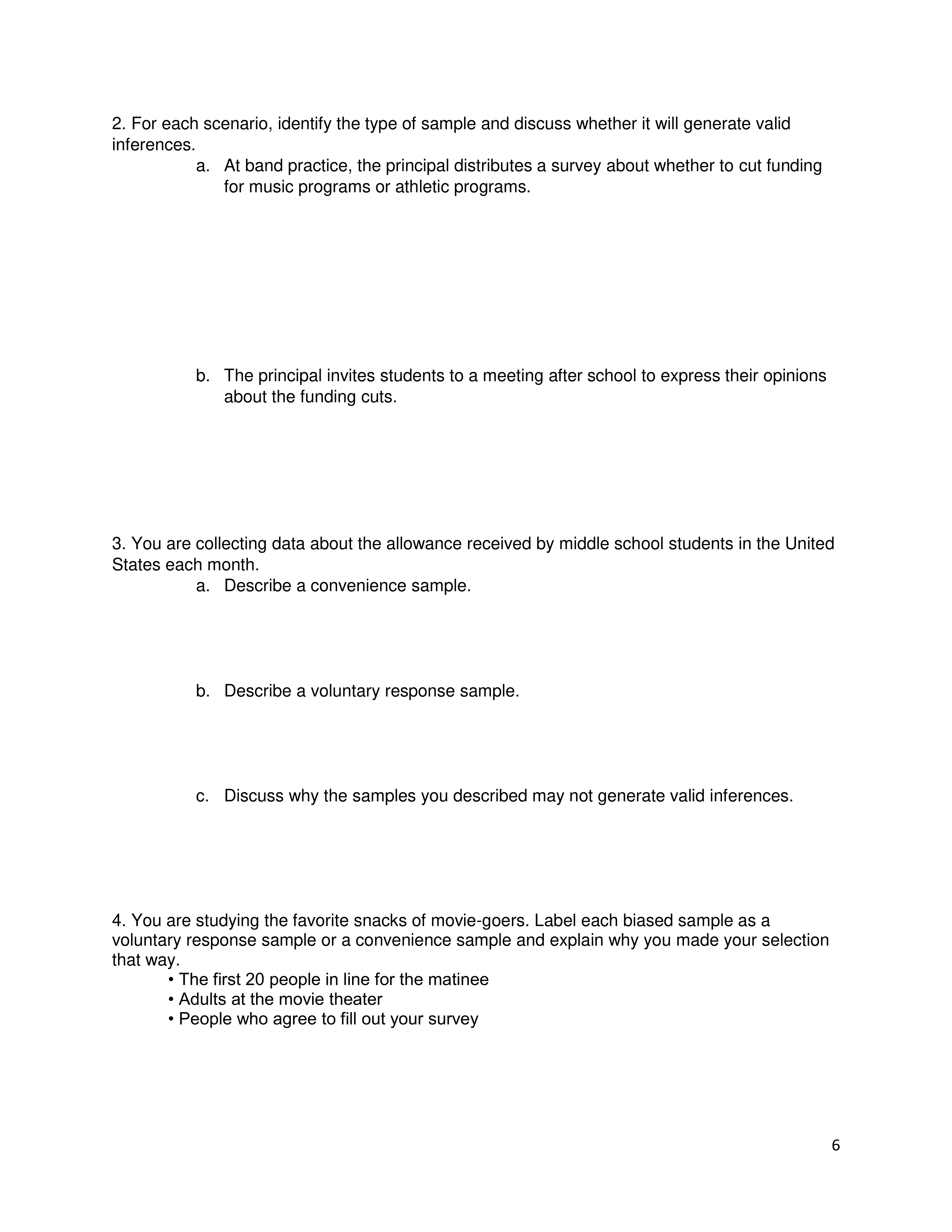
What type of sample is this?
1
Will this generate valid inferences? Explain
1
What type of sample is this?
1
Will this generate valid inferences? Explain
1
What would be a convience sample for this situation?
1
What would be a voluntary response sample?
1
Discuss why the samples you described may not generate valid inferences
1
"The first 20 people in line for the matinne"Which type of sample is this?
"The first 20 people in line for the matinne"
Which type of sample is this?
1
"Adults at the movie theater"Which type of sample is this?
"Adults at the movie theater"
Which type of sample is this?
1
"People who agree to fill out your survey"Which type of sample is this?
"People who agree to fill out your survey"
Which type of sample is this?

1
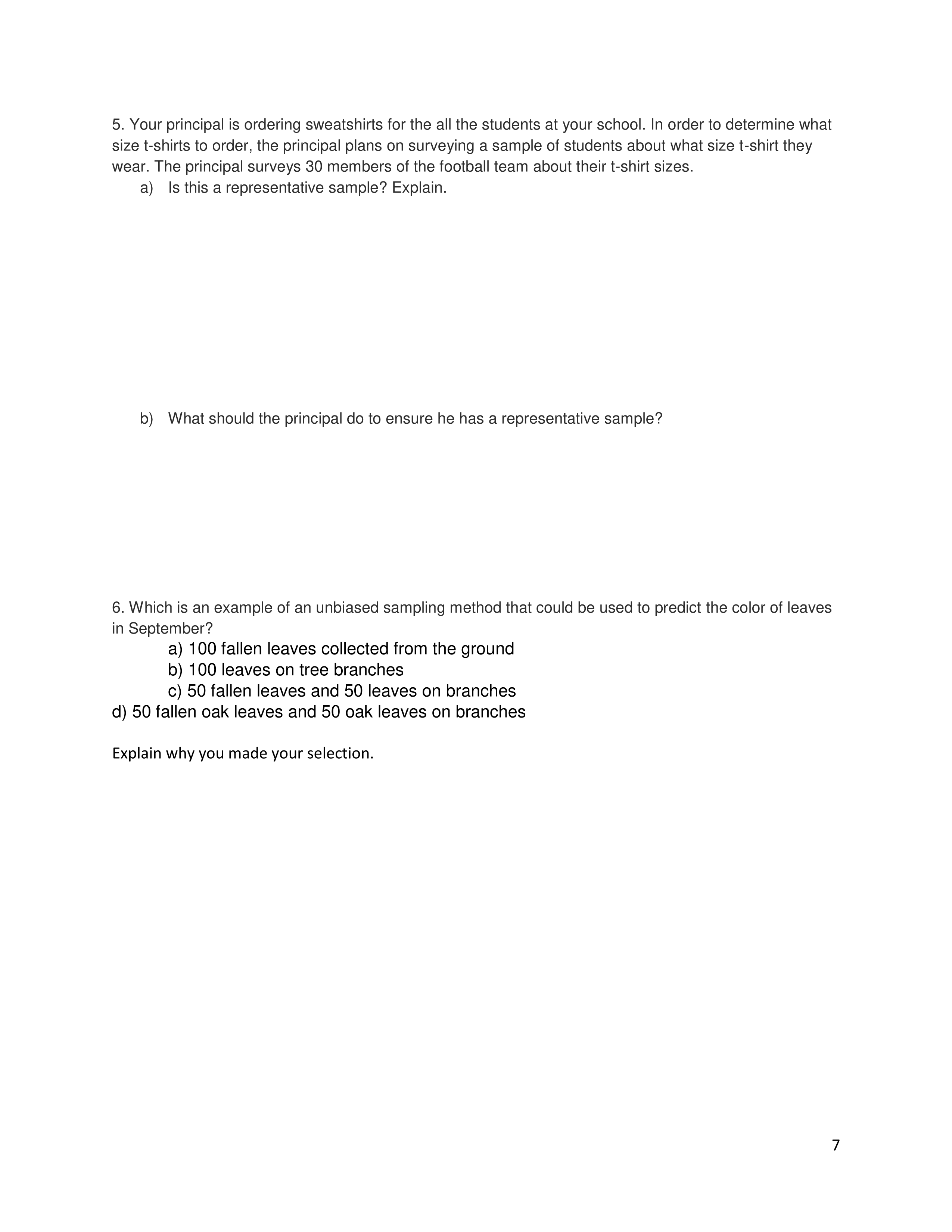
Is this a representative sample? Explain
1
What should the principal do?
1
Which is an example of unbiased sampling?