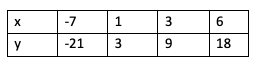
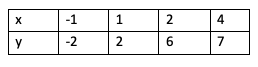
Inverse and direct variation can be easy to mix up.
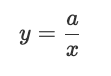
With inverse variation, the x times the y is always the same number. That is the constant of variation (a), so the equation that represents the relationship looks like:
With direct variation, the y divided by the x is always the same number. That is the constant of variation (a), so the equation that represents the relationship looks like:
If the relationship between the x- and y-values is anything else, it does not represent direct or inverse variation!
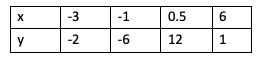
Question 1
1.
Question 2
2.
If it is direct or inverse variation, write the equation. If it is neither, just type neither.
Question 3
3.
Question 4
4.
If it is direct or inverse variation, write the equation. If it is neither, just type neither.
Question 5
5.
Question 6
6.
If it is direct or inverse variation, write the equation. If it is neither, just type neither.
Question 7
7.
Question 8
8.
Question 9
9.
Tell whether the table represents direct variation, inverse variation, or neither. If it is direct or inverse variation, write the equation.
Direct variation
Inverse variation
Neither
Tell whether the table represents direct variation, inverse variation, or neither. If it is direct or inverse variation, write the equation.
Direct variation
Inverse variation
Neither
Tell whether the table represents direct variation, inverse variation, or neither. If it is direct or inverse variation, write the equation.
Direct variation
Inverse variation
Neither
Select the three points that will create a relation that has inverse variation.
(1, 20)
(2, 10)
(2, 40)
(4, 5)
(4, 80)
(5, 100)
Which of the following tables indicates that x and y vary inversely?