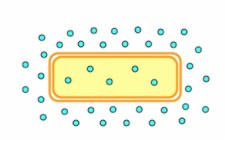
Lesson 8.3 Passive Transport and Gummy Bear Review

Last updated almost 5 years ago
10 questions
1

Which way would the blue molecules in the diagram at the right move if they are able to diffuse freely across the membrane? Into or out of the cell?

1

If a cell is placed in a solution where there is a high concentration of salt (solutes), will water move INTO the cell, or OUT OF the cell?

1

What type of solution is the solution in #2? (Hypertonic, Hypotonic, or Isotonic?)

1

If a cell is placed in a solution where there is a low concentration of solutes (for example, distilled water with nothing dissolved in it), will water move INTO the cell, or OUT OF the cell?

1

What type of solution is the solution in #4? (Hypertonic, Hypotonic, or Isotonic?)

1

Diffusion and osmosis are both types of passive transport. Does passive transport involve energy use by the cell to complete?

1

Why is osmosis considered to be facilitated diffusion?

Go back to your Gummy Bear Investigation. Use your data, and your notes to help you answer the following questions.
1

Imagine that your Gummy Bear represents a cell. Would the inside of the gummy bear represent intracellular fluid, or extracellular fluid? Explain

1

Would the distilled water surrounding your gummy bear represent intracellular fluid, or extracellular fluid? Explain.

1

Look back at your responses for Questions #4 and #5, explain what happened to your gummy bear when placed in distilled water. (Some terms that may apply that you can use in your explanation: intracellular, extracellular, hypertonic, hypotonic, isotonic, osmosis, diffusion, concentration, solute)