Chem Unit 6 Ionization Energy
star
star
star
star
star
Last updated 5 months ago
15 Nsɛmmisa
1
1
1
1
1
1
4
3
4
1
1
1
1
3
1
Ionization Energy
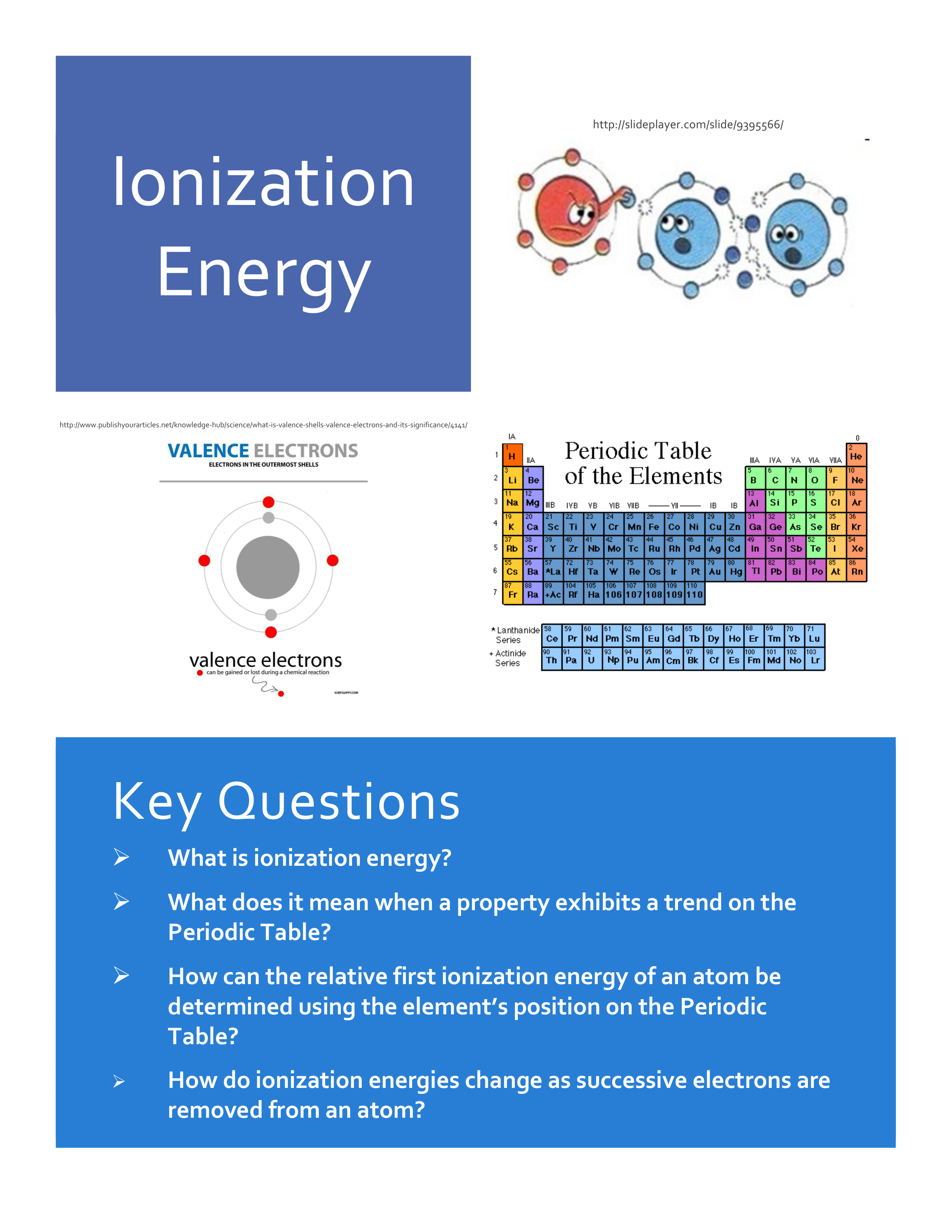
How are electrons held within atoms? What happens to an atom as it becomes an ion? What types of energy changes accompany the addition or loss of electrons from atoms?
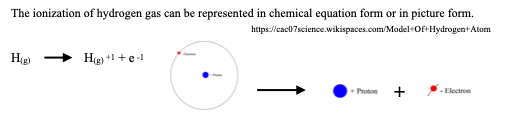
Electrons in atoms are attracted to the nucleus with an electrostatic force that exists between the positive charge of the protons and the negative charge of the electrons. In order for an electron to be removed from an atom, an energy source that can overcome the attractive force must be present. The removal of an electron from a neutral atom produces an ion with a positive charge and a free electron.
The first ionization energy of an element is the minimum energy required to remove one electron from a gaseous-state atom of that element. Ionization energies are measured through experimentation. Ionization energy values are also measured for the removal of successive electrons. Thus, a person could consider the energy involved in the removal of the first electron to form a +1 ion or the removal of the second electron to form a +2 ion or the removal of the third electron to form a +3 ion.
What is ionization energy involved with?
When an electron is removed from an atom, what happens with energy?
Please paste a photograph of your atom cards organized like the Periodic Table with the ionization energy value written on each card.
(Open the Google Sheets document that is included in the assignment in Google Classroom for this activity to find the values for ionization energy.)
Consider the values you wrote onto your atom cards organized like the Periodic Table with the ionization energy value written on each card.
What is true for the values in a horizontal row?
Consider the values you wrote your atom cards organized like the Periodic Table with the ionization energy value written on each card.
What is true for the values in a vertical column?
Please paste a screenshot of the graph of ionization energies AND a screenshot of the graph of atomic radii that you created using Sheets.
Open the Sheets document "ionization Energies to Graph" that is included in the assignment folder for this activity. Open in the app or online.
Select or highlight the element symbols, atomic numbers, and ionization energy values.
Make a column chart.
Mark up the screenshots of BOTH graphs by making a "swoosh" line that connects the tops of the bars in the graph. Use one "swoosh" for each period of elements.
Number the periods of elements 1-5.
Consider two elements that are on the same row of the periodic table, lithium and fluorine.
The following characteristics contribute to lithium's having a lower ionization energy than fluorine.
Match the characteristic to the element with that property.
has 9 protons
has 3 protons
has 1 valence electron
has 7 valence electrons
has the smaller radius
has the wider radius
is a metal that forms positive cations
is a nonmetal that forms negative anions
Lithium, Li
Fluorine, F
Consider two elements that are in the same column of the periodic table, magnesium and strontium.
The following characteristics contribute to strontium's having a lower ionization energy than magnesium.
Match the characteristic to the element with that property.
has 12 protons
has 38 protons
has 5 energy levels
has 3 energy levels
has the smaller radius
has the wider radius
Magnesium, Mg
Strontium, Sr
What are properties of elements that have high ionization energies and those that have low ionization energies?
tend to lose electrons to form ions
tend to gain electrons to form ions
tend to have wide atomic radii
tend to have small atomic radii
found in the upper right corner of the Periodic Table
found in the lower left corner of the Periodic Table
the nucleus has a strong pull on the valence electrons
the nucleus has a weak pull on the valence electons
High ionization energies
Low ionization energies
SUCCESSIVE IONIZATION ENERGIES
The first, most accessible electron is not the only electron that can be removed from an atom. Any number of electrons could be removed from an atom. The amount of energy required to remove each additional electron can be measured. Each removal of an electron has its own name that indicates which electron is being examined: the first ionization energy is the energy to remove the first electron; the second ionization energy is the energy to remove the second electron; the third ionization energy is the energy to remove the third electron; etc.

https://ak7.picdn.net/shutterstock/videos/17235157/thumb/9.jpg
What is the definition of the term "successive ionization energies"?
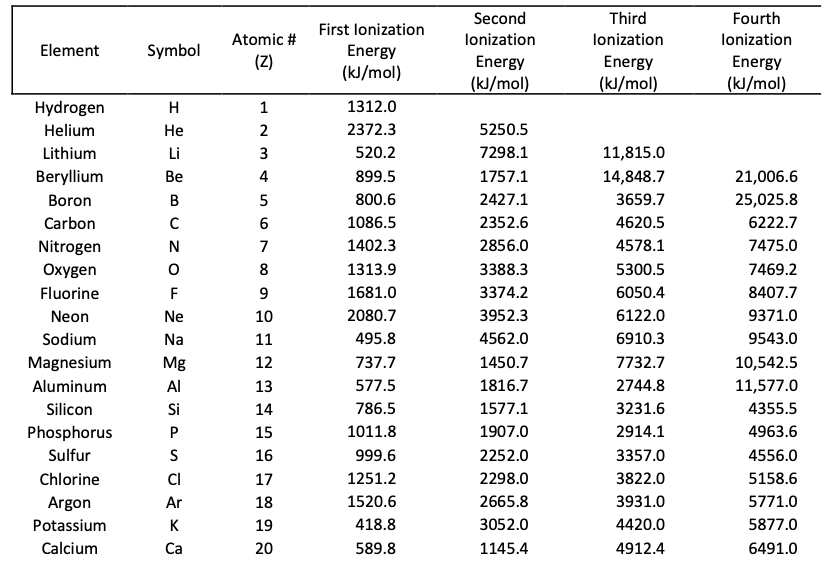
Look at the chart of successive ionization energies posted after the picture of the daisy.
Examine the values across a horizontal row.
How do the values for the ionization energies change from the 1st through the 4th values?
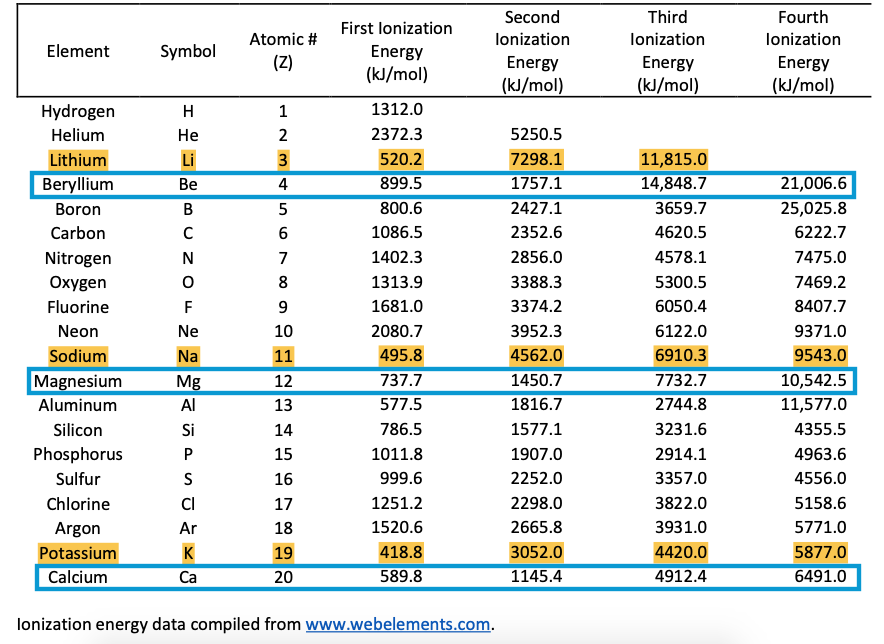
Looking at the values for successive ionization energies, when does the largest increase between two values occur for Li, Na, and K?
Looking at the values for successive ionization energies, when does the largest increase between two values occur for Be, Mg, and Ca?
The numbers of valence electrons and the preferred ion charge determine when the large jump in successive ionization energies will occur for metals.
1 valence electron
2 valence electrons
ions have +2 charge
ions have +1 charge
Alkali Metals: Li, Na, and K
Alkaline Earth Metals: Be, Mg, and Ca
Largest jump is after the 1st electron is removed
(trying to remove a 2nd electron)
Largest jump is after the 2nd electron is removed
(trying to remove a 3rd electron)
Why does the largest jump occur after the last valence electron is removed?