Log in
Sign up for FREE
arrow_back
Library

Prehistory: Our Ancestors Emerge

star
star
star
star
star
Last updated about 6 years ago
9 questions
1
1
1
Question 1
1.

1
1
1
1
1
1
Question 8
8.

Why are scientists interest in early humans' toolmaking skills? Support your answer with details and information from the article.

Question 9
9.

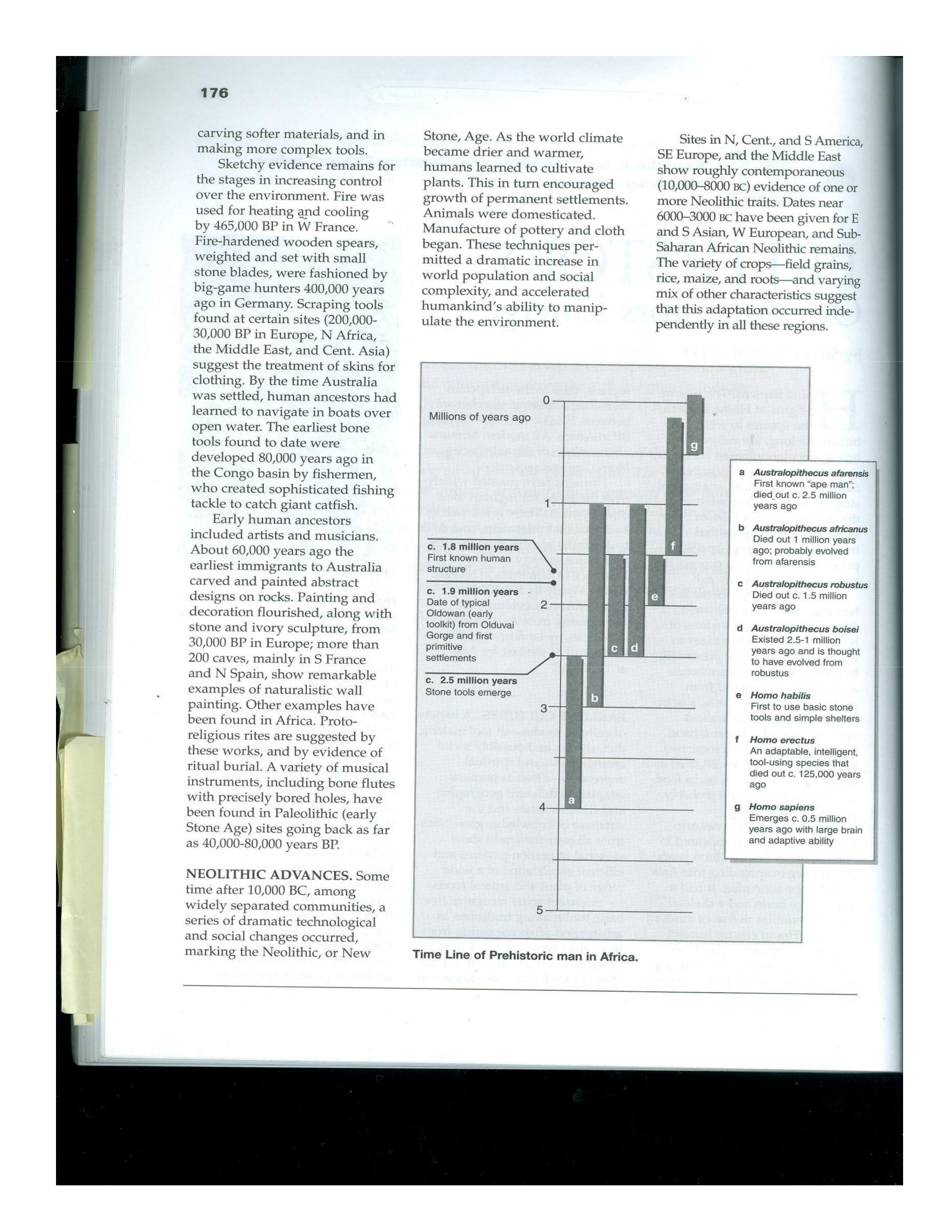
How does the chart support the information in the article? What additional information does the chart give? Support your answer with details and infomration from both the article and the chart.
What led scientists to believe that Homo erectus was the nearest ancestor to humans
It had a food-gathering economy.
It had a skelton like that of humans.
It was found in both Asia and Europe.
It was the first primate ancestor to walk upright.
Question 2
2.

Question 3
3.

Question 4
4.

Question 5
5.

Question 6
6.

Question 7
7.

What can you conclude from the article about the orgins of Homo sapiens?
Scientists have no idea how the Homo sapiens species began?
Scientist have pinpointed the exact time when Homo spaiens evolved.
Many scientists doubt the evidence from fossil records of homo sapiens.
Most scientists agree that Homo sapiens began to evolve millions of years ago.
Which statement is supported by both the article and the graph?
The different species of prehistoric man overlapped.
Most species of prehistoric man roamed extesively.
Homo habilis existed for the shortest amount of time
New species evolved after the old ones died out
The article suggests that learning to cultivate plants
was a key factor in early human migration.
was a major turning point in human evolution.
was vital to survival for the earliest human species.
was less important to human evolution than toolmaking.
What can one conclude from the article about Australopitchecus and Homo habilis
Austraolopitchecus were less social.
Homo habilis were more highly evolved.
Both species coexisted at the same time.
One species evolved from the other one.
Both the article and the chart support the idea that Australopithecus
did not use tools.
was a social animal.
had several subspecies.
was one of two hominid lines in Africa
How do scientists believe farming developed in vastly seperated areas?
Different populations developed farming on their own.
Migrating populations taight farming to other populations.
Farming increased after early humans learned to navigate boats.
Farming increased as humans began living in permananet settlements.