Here is the an image of an immunoassay. Draw your own in the space provided to show more than one type of antibody.

Here is the an image of an immunoassay. Draw your own in the space provided to show more than one type of antibody.
For Portola High School Forensic Science
Select all that apply: Toxicity of a given substance depends on _________
Put in order of slowest to fastest delivery routes for drugs
Injection
Ingestion
Inhalation
Explain your answer choice for the question above (this question will say it's wrong if it's not exactly what I put so don't worry about that)
An immunoassay can give you a specific kind of drug. (ex: morphine - specific vs. opiod - general class)
Place the words into the correct category. 2 words in each catagory (1) what it is (2) where it comes from
Antibodies
Toxins
Antigens
From our body
Works as a flag for the immune system
Causes an immune response
Here is the an image of an immunoassay. Draw your own in the space provided to show more than one type of antibody.
Mercury poisoning is an example of both Duration and Type of Exposure because..... (Select 2)
Match the toxin to the effect in the body
| Draggable item | arrow_right_alt | Corresponding Item |
|---|---|---|
Heroine | arrow_right_alt | Blocks production of ATP in our mitochondria during the Electron Transport Chain because it blocks oxygen recieving hydorgens to complete the chain. The person will have normal amounts of Oxygen in their blood |
Arsenic | arrow_right_alt | Binds of hemoglobin in red blood cells much more redily and for longer than oxygen. The person will not have oxygen being delivered to their cells, leading to no production of ATP. |
Ricin | arrow_right_alt | Normally injected as a poison into the body, this suppresses respiratory function of the body (slows down breathing and thus heartrate). Can cause death through apnea |
Carbon Monoxide | arrow_right_alt | Can be made from the waste products of castor bean processing. Inhibits the cells ability to perform protein synthesis of essential proteins needed for cell survival. Will lead to cell death and ultimately the death of the organism |
Cyanide | arrow_right_alt | Interferes with enzyme-mediated processes in the body, stopping various enzymes all over the body to stop functioning properly. Difficult to diagnosis because it causes a wide range of problems. |
It is important to get a sample from various parts of the body (blood, urine, liver, muscles) when testing for toxins because:
Peaks in a GCMS are caused by the chemical structure of the drugs you are analyzing
Below is an example of GCMS (YAY), with 2 knowns and 1 unknown. Draw lines (peaks) for the unknown to solve for what was in the victims system at the time of death. Circle the known GCMS when you think you've figured it out.
Below is an example of GCMS (DEAR LORD THIS IS GREAT), with 3 knowns and 1 unknown. Draw lines (peaks) for the unknown to solve for what was in the victims system at the time of death. Circle the known GCMS when you think you've figured it out.
Match the type of wound to the description
Information: post mortem wound most of the time, act of severe aggresion
Cause: Severance of limbs through large force
Appearance: clean cut
Appearance: similar to road rash
Causes: Friction between surface and skin
Appearance: Missing limb
Information: where a victim fell
Appearance: Flap of skin hanging from the body
Information: Act of aggression, couldn't amputate part of body
Cause: Hacking motion from object
Appearance: jagged cut on the body
Information: attacked with sharp object or an object at a high speed
Causes: slice/cut with (typically) a sharp object
Abrasions
Laceration
Avulsions
Amputation
What wound does this image depict?
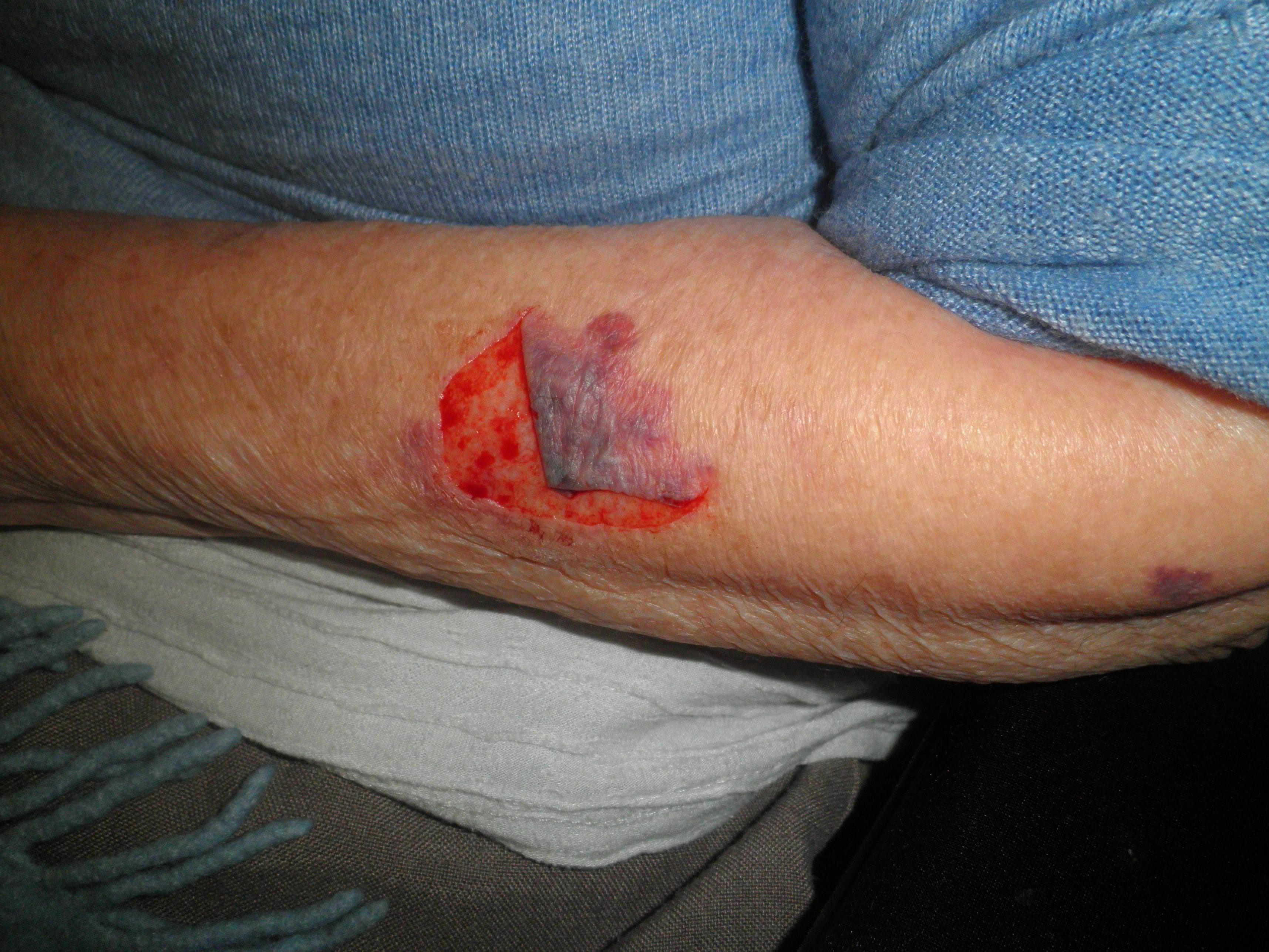
What wound does this image depict?

What wound does this image depict?
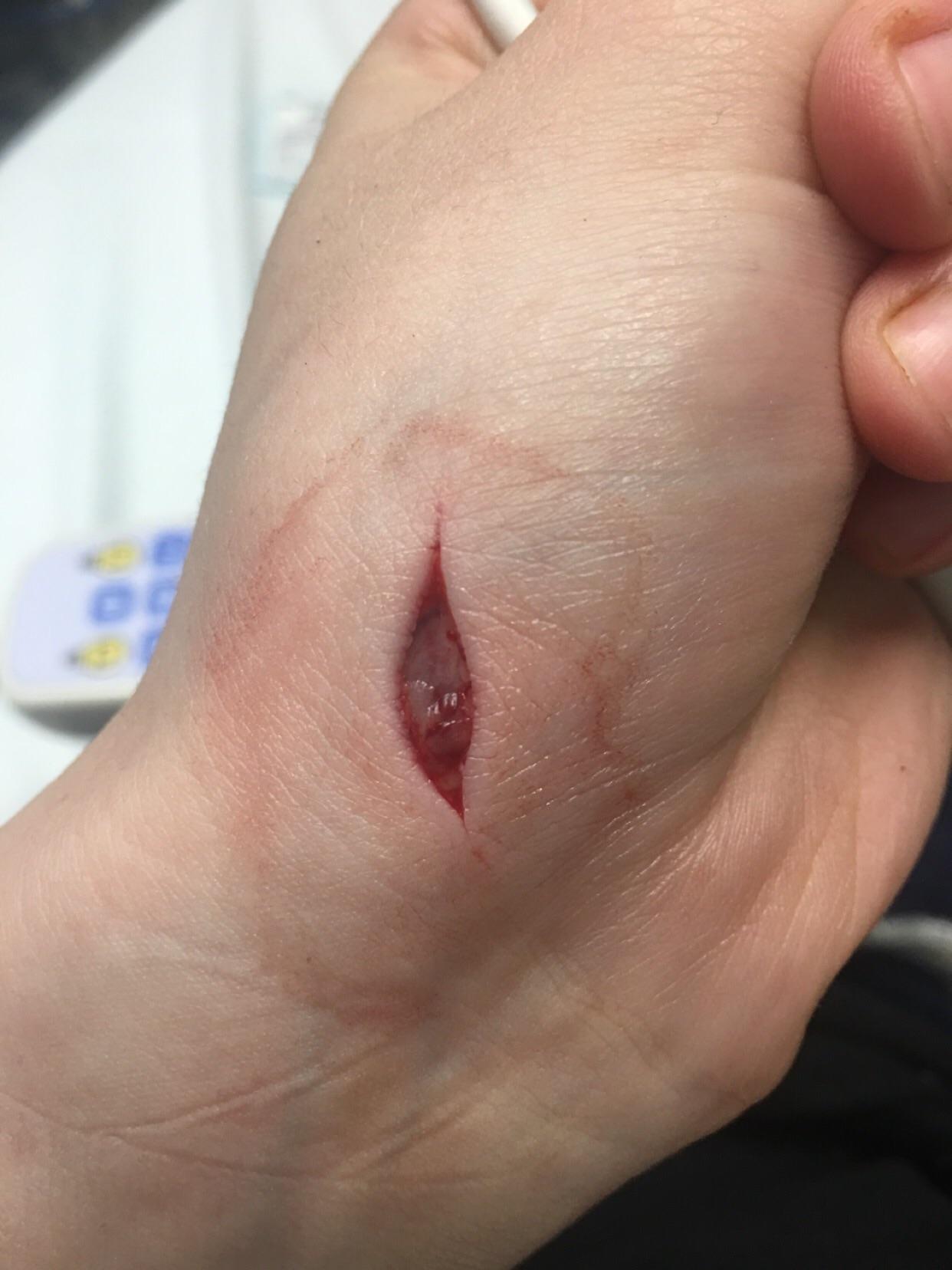
What wound does this image depict?
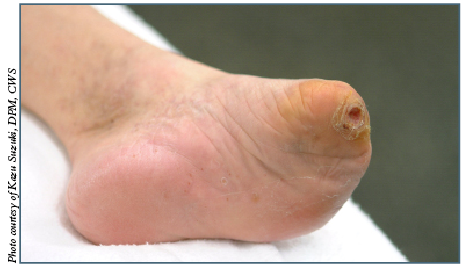
Use the following information to answer the next few questions:
You enter the scene of a crime and observe 2 bodies on the floor, dead.
Body one (Male, late 20's - early 30's): ecchymosis on the rib cage that was a lighter color than the one on his back near his kidneys; abrasion/laceration across his face; a large puncture wound in his chest
Body two (Female, late 20's - early 30's): bloodied fingernails on her right hand; a small puncture wound near her temple on her skull.
Who was the aggressor?
Which of the following would not be a logical conclusion
What is the most logical order of events (note, some may have taken place way before the crime)
Use the information below to answer the next few questions.
A neighbor calls police after hearing troubling noises of some shrieking coming from a house occupied by an elderly woman and a caretaker that her family pays for. When police arrive at the scene they find the woman welcoming them into the house. The caretaker is also there using a stern tone with the old women as she moves into the room behind the police. Police notice ecchymosis on the legs of the older woman as well as a laceration on her arm. When questioned on it she claimed she just had a terrible fall and her arm caught on the table. She claimed the shriek was from the fall and nothing more. When further questioned on previous "falls" (this is not the first phone call police have recieved), she says that due to her Parkinsons she is prone to more accidents, hense why her children got her a caretaker.
Do you think the older woman is telling the truth why or why not? What would she have to gain by lying?
Elderly abuse is a HUGE problem in our society. What are 2 reasons as to why it is difficult to detect
How can bullet trajectory be helpful for police investigations?
Use this crime scene information to solve for questions 24-26.
At a crime scene, police found a gunshot victim on the 4th story of a building (55 feet above ground level). They only had entry wounds to the body (chest cavity), no exit wounds could be found. However, severl of the bullets shot did pass through the railing of the balcony that was made out of a decorative wooden structure.
At a crime scene, police found a gunshot victim on the 4th story of a building (55 feet above ground level). They only had entry wounds to the body, no exit wounds could be found. How could they get an approximate Angle of Elevation? (Select 2)
If it is calculated that the distance between the hole in the balcony railing and the most likely bullet hole in the victim from that same bullet is about 3 inches, and the chest cavity is about 19 inches thick, what is the angle of elevation? Round to the nearest tenth or whole number if it's really close to a whole number (you do not need to type "degree's")
Use the angle of elevation that you just solved for and the information already given to determine how far away the shooter was. Round to the nearest whole number.
Sort the weapon/injury into the correct vecolity
100 feet per second
hit with blunt weapon
laceration of an artery
A nose bleed
projected bloodstain
made by gravity
25 feet per second
cast off
mist-like spray
stabbed with knife
Gunshot
passive bloodstain
Low Velocity
Medium Velocity
High Velocity
The angle of impact, determined by the roundness ratio, can help to determine the origin of the attack.
How can bloodstains help give you the sequence of events at a crime scene
Draw examples of a passive bloodstain, transfer bloodstain, and a projected bloodstain. For projected please designate if it is medium or high velocity.