Log in
Sign up for FREE
arrow_back
Library

Ch 10 Test: Agriculture & Rural Land Use

star
star
star
star
star
Last updated about 6 years ago
51 questions
Note from the author:
Unit test on Agriculture
1
1
1
1
1
1
1
1
1
1
1
1
1
1
1
1
1
1
1
1
1
1
1
1
1
1
1
1
1
1
1
1
1
1
1
1
1
1
1
1
1
2
Question 42
42.

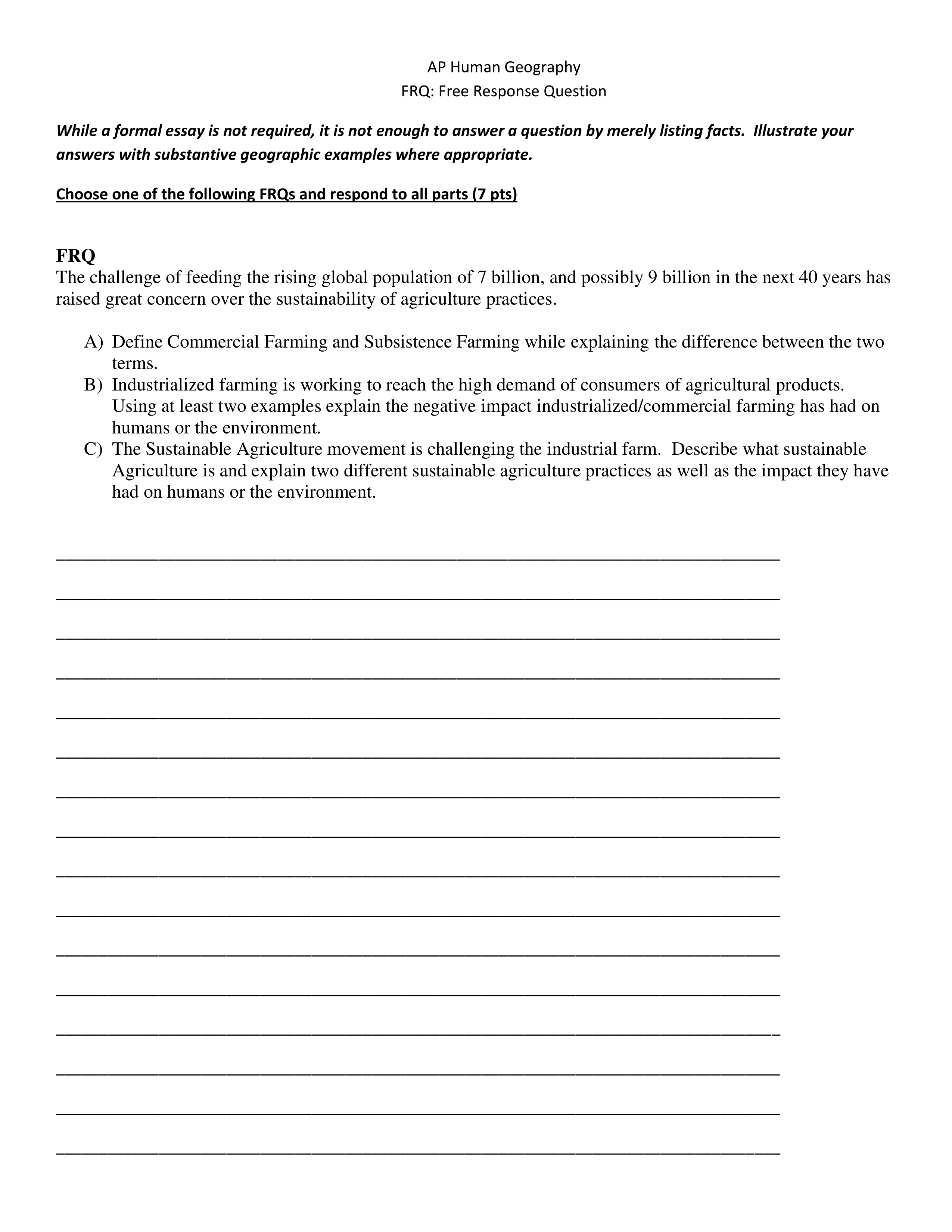
FRQ 1: A) Define Commercial Farming and Subsistence Farming while explaining the difference between the two terms.

2
3
1
1
1
1
1
1
1
Question 1
1.

Question 2
2.

Question 3
3.

Question 4
4.

Question 5
5.

Question 6
6.

Question 7
7.

Question 8
8.

Question 9
9.

Question 10
10.

Question 11
11.

Question 12
12.

Question 13
13.

Question 14
14.

Question 15
15.

Question 16
16.

Question 17
17.

Question 18
18.

Question 19
19.

Question 20
20.

Question 21
21.

Question 22
22.

Question 23
23.

Question 24
24.

Question 25
25.

Question 26
26.

Question 27
27.

Question 28
28.

Question 29
29.

Question 30
30.

Question 31
31.

Question 32
32.

Question 33
33.

Question 34
34.

Question 35
35.

Question 36
36.

Question 37
37.

Question 38
38.

Question 39
39.

Question 40
40.

Question 41
41.

Question 43
43.

FRQ 1: B) Industrialized farming is working to reach the high demand of consumers of agricultural products. Using at least two examples explain the negative impact industrialized/commercial farming has had on humans or the environment.

Question 44
44.

FRQ 1: C) The Sustainable Agriculture movement is challenging the industrial farm. Describe what sustainable Agriculture is and explain two different sustainable agriculture practices as well as the impact they have had on humans or the environment.
Question 45
45.

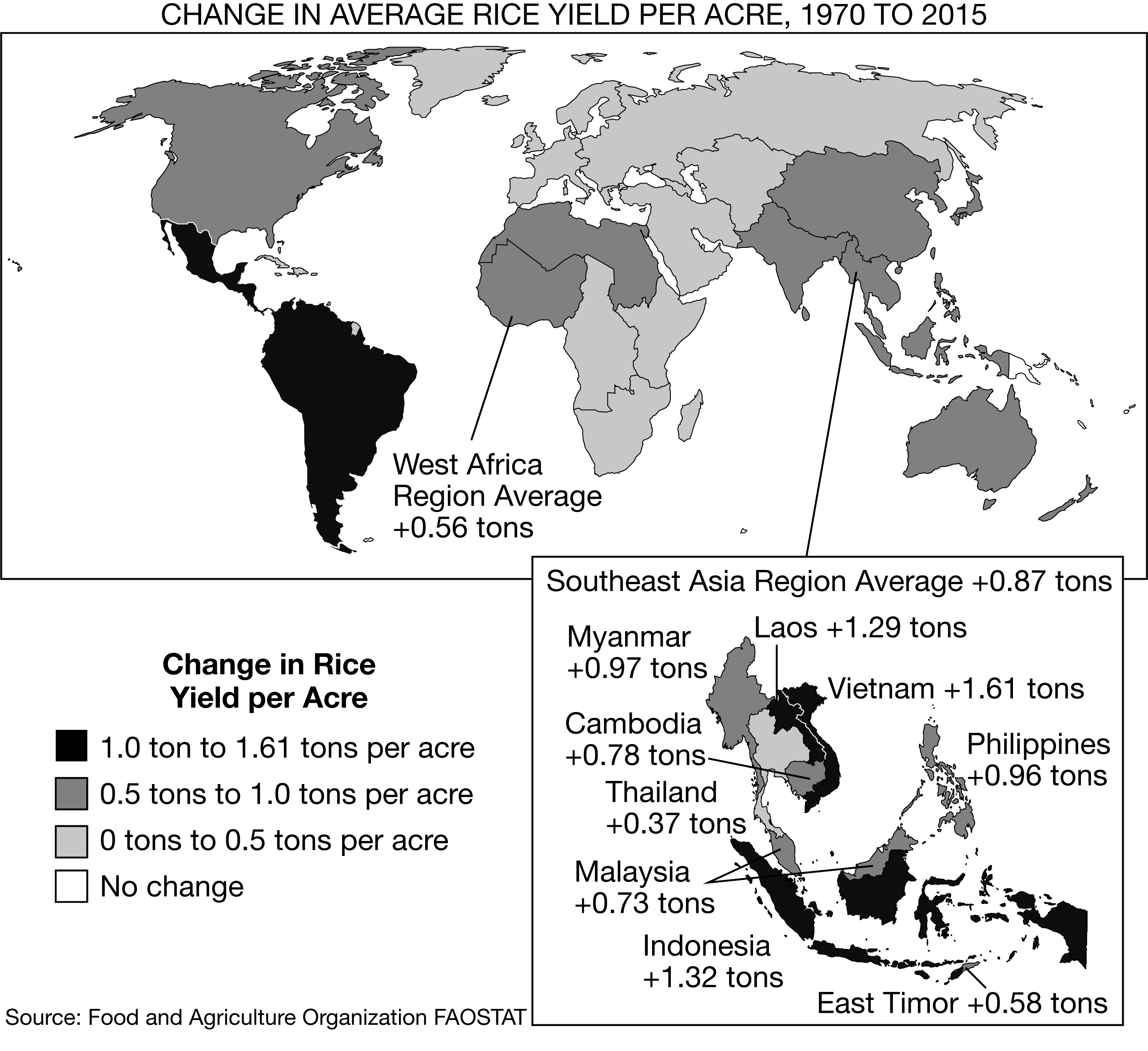
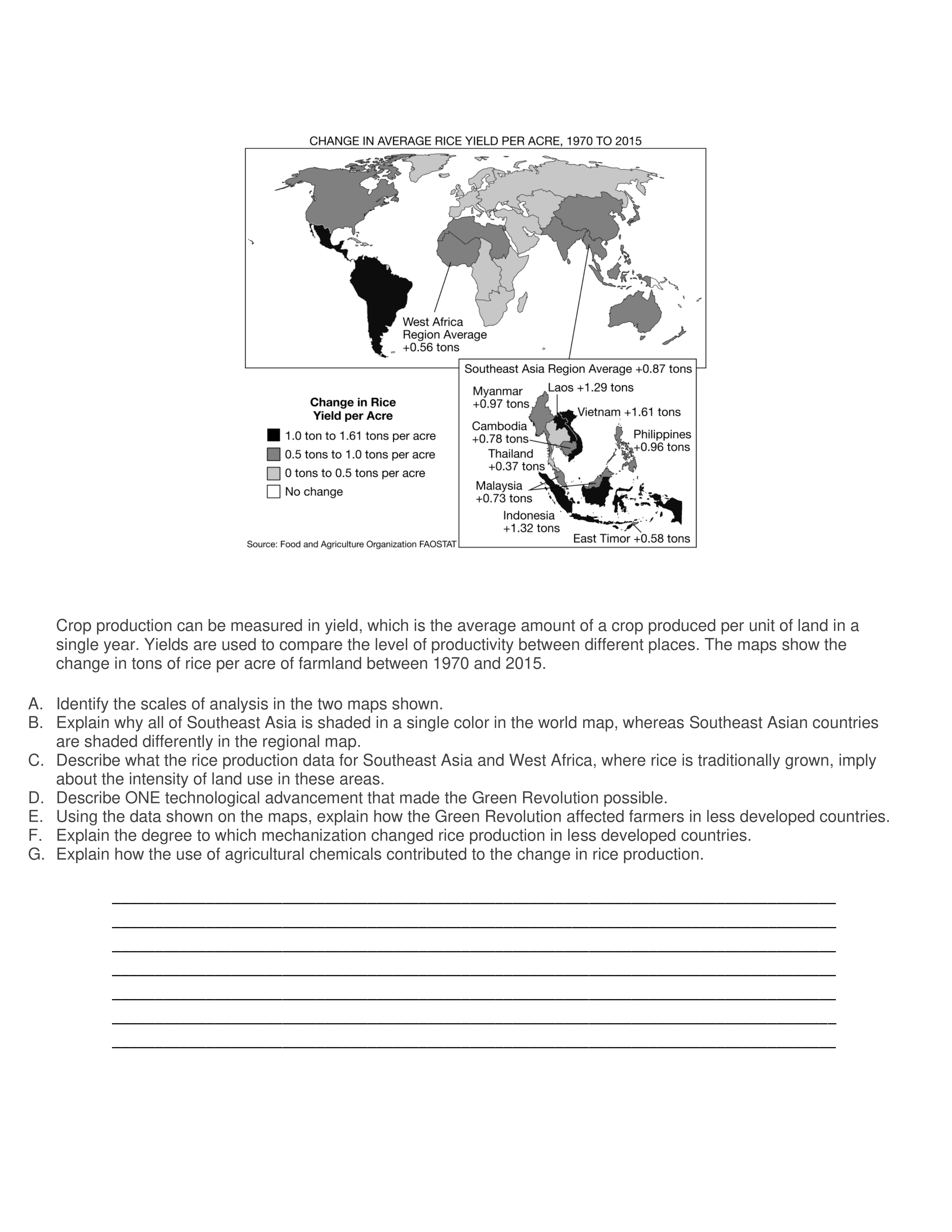
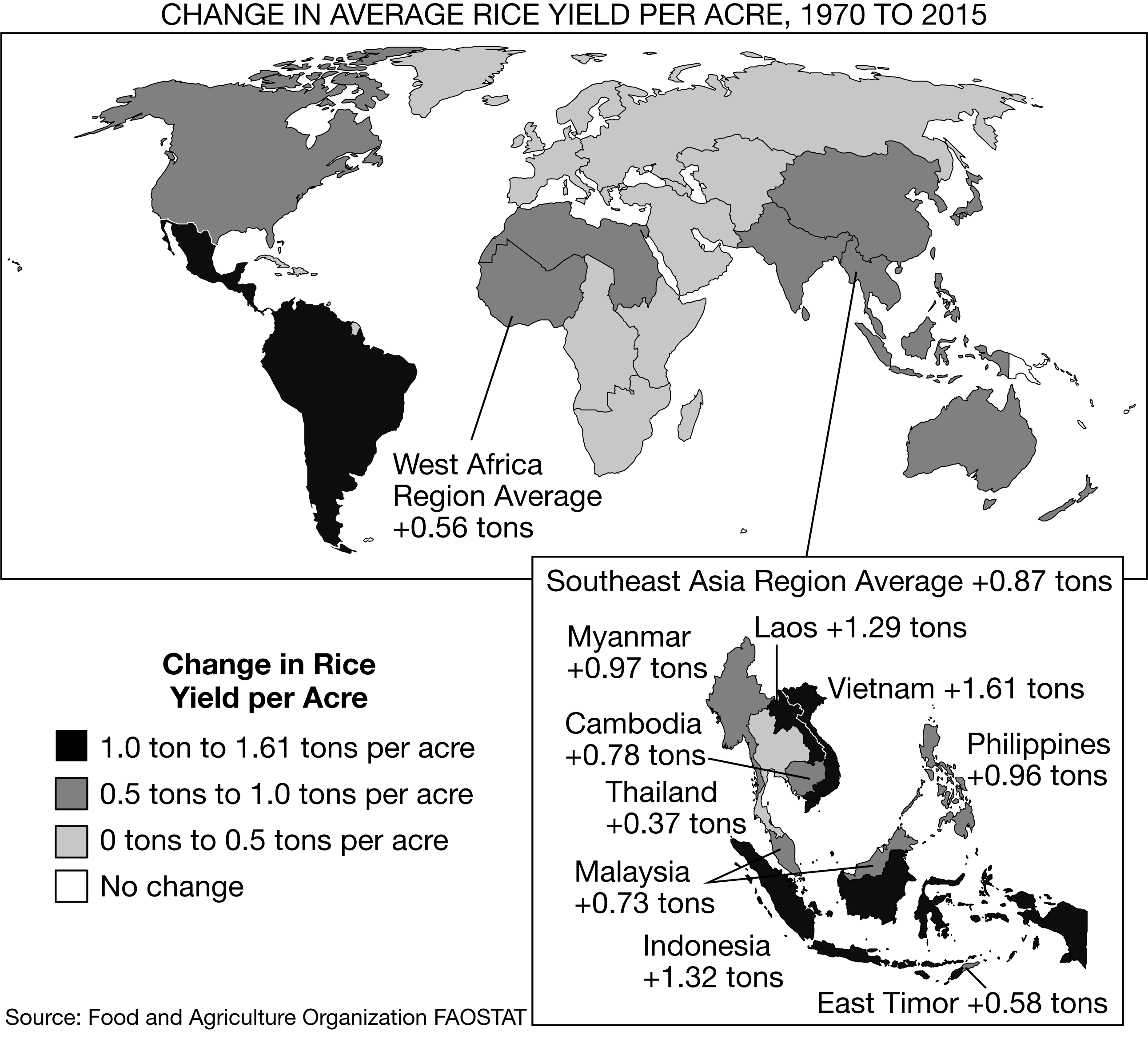
FRQ 2: A) Identify the scales of analysis in the two maps shown.
Question 46
46.

FRQ 2: B) Explain why all of Southeast Asia is shaded in a single color in the world map, whereas Southeast Asian countries are shaded differently in the regional map.

Question 47
47.

FRQ 2: C)
Describe what the rice production data for Southeast Asia and West Africa, where rice is traditionally grown, imply about the intensity of land use in these areas.

Question 48
48.

FRQ 2: D) Describe ONE technological advancement that made the Green Revolution possible.

Question 49
49.

FRQ 2: E) Using the data shown on the maps, explain how the Green Revolution affected farmers in less developed countries.

Question 50
50.

FRQ 2: F) Explain the degree to which mechanization changed rice production in less developed countries.

Question 51
51.

FRQ 2: G) Explain how the use of agricultural chemicals contributed to the change in rice production.

Which type of agriculture is found primarily in less developed countries?
Meiterranean
Plantation
Truck farming
Commercial gardening
Mechanized
Which type of agriculture is practiced by the largest percentage of the world's people?
hunting and gathering
shifting cultivation
pastoral nomadism
intensive subsistence
plantation
Which of the following is a typical practice in growing rice in Asia?
preparing fields with a plow drawn by oxen
Flooding the plowed field with water
growing seedlings in a nursery
transplanting seedlings into the flooded field
All of these answers are correct
Unlike other forms of commercial agriculture, plantations are
part of agribusiness
owned by day laborers in less developed countries.
found primarily in less developed countries.
situated in densely populated locations.
found primarily in more developed countries.
Which of the following have aided commercial farmers in MDCs?
transportation improvements and the rise of sea levels
scientific advances and the reduction in the need for electronics.
ancient irrigation projects that can be refitted for modern farming
transportation improvements, scientific advances, and electronics
The decline in the number of farmers in MDCs can best be described as a consequence of
push/pull economic factors, including the lack of opportunity in rural areas and higher-paying jobs in urban areas.
urban sprawl, including the development of rings of suburbs and exurbs around major metropolitan areas, which required larger amounts of farm production.
push/pull economic factors, including greater opportunities in rural areas and lower-paying jobs in urban areas.
the increase of populations in urban areas and the reduced population in rural areas.
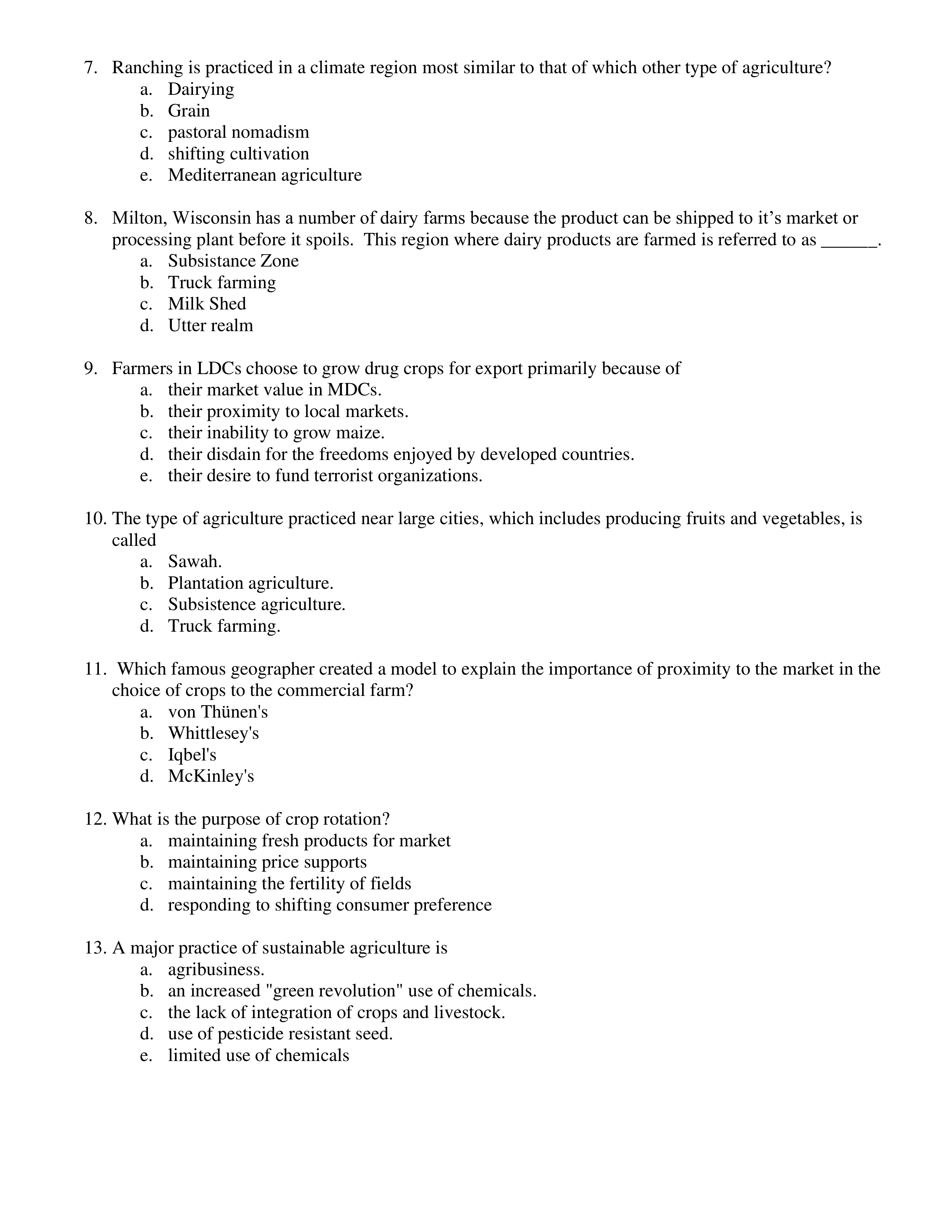
Ranching is practiced in a climate region most similar to that of which other type of agriculture?
dairying
grain
pastoral nomadism
shifting cultivation
mediterranean agriculture
Milton, Wisconsin has a number of dairy farms because the product can be shipped to it’s market or processing plant before it spoils. This region where dairy products are farmed is referred to as ______.
Subsistance Zone
Truck farming
Milk shed
Utter realm
Farmers in LDCs choose to grow drug crops for export primarily because of . . .
their market value in MDCs
their proximity to local markets
their inability to grow maize
their disdain for the freedoms enjoyed by developed countries
their desire to fund terrorist organizations
The type of agriculture practiced near large cities, which includes producing fruits and vegetables is called _________.
Sawah
Plantation agriculture
Subsistence agriculture
Truck farming
Which famous geographer created a model to explain the importance of proximity to the market in the choice of crops to the commercial farm?
von Thunen
Whittlesey
Iqbel
McKinley
What is the purpose of crop rotation?
maintain fresh products for market
maintaining price supports
maintaining the fertility of fields
responding to shifting consumer preference
A major practice of sustainable agriculture is . . .
agribusiness
an increased "green revolution" use of chemicals
the lack of integration of crops and livestock
use of pesticide resistant seeds
limited use of chemicals
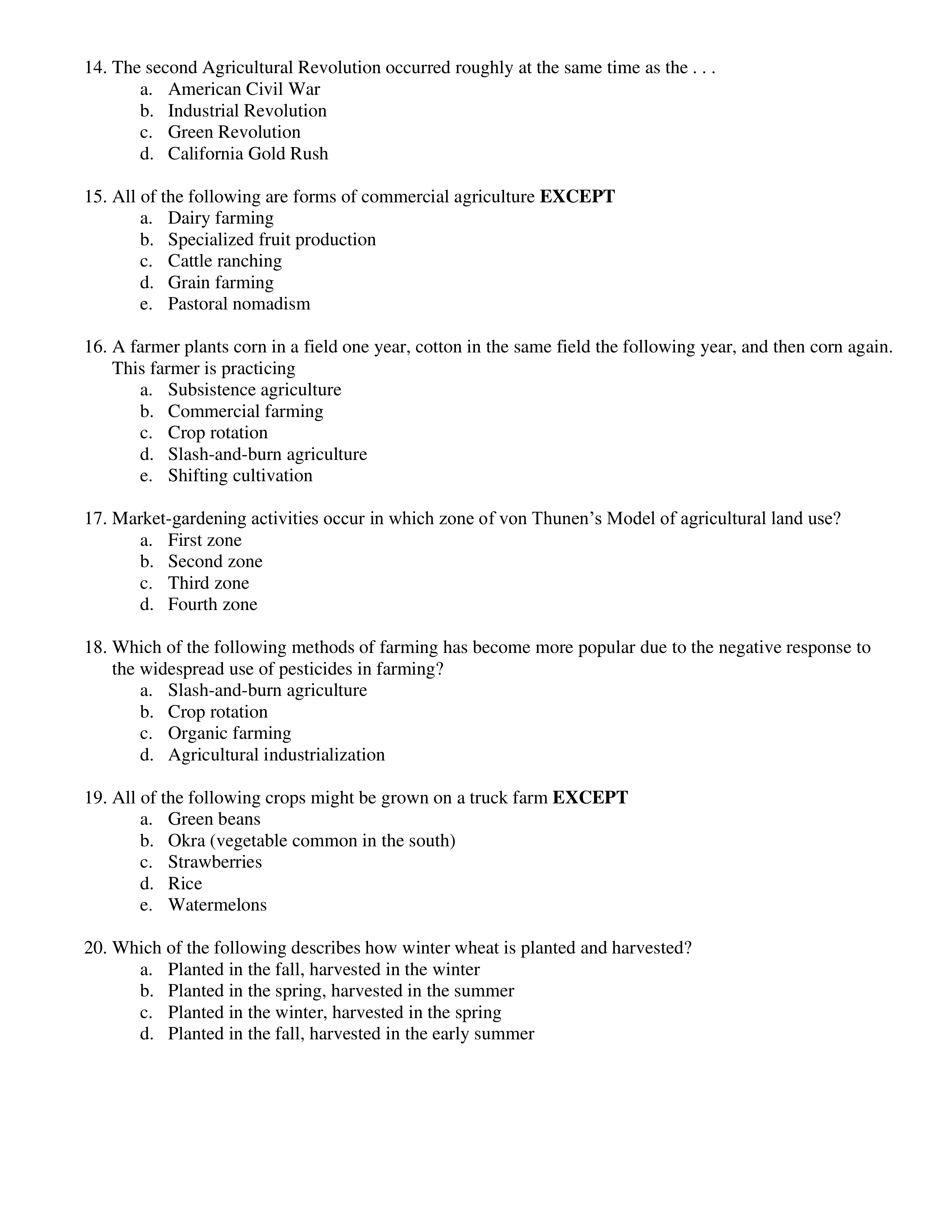
The second Agricultural Revolution occured roughly at the same time as the . . .
American Civil War
Industrial Revolution
Green Revolution
California Gold Rush
All of the following are forms of commercial agriculture EXCEPT
Dairy farming
Specialized fruit production
Cattle ranching
Grain farming
Pastoral nomadism
A farmer plants corn in a field one year, cotton in the same field the following year, and then corn again. This farmer is practicing
Subsistence agriculture
Commercial farming
Crop rotation
Slash-and-burn agriculture
Shifting cultivation
Market-gardening activities occur in which zone of von Thunen’s Model of agricultural land use?
First zone
Second zone
Third zone
Fourth zone
Which of the following methods of farming has become more popular due to the negative response to the widespread use of pesticides in farming?
Slash-and-burn agriculture
Crop rotation
Organic farming
Agricultural industrialization
All of the following crops might be grown on a truck farm EXCEPT
Green beans
Okra (vegetable common in the south)
Strawberries
Rice
Watermellon
Which of the following describes how winter wheat is planted and harvested?
planted in the fall, harvested in the winter
Planted in the spring, harvested in the summer
Planted in the winter, harvested in the spring
Planted in the fall, harvested in the early summer
All of the following crops are products of a Mediterranean agriculture EXCEPT
Olives
Grapes
Dates
Figs
Apples
1. Which of the following refers to the decision to abandon the use of a product that harms the environment and switch to a product that is more environmentally friendly?
Subsistence
Substitution principle
Sustainability
Recycling
In the preservationist land use model, people are encouraged to
Not alter the natural environment
Clear only land that is not currently in use
Raise only enough crops to feed the local population
Explore wilderness areas previously untouched.
The theory that people will do what is in their own best interest even when it is not in the best interest of the common good is called the
Theory of the common good
Theory of nonsustainability
Tragedy of the commons
Commedy of the anticommons
Which of the following is characterized by a commercial farm where no one lives and it is farmed by migrant workers?
Cottage industry farms
Suitcase farms
Long-lot farms
Organic farms
Which of the following is an example of the implementation of the sustainable land use model?
A logger who cuts down trees for lumber plants more trees.
A farmer plants a secondary crop in the space between the primary crops.
A farmer plants only what is needed to feed his or her family.
A herder moves from one location to another in order to find food for his or her herd.
All of the following states are located in the Corn Belt EXCEPT
Nebraska
Illinois
Indiana
Montana
A type of animal feeding operation (CAFO) that prepares an animal for slaughter by increasing the weight of the animal is called
Dairying
A grazing farm
A feedlot
A cattle drive
Which of the following is a benefit of industrial agriculture?
It uses fewer fossil fuels
It gives consumers more access to food.
It conserves water through irrigation
It increases the number of farming jobs
A crop grown for profit is called a __________.
Staple crop
Domesticated crop
Food crop
Primary crop
Cash crop
Which of the following is a practice of an extractive industry?
Cutting timber and forest regeneration
Mining for copper
Horse breeding
Growing soybeans
Fishing for salmon
A developer clears several acres of forest to make room for a shopping center. All traces of the original landscape have been eliminated. This is an example of ______.
Topicide
Sustainable development
Desertification
Agribusiness
The agricultural location model suggests that
Grain crops should lie closest to the market center to maximize profits
Ranching should lie closest to the market center to maximize profits
Vegetable farms should lie far from the market center to maximize profits
Dairying should lie closest to the market center to maximize profits.
The farming of oysters is an example of ____.
Polyculture
Hydroponics
Aeroponics
Aquaculture
Which of the following is NOT and example of a luxury crop?
Tea
Cacao
Tobacco
Wool
Coffee
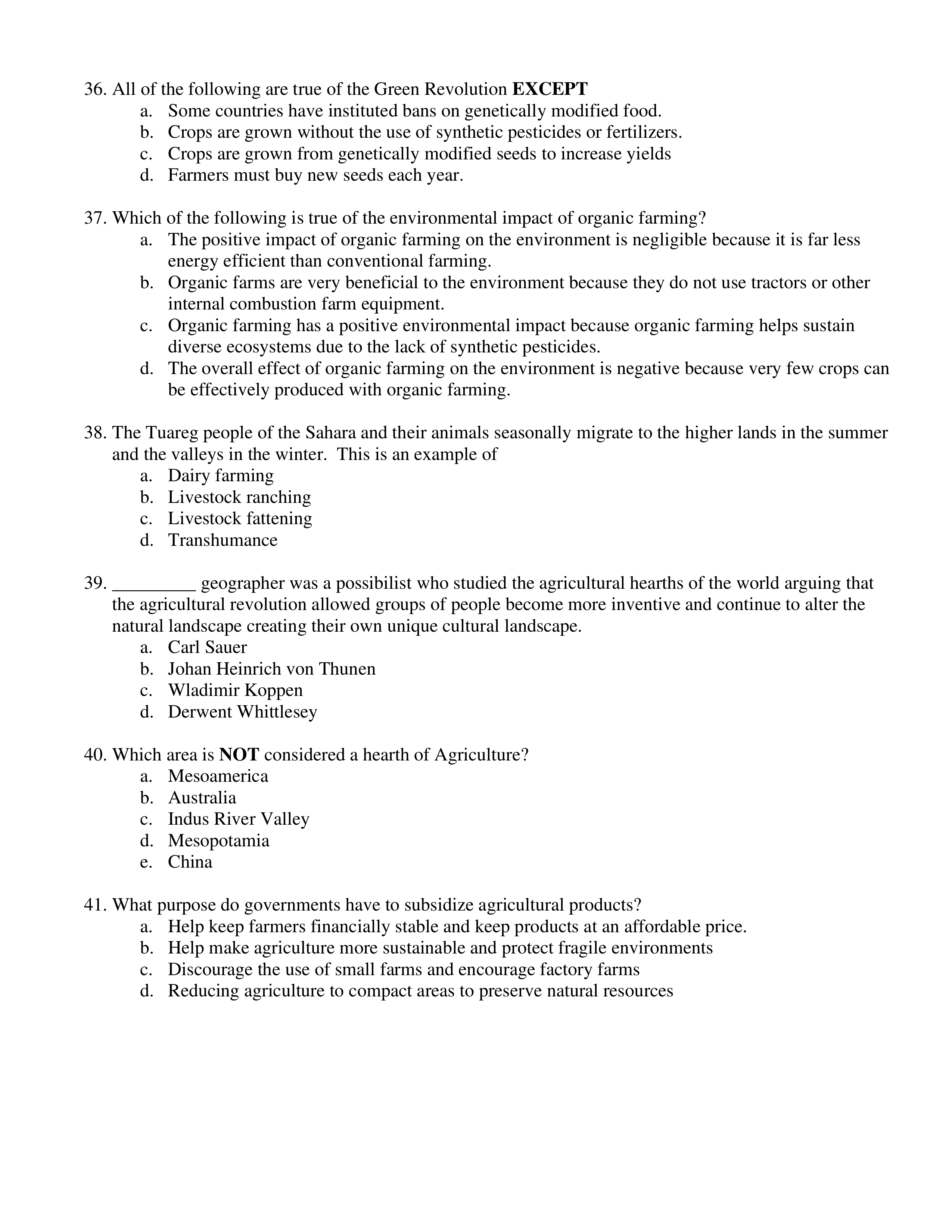
All of the following are true of the Green Revolution EXCEPT
Some countries have instituted bans on genetically modified food.
Crops are grown without the use of synthetic pesticides or fertilizers.
Crops are grown from genetically modified seeds to increase yields
Farmers must buy new seeds each year.
Which of the following is true of the environmental impact of organic farming?
A. The positive impact of organic farming on the environment is negligible because it is far less energy efficient than conventional farming.
B. Organic farms are very beneficial to the environment because they do not use tractors or other internal combustion farm equipment.
C. Organic farming has a positive environmental impact because organic farming helps sustain diverse ecosystems due to the lack of synthetic pesticides.
D. The overall effect of organic farming on the environment is negative because very few crops can be effectively produced with organic farming.
The Tuareg people of the Sahara and their animals seasonally migrate to the higher lands in the summer and the valleys in the winter. This is an example of
Dairy farming
Livestock ranching
Livestock fattening
Transhumance
_________ geographer was a possibilist who studied the agricultural hearths of the world arguing that the agricultural revolution allowed groups of people become more inventive and continue to alter the natural landscape creating their own unique cultural landscape.
Carl Sauer
Johan Heinrich von Thunen
Wladimier Koppen
Derwent Whittlesey
Which area is NOT considered a hearth of agriculture?
Mesoamerica
Australia
Indus River Valley
Mesopotamia
China
What purpose do governments have to subsidize agricultural products?
Help keep farmers financially stable and keep products at an affordable price.
Help make agriculture more sustainable and protect fragile environments
Discourage the use of small farms and encourage factory farms
Reducing agriculture to compact areas to preserve natural resources