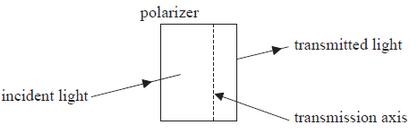
Which of the following facts about polarisation is correct?
2 points
2
Question 2
2.
Unpolarised light is incident upon two polarisers, which have an angle of θ between the planes of polarisation. If the original intensity is 300Wm−2, and the final intensity is 62Wm−2, what is the value of θ, to the nearest degree? Assume negligible change in distance from source. Give your answer without a unit.
1 point
1
Question 3
3.
Define plane polarized light
2 points
2
Question 4
4.
The intensity of plane polarised light, at 30∘ to the vertical is I. After passing through an analyser at 60∘ to the vertical, what is the intensity measured?
2 points
2
Question 5
5.
Polarized light is incident on a polarizer before it is observed.
Calculate the possible angle from the direction of the polarized light (in degrees) for which the polarizer could be oriented such that the intensity of observed polarized light is reduced to one-fourth of its original value?
4 points
4
Question 6
6.
State and explain two methods by which light can be polarized.
1 point
1
Question 7
7.
Light is incident on a polariser. The transmitted intensity is measured as the orientation of the
polariser is changed. In each of the following three outcomes, determine whether the incident light is polarised, partially polarised or completely unpolarised
Draggable item
arrow_right_alt
Corresponding Item
The intensity of the transmitted light varies
depending on the orientation of the polariser.
At a particular orientation, the transmitted
intensity is zero.
arrow_right_alt
Unpolarized light
The transmitted intensity varies as the
orientation varies, but it never becomes zero.
arrow_right_alt
Polarized light
The intensity of the transmitted light is the
same no matter what the orientation of the polariser.
arrow_right_alt
partially polarized light
Untitled Section
2 points
2
Question 8
8.
State Malus's law
1 point
1
Question 9
9.
Polarised light is incident on a polariser whose transmission axis makes an angle of 25° with the direction of the electric field of the incident light. Calculate the fraction of the incident light intensity that is transmitted through the polariser.
Untitled Section
2 points
2
Question 10
10.
Two polarisers have their transmission axes at right angles to each other.
a Explain why no light will get transmitted through the second polariser.
1 point
1
Question 11
11.
b A third polariser is inserted in between the first two. Its transmission axis is at 45° to the other two.
Determine whether any light will be transmitted by this arrangement of three polarisers.
1 point
1
Question 12
12.
c If the third polariser were placed in front of the first rather than in between the two, would your answer to b change?(1)
Untitled Section
4 points
4
Question 13
13.
Light of intensity I0is incident on a polarizer. The transmission axis of the polarizer is vertical. The polarizer is rotated by an angle θ about the direction of the incident light. The intensity of the transmitted light is measured for various angles θ.
On the axes below, sketch graphs to show the variation of the transmitted intensity I with θ when the incident light is
i. horizontally polarized
ii. Unpolarized
Untitled Section
2 points
2
Question 14
14.
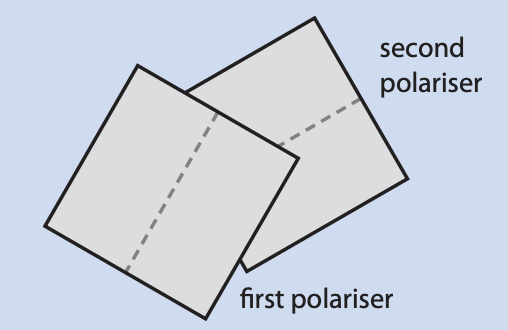
Vertically polarised light of intensity I0 is incident on a polariser that has its transmission axis at θ = 30° to the vertical.The transmitted light is then incident on a second polariser whose axis is at θ = 60° to the vertical, as shown in the figure.
Calculate the factor by which the transmitted intensity is reduced.
1 point
1
Question 15
15.
Unpolarised light of intensity I0 is incident on two polarisers, one behind the other, with parallel transmission axes.The first polariser is rotated by 30° clockwise and the second 30° counter-clockwise.What is the intensity transmitted?