Measuring poverty and inequality

Last updated over 4 years ago
11 questions

MEASURING POVERTY:

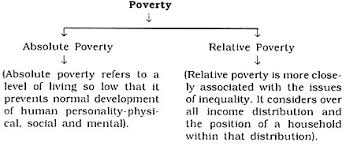
When it comes to poverty, we distinguish between absolute and relative poverty.
1

Think for a moment and try to come up with a number - what do you think, what should be the threshold for absolute poverty in Vietnam right now?
(income per person below which basic human needs cannot be met)

1

Now using this resource and find out what is the actual income under which a person is cosidered to be in absolute poverty in Indonesia. And what about relative poverty?

1

Summarise using Gini data the level of inequality in Vietnam. Is it getting better or worse?

Let's see how it looks on a global scale:

1

Go to the World Poverty Clock and find out how many people live in extreme (absolute) poverty right now?

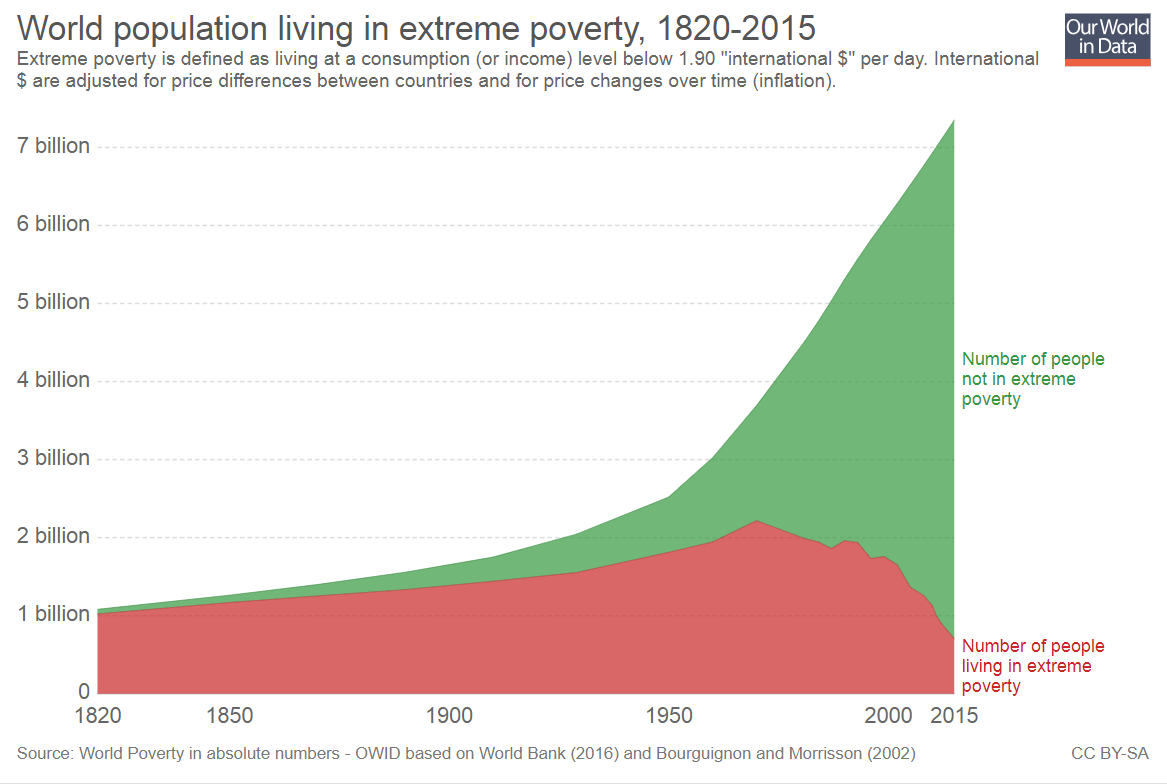
As you can see on the graph below, worldwide extreme (absolute) poverty is declining:
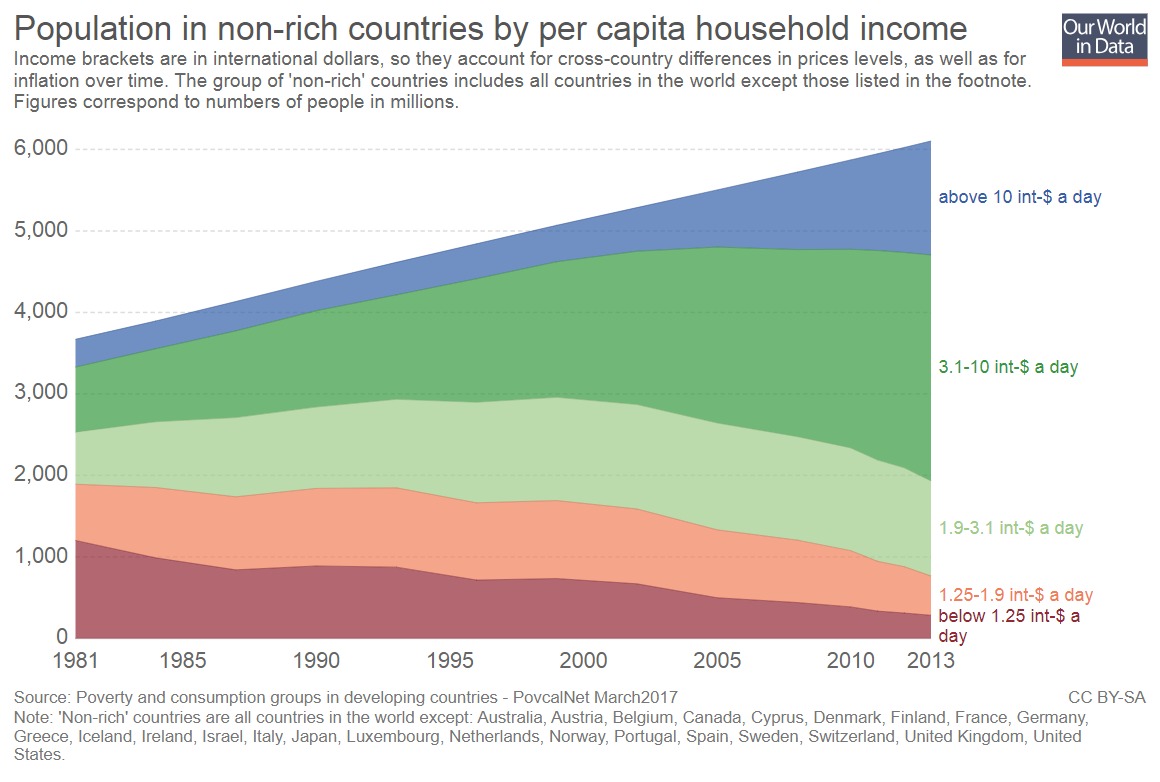
However, due to economic inequality billions still live for less than couple dollars a day:
MEASURING INEQUALITY:

Income inequality can be measured in three ways:

1) by comparing incomes od different quintiles of society

2) using Lorenz curve

3) with Gini coefficient

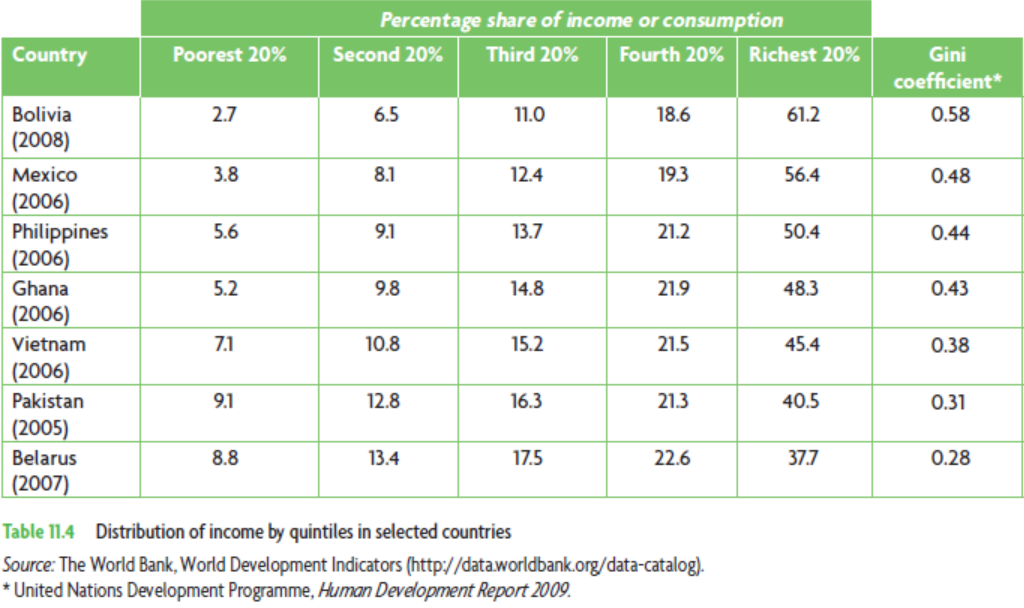
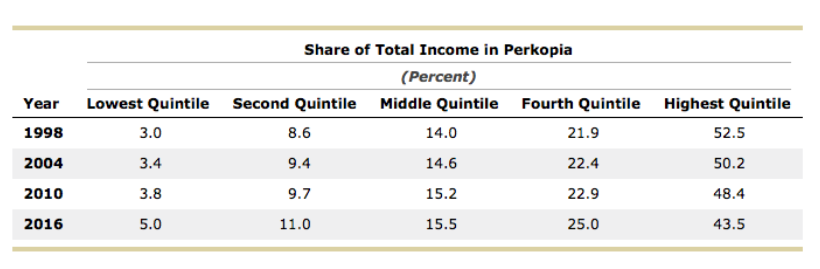
Let's begin with analysing this table:
1

The data in the table suggests that in years 1998-2016 income inequality in Perkopia was...

1

The data in the table suggests that in years 1998-2016 wealth inequality in Perkopia was...

1

If Pernukopia has
- steady population of 10,000
- steady total annual income of $1,200,000,000
- poverty line set at $1500

How many people were below the poverty line in 1998?

1

Which of the above countries has the most unequal distribution of income?

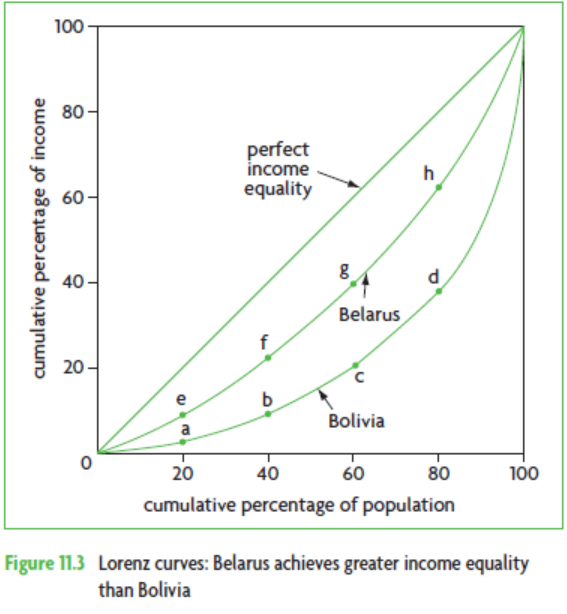
Income distribution can be presented using Lorenz curve. To construct a Lorenz curve, we draw a square box, where the vertical axis measures the total amount of income in an economy in cumulative percentages (therefore it runs from 0 to 100%), and the horizontal axis plots the total population in the economy, also in cumulative percentages (therefore this, too, runs from 0 to 100%).
(‘Cumulative’ means that 20 represents the poorest 20% of the population, 40 represents the poorest 40%, and so on.)

See the example:
The diagonal line in the diagram represents perfect equality in income distribution, as it shows that if income were perfectly equally distributed, 20% of the population would received 20% of income, 40% would receive 40% of income, and so on. The Lorenz curve plots the actual relationship between percentages of the population and the shares of income they receive.

The figure above plots two Lorenz curves, one for Bolivia, and one for Belarus (based on the data in Table 11.4). In
the case of Bolivia, the poorest 20% of the population receives 2.7% of income; this is shown by point a. Point b on Bolivia’s curve is obtained by adding the 2.7% of income of the poorest quintile to the 6.5% of income received by the second quintile, giving 9.2%, or the cumulative income of the bottom 40% of the population. Similarly, point c is obtained by adding the percentages of income received by the bottom three quintiles, giving 20.2% of income, and finally to find
point d we add the incomes of the bottom four quintiles, getting 38.8% of income for 80% of the population.

When these points are joined together starting from 0 and going up to 100% of the population, we obtain Bolivia’s Lorenz curve. Points e, f, g and h on Belarus’ curve are calculated and plotted in exactly the same way.

Note that to plot a Lorenz curve, we could use income distribution fi gures that divide the population into ten deciles (or tenths), or any other convenient subdivision.
1

Now, draw a Lorenz curve for Ghana:

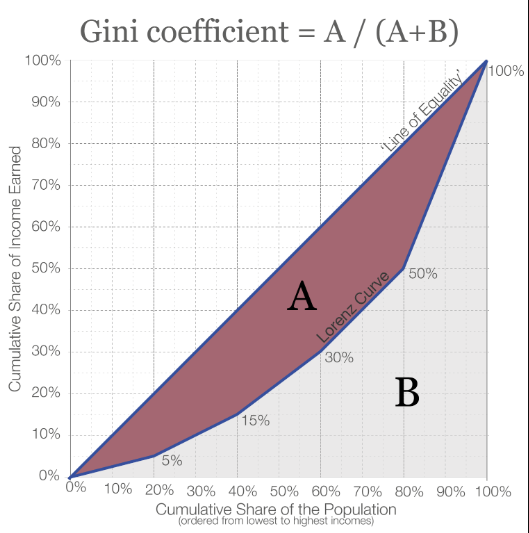
Third way to portray income inequality is by using Gini coefficient - named after Corrado Gini, an Italian statistician, who came up with a numerical measure of the information contained in the Lorenz curve of an economy.

Gini coefficient = area between diagonal and Lorenz curve / entire area under diagonal
as seen on the diagram below:
The Gini coefficient has a value between 0 and 1. If there were perfect income equality, the coefficient would be zero, since the numerator of the ratio would be zero.
The larger the Gini coefficient, and the closer it is to 1, the greater is the income inequality, since the further away is the Lorenz curve from the diagonal.
1

Inspect this data.

What are the three countries with the highest income inequality in the world (according to the World Bank)?
What's the Gini coefficient in these countries?
Do they have anything in common?

1

What are the three countries with the lowest income inequality in the world (according to the World Bank)?
What's the Gini coefficient in these countries?