Preskoči na glavni sadržaj
Prijava
Sign up for FREE
arrow_back
Biblioteka

Inflation: consequences and causes

star
star
star
star
star
Posljednje ažuriranje about 4 years ago
24 questions

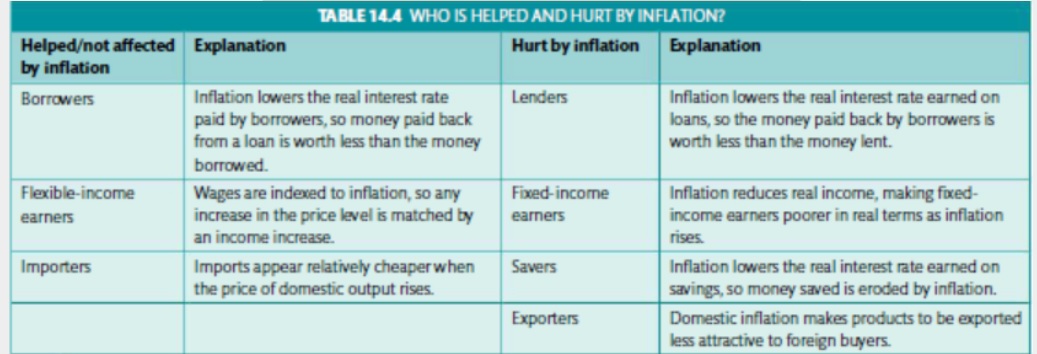
Let's start with some consequences of inflation. One of them is redistribution. Redistribution means moving income away from certain groups in the economy towards other groups.
1
1
1
1
1
1

Now we move to CAUSES of inflation. Watch a video of a historical example of demand-pull inflation and answer the questions below:

1
1
1
1
1
1
1
1

Draw a diagram showing cost-Push inflation and explain (reffering to the diagram) why is cost-push inflation considered as worse than demand-pull inflation.

1
1

Now you already have some idea about causes and consequences of inflation. Let's move on to some important terms related to inflation and to its impacts on our purchasing power.
1
1
1
1

Explain what happens to your real income (your purchasing power) in each of the following situations

(p. 278 might be useful)

Format of the answer: increases by x% or decreases by x% or stays unchanged

1
1
1
1
Pitanje 1
1.

Explain on an example why borrowers tend to be helped by inflation.

Pitanje 2
2.

Explain using examples who are 'fixed income' earners and why they lose when inflation occurs. Give at least 2 examples other than typical fixed wage-earner (Textbook!).

Pitanje 3
3.

'When inflation in our country is higher than elsewhere our firms will export less, but imports will be smaller as well, ceteris paribus.' Is it true? Why?

Pitanje 4
4.

At least one important group that loses during inflation and one that gains are missing in the table. Find them in the textbook and explain why the lose/gain?

Pitanje 5
5.

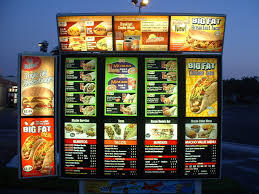
Apart from redistribution, there are some other consequences of inflation. The image above refers to one or them which one? Explain the mechanism.

Pitanje 6
6.

Why inflation leads to uncertainity? Do you agree that this might be considered as the biggest negative consequence of inflation? Why? Why not?

Pitanje 7
7.

What are the economic objectives that Kennedy managed to achieve?

Pitanje 8
8.

What does Vietnam war have to do with the economic situation in the US under Johnson?

Pitanje 9
9.

Why the author considers social programs under Kennedy as being beneficial for the economy and social programs under Johnson as being detrimental for the economy?

Pitanje 10
10.

Draw a diagram showing a demand-pull inflation (please label the y-axis better than the author did;).

Pitanje 11
11.

What does it mean that the economy gets 'overheated'?

Pitanje 12
12.

What does 'stagflation' stand for?

Pitanje 13
13.

What were the 2 events in the 70. that contributed to stagflation in th US (and elsewhere)?

Pitanje 14
14.

Why these events caused inflation - explain the mechanism:

Pitanje 15
15.

Diagram:

Pitanje 16
16.

Explanation:

Pitanje 17
17.

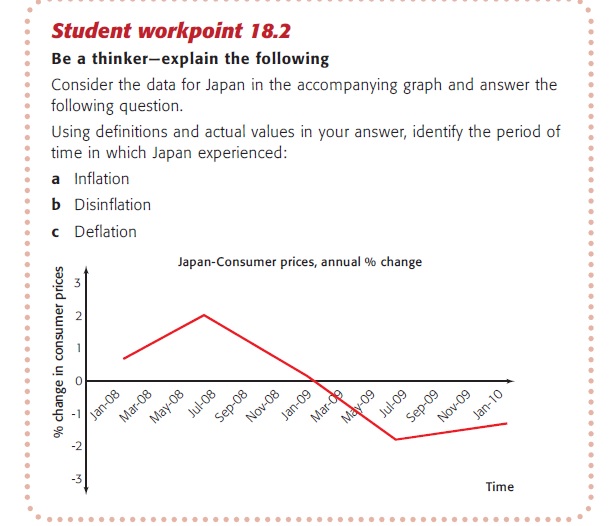
period when inflation occured (Format of the answer: Xyz-04 to Xyz-05)

Pitanje 18
18.

period when disinflation occured (Format of the answer: Xyz-04 to Xyz-05)

Pitanje 19
19.

Period when deflation occured (Format of the answer: Xyz-04 to Xyz-05)

Pitanje 20
20.

What is the difference between real income and nominal income?

Pitanje 21
21.

your nominal income increases by 5% and the rate of inflation is 8%. Real income:

Pitanje 22
22.

your nominal income falls by 10% and the rate of inflation is 3%. Real income:

Pitanje 23
23.

your nominal income increases by 5% and the rate of deflation is 3%. Real income:

Pitanje 24
24.

your nominal income increases from 1000zł to 1070zł and the rate of inflation is 7%. Real income: