How many bonding electrons are there present in a molecule of urea (pictured below)?
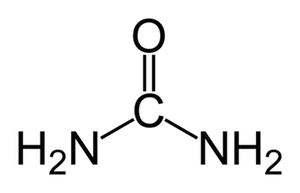
How many bonding electrons are there present in a molecule of urea (pictured below)?
Which pair of elements is most likely to form an ionic compound with each other?
Predict the formula for the compound that forms between aluminum and fluorine.
The name of the compound N2O4 is......
The correct name for K2S is.....
Manganese and chlorine form a compound whose name is manganese (IV) chloride. The correct formula for this compound is
Using the octet rule and the electron configurations of each element, identify and select all answers that explain what the elements C, N, and H need to do in order to achieve stability and form the compound HCN.
What does the number of dots in a Lewis Dot structure indicate about the atom?
Draw a model that shows how magnesium and chlorine combine to form a bond.
Start with the electron dot structure for magnesium and chlorine, then use a series of 2 or more drawings to show the electron movement (please note that there maybe more than 1 atom for either magnesium and chlorine).
Use any model appropriate for the bond type.
Using the octet rule and the electron configurations of each element, select all the answers that explain what the elements Na and O need to do in order to achieve stability.
Draw a model that shows how hydrogen, carbon, and nitrogen combine to form the compound CH3NH2
Start with the electron dot structures for hydrogen, carbon, and nitrogen , then use a series of 2 or more drawings to show the electron movement
Use any model appropriate for the bond type.
If a bond is formed when atoms share of electrons it is a __________ bond.
A bond that has a partial positive end and a partial negative end because of unequal sharing of electrons is called a _________ bond
How many bonding electrons are there present in a molecule of urea (pictured below)?
An unkown element is a soft, shiny solid at room temperature. It reacts with oxygen to form the compound XO. Which of the following is likely an identity for the unknown element?
Name the compound Mg(NO3)2
Name the compound FeBr3
Write the formula for vanadium (III) hydroxide. Use normal numbers for subscripts
Name the compound CS2
Write the formula for carbon tetrabromide. Use normal numbers for subscripts
Name the compound P4O10