Log in
Sign up for FREE
arrow_back
Library
U4 Livestock Reproduction
By Taylor Bryant
star
star
star
star
star
Share
share
Last updated about 5 years ago
43 questions
Add this activity
1
1
1
1
1
1
1
1
1
1
1
1
1
1
1
1
1
1
1
1
1
1
1
1
1
1
1
1
1
1
1
1
1
1
1
1
1
1
1
1
1
1
1
Question 1
1.
Maturation of Sperm Cells take
10 - 15 Days
20 - 30 Days
40 Days
50 Days
Question 2
2.
What is the main purpose of the epididymis?
Create fructose
Create sperm cells
Maturation of sperm cells
Question 3
3.
Accessory Glands produce more than ____ of total ejaculation volume.
75%
85%
95%
Question 4
4.
In ejaculation volume, the seminal vesicles accounts for the production of
secretion of cleansing fluid
secretion of enzymes
secretion of fructose
Question 5
5.
In ejaculation volume, the prostate gland accounts for the production of
secretion of cleansing fluid
secretion of enzymes
secretion of fructose
Question 6
6.
In ejaculation volume, the cowper's gland accounts for the production of
secretion of cleansing fluid
secretion of enzymes
secretion of fructose
Question 7
7.
Which muscle is responsible for extending the penis
Sigmoid Flexure
Retractor Muscle
Question 8
8.
An Ovary produces ova or eggs at the following rate
50,000 - 150,000 a day
50,00 - 150,000 a month
50,000 - 150,000 a year
50,000 - 150,000 a lifetime
Question 9
9.
The Broad Ligament is responsible for
Controlling the muscle contractions of the vagina
Holding the reproductive track in place
Holding the ovaries in place
Question 10
10.
Which is not the purpose use of the uterus.
serve as a passageway for sperm cells to the egg
provides a barrier to the external environment
produce a histotroph
site of pregnancy
Question 11
11.
What organ is made of ringed tissue to serve as a receptacle for semen?
Cervix
Vagina
Vulva
Question 12
12.
What organ is the opening of the female reproductive tract
Cervix
Vagina
Vulva
Question 13
13.
The anterior pituitary gland regulates
Stress
Growth
Reproduction
Lactation
All of the Above
Question 14
14.
The FSH regulates
Stress
Growth
Reproduction
Lactation
Question 15
15.
The LH regulates
Stress
Growth
Reproduction
Lactation
Question 16
16.
What is puberty
The stage during which the animal becomes sexually mature
The period in which the female is receptive to mating.
Question 17
17.
What is estrus?
The stage during which the animal becomes sexually mature
The period in which the female is receptive to mating.
Question 18
18.
What are the stages of estrus? (mark all that apply)
Estrus Phase
Progesterone Phase
Follicular Phase
Luteal Phase
Prostaglandin Phase
Question 19
19.
What are the factors to determine bred maturity?
Physical Size
Vulva Size
Age
Testicle Size
Breed Standards
Question 20
20.
What is conception?
Question 21
21.
Which best describes Natural Breeding?
Male animal copulates with female animal
Female releases many eggs during ovulation because of FSH injections
Semen is collected and stored
During estrus, previously collected semen is inserted into female reproductive tract
Eggs are fertilized by natural or artificial mating
After conception, embryos are collected from female and transferred to other females (recipients) for gestation
Question 22
22.
Which best describes Embryo Transfer?
Male animal copulates with female animal
Female releases many eggs during ovulation because of FSH injections
Semen is collected and stored
During estrus, previously collected semen is inserted into female reproductive tract
Eggs are fertilized by natural or artificial mating
After conception, embryos are collected from female and transferred to other females (recipients) for gestation
Question 23
23.
Which best describes AI?
Male animal copulates with female animal
Female releases many eggs during ovulation because of FSH injections
Semen is collected and stored
During estrus, previously collected semen is inserted into female reproductive tract
Eggs are fertilized by natural or artificial mating
After conception, embryos are collected from female and transferred to other females (recipients) for gestation
Question 24
24.
What is a Gene?
Unit of inheritance carrying traits inherited by offspring through reproduction
Genes are divided into sections
Component of the gene that controls inheritance
Question 25
25.
What is a DNA
Unit of inheritance carrying traits inherited by offspring through reproduction
Genes are divided into sections
Component of the gene that controls inheritance
Question 26
26.
What is a Chromosomes?
Unit of inheritance carrying traits inherited by offspring through reproduction
Genes are divided into sections
Component of the gene that controls inheritance
Question 27
27.
Which is not true about Chromosomes?
Found in the nucleus of cell
Carry the genes
Occur in singles
Question 28
28.
Dominant Genes
Gene that is overshadowed by a gene
One gene overshadows the other
Question 29
29.
Recessive Genes
Gene that is overshadowed by a gene
One gene overshadows the other
Question 30
30.
Homozygous
possesses both of the same genes
possesses the dominant trait phenotypically but genotypically contains one recessive gene.
physically will show dominant trait
TT or Tt or tt
Question 31
31.
Heterozygous
possesses both of the same genes
possesses the dominant trait phenotypically but genotypically contains one recessive gene.
physically will show dominant trait
TT or Tt or tt
Question 32
32.
Phenotype
possesses both of the same genes
possesses the dominant trait phenotypically but genotypically contains one recessive gene.
physically will show dominant trait
TT or Tt or tt
Question 33
33.
Genotype
possesses both of the same genes
possesses the dominant trait phenotypically but genotypically contains one recessive gene.
physically will show dominant trait
TT or Tt or tt
Question 34
34.
EPD
Based on a measurement of how well the bull’s offspring perform.
A measurement of genetic potential based on the performance of relatives.
Done from an ultrasound of the actual bull.
Based on how well the bull’s offspring have performed on the rail.
Question 35
35.
Performance-based
Based on a measurement of how well the bull’s offspring perform.
A measurement of genetic potential based on the performance of relatives.
Done from an ultrasound of the actual bull.
Based on how well the bull’s offspring have performed on the rail.
Question 36
36.
Carcass-based
Based on a measurement of how well the bull’s offspring perform.
A measurement of genetic potential based on the performance of relatives.
Done from an ultrasound of the actual bull.
Based on how well the bull’s offspring have performed on the rail.
Question 37
37.
Ultrasound
Based on a measurement of how well the bull’s offspring perform.
A measurement of genetic potential based on the performance of relatives.
Done from an ultrasound of the actual bull.
Based on how well the bull’s offspring have performed on the rail.
Question 38
38.
Culling
Should be culled from the herd based on the great productivity of their offspring.
Should be culled from the herd based on the poor productivity of their offspring.
Question 39
39.
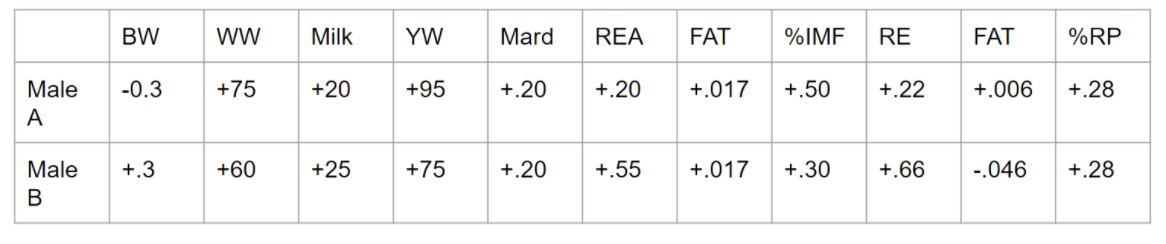
How much more will Bull B weight at birth than Bull A?
Question 40
40.
How much more will Bull A weight at weaning than Bull B?
Question 41
41.
Which bull would be a better bull for heifers?
Male A
Male B
Question 42
42.
Which bull has a bigger Rib-eye Area?
Male A
Male B
Question 43
43.
Which bull has the largest Yearly Weaning Weight
Male A
Male B