Motion Test
star
star
star
star
star
Last updated over 6 years ago
30 Nsɛmmisa
Hyɛ no nsow a efi ɔkyerɛwfo no hɔ:
Unit test over Motion for Physical Science
1
1
1
1
1
1
1
1
1
1
1
1
1
1
1
1
1
1
1
1
1
1
1
1
1
1
1
1
1
1
Unit test over Motion for Physical Science
Which of the following would reduce the resistance of a metal wire?
A region that has a large number of atoms whose magnetic fields are lined up parallel to a magnet's field is
Which wave causes the medium to vibrate only in a direction parallel to the wave's motion?
A passenger in the rear seat of a car moving at a steady speed is at rest relative to
Which distance can be most accurately measured with a ruler?
A person walks 1 mile every day for exercise, leaving her front porch at 9:00 AM and returning to her front porch at 9:25 AM. What is the total displacement of her daily walk?
A person drives north 3 blocks, then turns east and drives 3 blocks. The driver then turns south and drives 3 blocks. How could the driver have made the distance shorter while maintaining the same displacement?
A ball is rolled uphill a distance of 3 meters before it slows, stops, and begins to roll back. The ball rolls downhill 6 meters before coming to rest against a tree. What is the magnitude of the ball's displacement?
Speed is the ratio of the distance an object moves to
Instantaneous speed is measured
A car traveled 88 km in 1 hour, 90 km in the next 2 hours, and then 76 km in 1 hour before reaching its destination. What was the car's average speed?
A horizontal line on a distance-time graph means the object is
What is the speed of a bobsled whose distance-time graph indicates that it traveled 100 m in 25 s?
The rate at which velocity changes is called
Which example identifies a change in motion that produces acceleration?
Objects in free fall near the surface of the Earth experience
Suppose you increase your walking speed from 1 m/s to 3 m/s in a period of 2 s. What is your acceleration?
An object moving at 30 m/s takes 5 s to come to a stop. What is the object's acceleration?
The slope of a speed-time graph indicates
Distance is a measure of length. What information does displacement give in addition to distance?
What types of changes in motion cause acceleration?
During a race, a runner runs at a speed of 6 m/s. Four seconds later, she is running at a speed of 10 m/s. What is the runner's acceleration? Show your work and please circle your answer.
If you ride your bike at an average speed of 2 km/h and need to travel a total distance of 20 km, how long will it take you to reach your destination? Show your work and please circle your answer.
A girl walks from her home to a friend's home 3 kilometers north. She then walks east 2 km to the post office, 1 km north to the library, and 1 km east to the park. From the park, she walks 2 km west to the movie theater. After the movie, she walks 4 km south to the pet store.
a. What is the girl's displacement from her starting point to the pet store?
b. Calculate the distance she walked in kilometers.
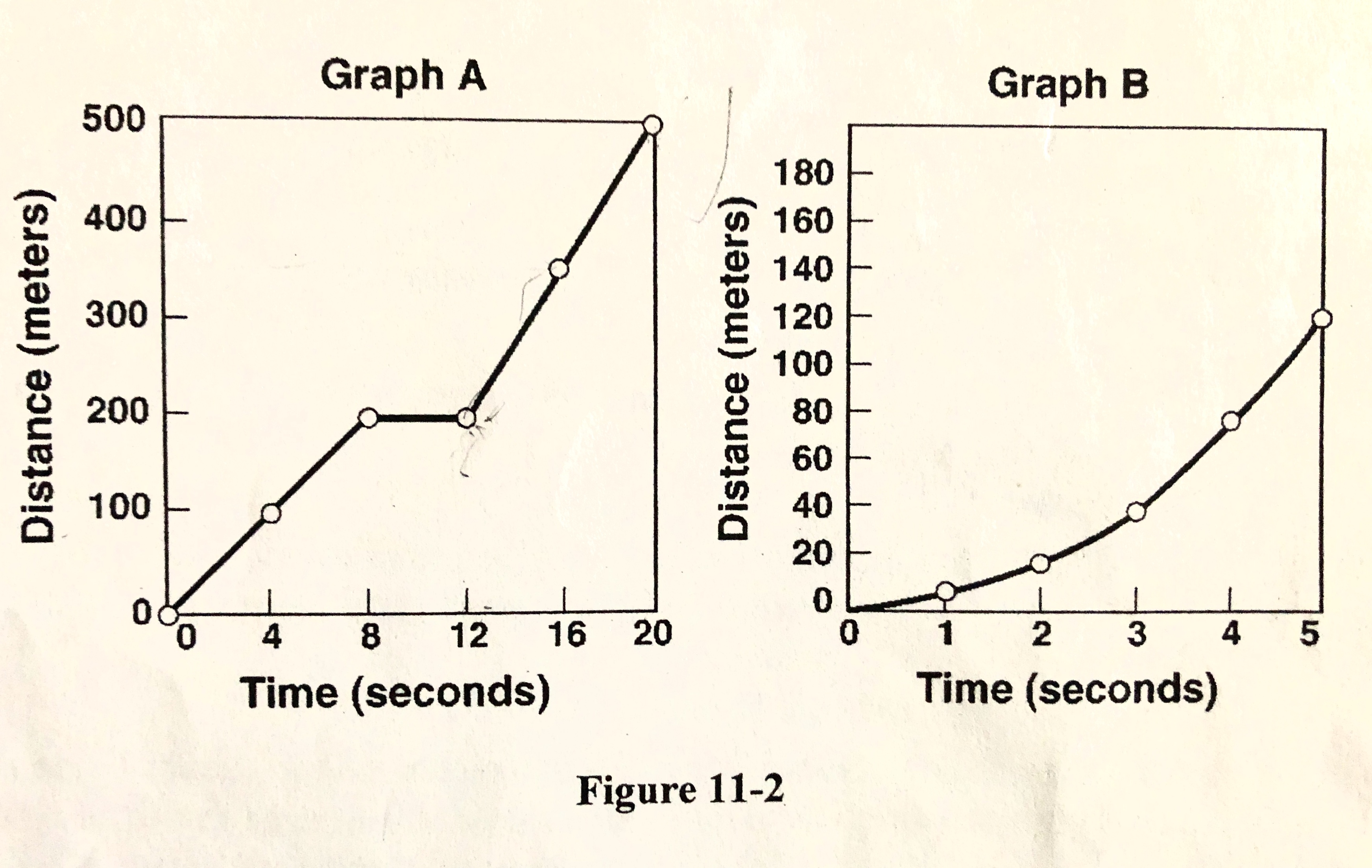
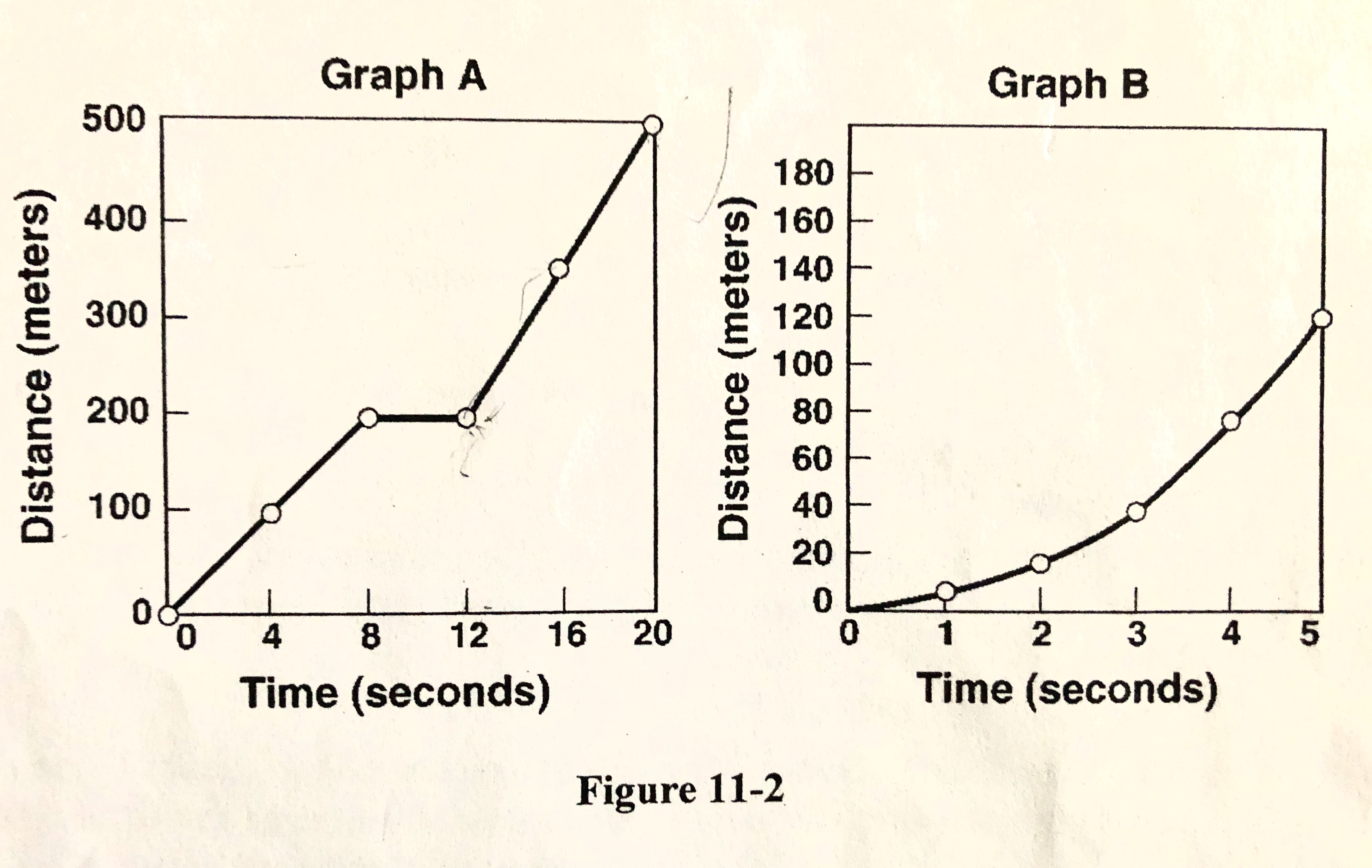
Which graph in Figure 11-2 shows periods of constant speed? Explain your answer.
Look at Figure 11-2. Describe the motion of the object in Graph A?
Which graph in Figure 11-2 shows acceleration? How do you know?
Using Graph A in Figure 11-2, calculate the average speed of the object in motion from 12 s to 20 s. Show your work and please circle your answer.
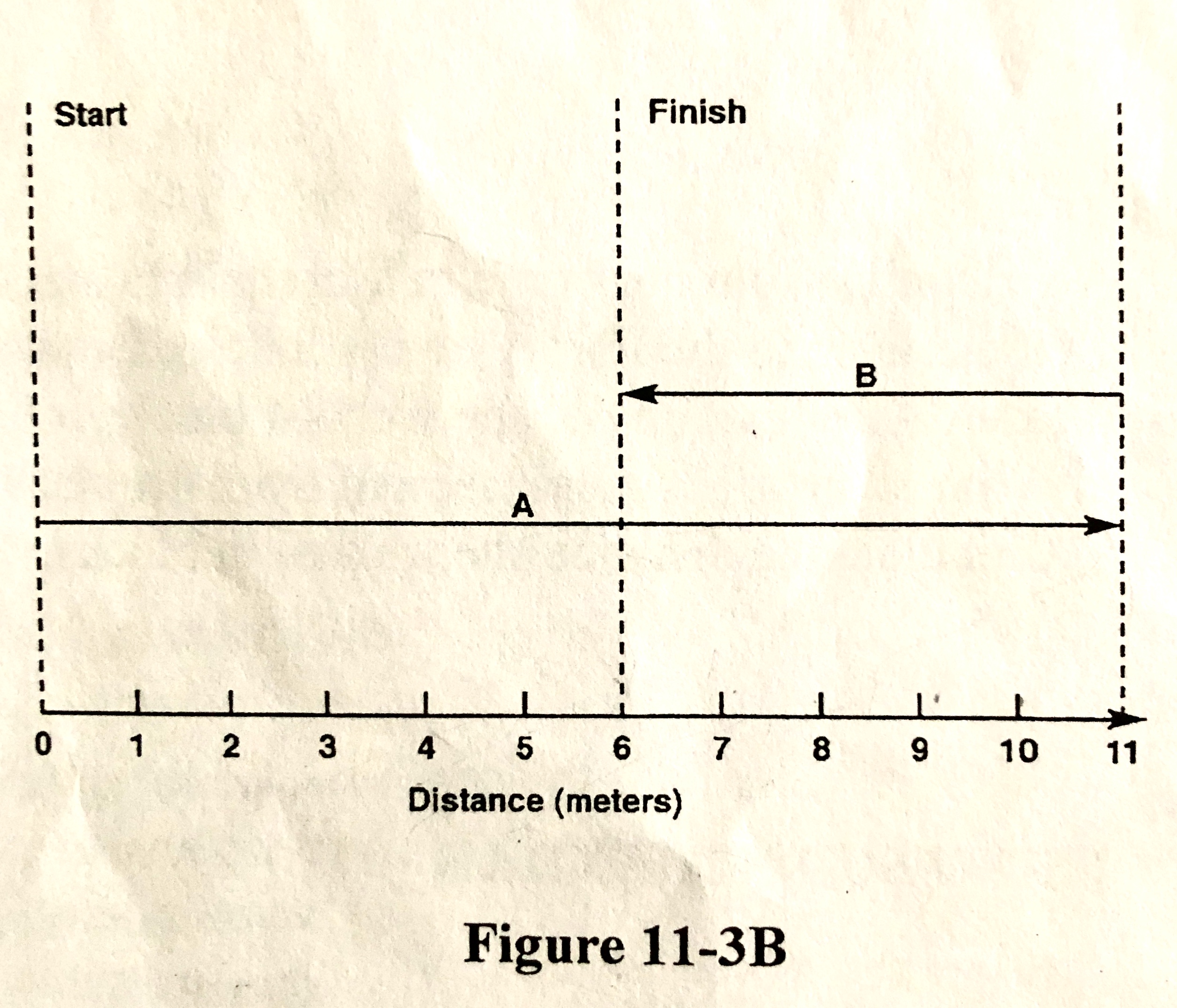
Figure 11-3B illustrates the displacement of an object moving in a plane. Explain what information is provided by arrows A and B.
Using vector addition, for the object represented in Figure 11-3B, calculate
a. the distance traveled by the object and
b. the displacement of the object.