Do Now: Is it possible to make race cars even faster? ( 5 minutes)

Do Now: Is it possible to make race cars even faster? ( 5 minutes)
Directions: The goal of this activity is to determine how the mass of an object impacts the acceleration when a constant force is exerted on the object.
Procedure: Using a simulation of a spring scale, students will pull a cart along a path measured. The simulation will give you the measure of time each second. There will be two different trials run. The force is going to be 2N. Trial 1 will use a cart with 5 Kg; Trial 2 will use a cart with 10 Kg.
What is the mass in the first trial
What is the force in the first trial
Create a data table of the first trial, posicion (m) and time (s)
Using the data, create a graph showing distance and time for Trial 1
What is the mass in the second trial
What is the force in the second trial
Create a data table of the second trial, posicion (m) and time (s)
Using the data, create a graph showing distance and time for Trial 2.
Using the data, create a graph showing distance and time for Trial 1 and Trial 2 together
Acceleration can be calculated by dividing the force applied to the object (in Newtons) by the mass of the object (in kilograms). Use the force and mass you recorded to calculate the rate of acceleration for each trial. The formula is f=ma a=f/m
Acceleration can be calculated by dividing the force applied to the object (in Newtons) by the mass of the object (in kilograms). Use the force and mass you recorded to calculate the rate of acceleration for each trial. The formula is f=ma a=f/m
Find the force applied to a box of 2Kg, if the acceleration is 4m/s2

The formula used to support Newton’s second law of motion is force = mass * acceleration (f = ma).
Using the information in this demonstration, write a scientific claim for the relationship of mass and acceleration on an object when the force is held constant.
Using the information in this demonstration, write a scientific claim for the relationship of mass and acceleration on an object when the force is held constant.
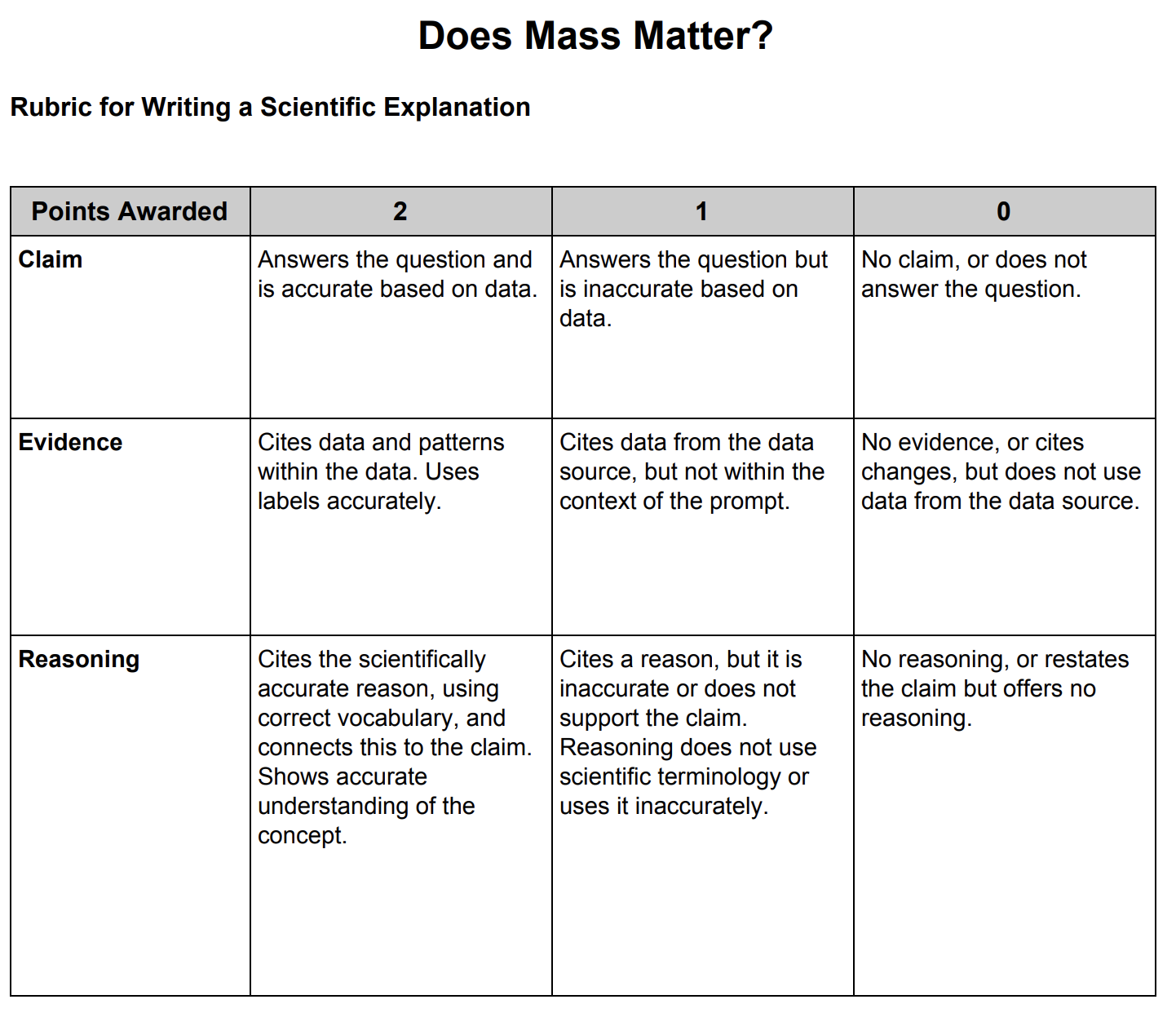
Claim
Evidence
Reasoning