Log in
Sign up for FREE
arrow_back
Library
IGCSE PE Mock Exam
By Peter Dawson
star
star
star
star
star
Share
share
Last updated almost 6 years ago
41 questions
Add this activity
1
1
1
1
3
3
2
3
3
3
2
2
2
1
2
3
2
2
1
4
2
2
3
4
2
2
2
3
2
2
6
2
3
2
4
2
3
4
4
2
2
Question 1
1.
State ONE example of a closed skill.
Question 2
2.
Name ONE food source that is rich in carbohydrate?.
Question 3
3.
State the type of motivation usually associated with a performer who only plays to win a trophy.
Question 4
4.
State ONE piece of personal saftey equipment, other than footwear, that can prevent injury in a named team game.
Please name the team game and the piece of equipment.
Question 5
5.
Describe three reasons why a coach should regularly test the fitness of a performer.
Question 6
6.
Describe three benefits of a cool down.
Question 7
7.
Explain why closed skills are usually easier to learn than open skills.
Question 8
8.
Describe how arousal can affect performance.
Question 9
9.
The diagrams, A to C, show performers from different sports.
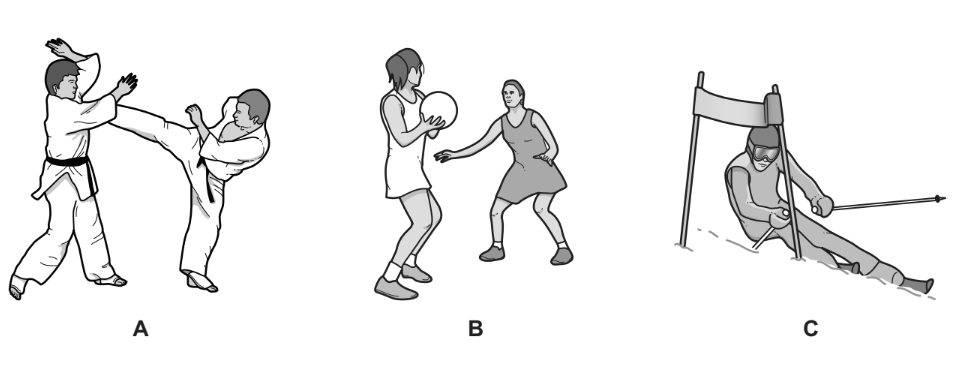
For each sport name a different component of skill related fitness and explain why it is required.
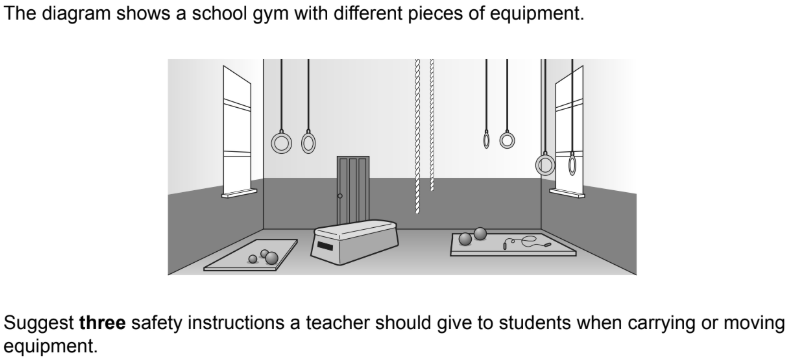
Question 10
10.
Describe gaseous exchange in the lungs.
Question 11
11.
Describe the long-term effects of regular aerobic training on the respiratory syatem
Question 12
12.
Suggest two factors a coach should consider when planning a six-week exercise
programme for a person who has a low level of fitness.
Question 13
13.
Describe the short-term improvements that could result from using the exercise
programme.
Question 14
14.
Elite athletes often spend periods of time living and training at altitude.
State the component of fitness that is most likely to improve as a result of periods of
time spent at altitude.
Question 15
15.
Explain the long-term benefits to an athlete of living and training at altitude.
Question 16
16.
Suggest difficulties an athlete may experience when living and training at altitude.
Question 17
17.
Describe how playing sports can contribute to a person’s mental well-being.
Question 18
18.
Suggest the main differences in the diet required by an elite sprinter and an elite endurance athlete and give reasons for your answer.
Question 19
19.
Name a training method that should be used by a person who is preparing for a
5000-metre (5K) charity run and has a low level of fitness.
Question 20
20.
State the advantages and disadvantages of using this type of training for the person.
Question 21
21.
Training can involve different types of muscle contraction.
Name
two
types of muscle contraction.
Question 22
22.
Describe the advantages of using exercises to improve
one
named type of muscle contraction.
Write the type of muscle contraction and then the advantage of using exercise to improve it.
Question 23
23.
Question 24
24.
Question 25
25.
Question 26
26.
Describe two benefits of elevating an injured limb.
Question 27
27.
Explain how limited channel capacity affects the learning of a skill.
Question 28
28.
Some stimulants are banned performance-enhancing drugs.
Suggest three effects of taking a stimulant on an athlete.
Question 29
29.
Question 30
30.
Describe possible improvements to a sprinter's performance from using weight training.
Question 31
31.
Explain factors that may affect the fitness of a performer.
Question 32
32.
Circuit training can be used in a variety of ways.
(i) State two factors that need to be considered when planning a circuit-training programme.
Question 33
33.
(ii) Explain how three training principles can be applied to a circuit-training programme.
Question 34
34.
Describe two examples of the skeleton providing protection for major organs.
Question 35
35.
An athlete performs well in training but then suffers a decline in performance when taking part in
competitions.
Suggest reasons why.
Question 36
36.
Explain, using an example, what is meant by the term intrinsic motivation.
Question 37
37.
State three ways a coach could make feedback more effective for a performer who is learning a new skill
Question 38
38.
Suggest four negative effects on a performer of not setting appropriate goals for their training programme.
Question 39
39.
Question 40
40.
State two parts of the World Health Organization’s definition of health.
Question 41
41.
Describe two examples of the skeleton providing protection for major organs.