Log in
Sign up for FREE
arrow_back
Library
5AT L17
By Megan Calamaras
star
star
star
star
star
Share
share
Last updated almost 6 years ago
6 questions
Add this activity
1
1
1
1
1
1
Question 1
1.
How long was the longest whale measured?
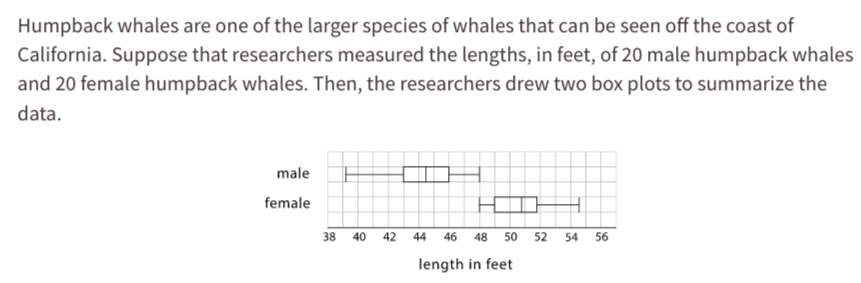
The longest whatle was about 39 feet long
The longest whale was about 55 feet long
The longest whale was between 52 and 55 feet long
The longest whale was 48 feet long
Question 2
2.
Was this whale male or female?
Female
Male
Cannot tell from this data set
Question 3
3.
What was a typical length for the male humpback whales that were measured?
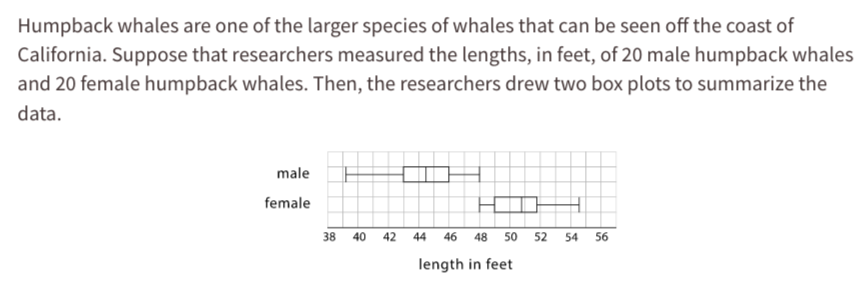
A typical male humpback whale was about 48 feet long
A typical male humpback whale was about 51 feet long
A typical male humpback whale was about 43 feet long
A typical male humpback whale was about 44.5 feet long.
Question 4
4.
Do you agree with each of the following statements about the whales that were measured? Explain your reasoning.
More than half of male humpback whales measured were longer than 46 feet.
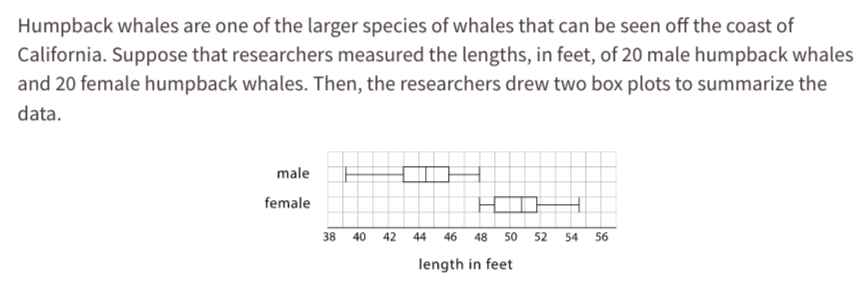
Disagree. The upper quartile of the data for the male humpbacks is 46 feet, which means a quarter of the whales are longer than 46 feet.
Disagree. The upper quartile of the data for the male humpbacks is 44.5 feet, which means a quarter of the whales are longer than 46 feet.
Agree. The lower quartile of the data for the male humpbacks is 43 feet, which means a quarter of the whales are less than 46 feet.
Agree. The lower quartile of the data for the male humpbacks is 51 feet, which means a quarter of the whales are less than 46 feet.
Question 5
5.
The male humpback whales tended to be longer than female humpback whales.
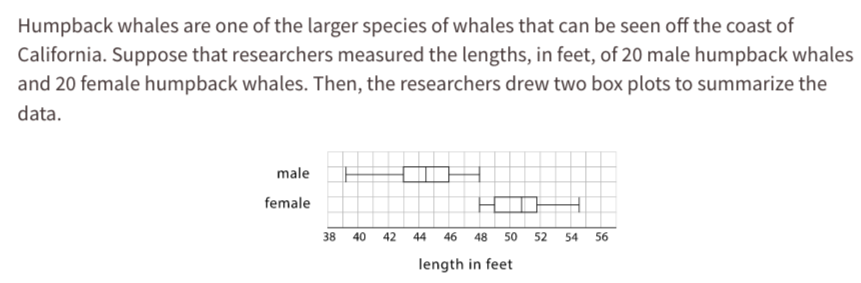
Agree. The entire distribution for the lengths of male humpback whales is greater than that for female humpbacks, so male humpback whales tend to be longer than their female counterparts.
Agree. The male humpback whale's Q1 distribution is considerably wider than that of the female humpback whale. This shows that male humpback whales tend to be longer.
Disagree. The spread is not evenly distributed nor is it symmetrical.
Disagree. The entire distribution for the lengths of female humpbacks is greater than that for male humpbacks, so female humpback whales tend to be longer than their male counterparts.
Question 6
6.
The lengths of the male humpback whales tended to vary more than the lengths of the female humpback whales.
Agree. The IQR of the data for male humpbacks is slightly greater than that for female humpbacks, and the range of the data for the males is larger than that for females, so the lengths of male humpbacks tend to vary more.
Agree. The mean for male humpack whales is greater than that for female humpbacks, so I can infer that the distribution is greater.
Disagree. The IQR of the data for female humpbacks is greater than that for male humpbacks, and the range of the data for the females is larger than that for males, so the lengths of the female humpbacks tend to vary more.
Disagree. The minimum value for humpback females lands on the maximum value for the male humpbacks. This shows that the distributions are exactly the same.