You need to be able to use the following words in your response: wavelength, Wavefronts, aperture/obstacle.
2 points
2
Question 2
2.
The figure shows plane water waves in a ripple tank approaching a narrow gap, the size of which is approximately the same as the wavelength of the waves.
a.On the figure draw the pattern of the wavefronts emerging from the gap.
b.State how the wavelength of the waves could be shortened.
2 points
2
Question 3
3.
a.Describe how the pattern of wavefronts emerging from the gap would change if the size of the gap were significantly increased.
b.State why, under normal circumstances, light seems to travel in a straight line and does not appear to be diffracted.
2 points
2
Question 4
4.
In two separate experiments monochromatic light is incident on a single slit. The diagrams show the diffraction patterns obtained on a screen far from the slit. In the top diagram the wavelength of light is λ1 and the slit width is b1. In the bottom diagram the wavelength of light is λ2 and the slit width is b2.

In each experiment the distance between the slit and the screen is the same.
Which of the following may be deduced?( your working is needed to support the correct response)
2 points
2
Question 5
5.
What changes are observed in a diffraction pattern if the whole apparatus is immersed in water?Explain
2 points
2
Question 6
6.
Explain how the diffraction pattern changes when white light is used instead of a monochromatic light passing through a slit? You can pick one of the following choices(a,b,c,d) and use it to further explain your answer:
a) The pattern will no longer be visible
b) The shape of the pattern will change from hyperbolic to circular
c) The colored pattern will be observed with a white bright fringe at the center
d) The bright and dark fringes will change position
4 points
4
Question 7
7.
Two loudspeakers emit identical sound waves of frequency 850Hz (Take the speed of sound in air to be 340ms-1).
An observer is 8.1m from the first source and 8.7m from the second.
a.Describe and explain what the observer hears.
b.The observer now moves to 8.2m from the first source and 9.0m from the second.
Describe and explain what he hears now.
2 points
2
Question 8
8.
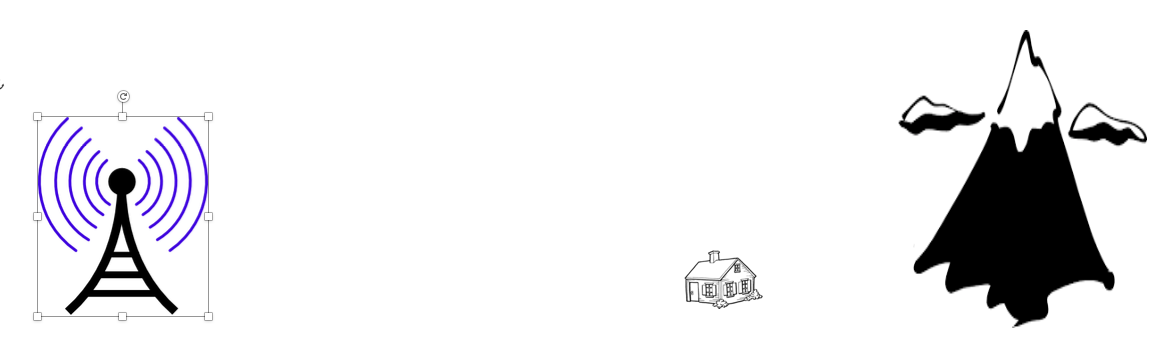
A radio station emits radio waves of wavelength 1600m which reach a house directly. Some radio waves also reach the house after being reflected by a mountain behind the house (see diagram).
If the radio reception at the house is poor, estimate the shortest possible distance from the house to the mountain?
7 points
7
Question 9
9.
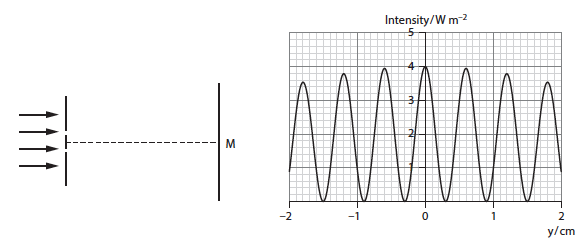
In a two-slit experiment, red light is incident on two parallel slits. The light is observed on a screen far from
the slits. The graph shows how the intensity of the light on the screen varies with distance y from M.
a.The two slits are separated by a distance of 0.39mm and the screen is 3.2 m from the slits.
Determine the wavelength of light used in this experiment.(2)
b.The red light is replaced by blue light. Suggest the effect on the separation of the fringes on the screen.(2)
c. State the feature of the graph that enables you to deduce that the slit width is negligible.(1)
d.One of the slits is covered. Describe the appearance of the pattern on the screen.(2)
3 points
3
Question 10
10.
A single slit is illuminated by a monochromatic (single colour) light source. A screne is placed 5.0 m away from this slit and two very narrow, parallel slits, 0.5 mm apart, are placed half way between the single slit and the screen. Interference fringes are visible on the screen and 10 fringe spaces measure 20 mm on the screen.
a)Determine the wavelength of the light(2)
b)Predict happens if you use double slits with half the spacing between them?(1)
8 points
8
Question 11
11.
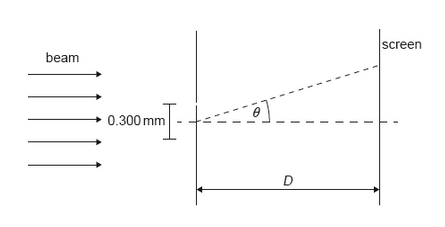
A beam of coherent monochromatic light from a distant galaxy is used in an optics experiment on Earth.
The beam is incident normally on a double slit. The distance between the slits is 0.300 mm. A screen is at a distance D from the slits. The diffraction angle θ is labelled.
The air between the slits and the screen is replaced with water. The refractive index of water is 1.33.
A series of dark and bright fringes appears on the screen.
a.Explain how a dark fringe is formed.[3]
b.The wavelength of the beam as observed on Earth is 633.0 nm. The separation between a dark and a bright fringe on the screen is 4.50 mm. Calculate D. [2]
c.Calculate the wavelength of the light in water.[1]
d.State two ways in which the intensity pattern on the screen changes.[2]
1 point
1
Question 12
12.
A single slit of width 1.50 μm is illuminated with
light of wavelength 500.0 nm. Determine the angular width of the central maximum. (Use the approximate formula.)
1 point
1
Question 13
13.
In a single-slit diffraction experiment the slit width is 0.12 mm and the wavelength of the light used is 6.00 × 10⁻⁷ m. Calculate the width of the central maximum on a screen 2.00 m from the slit.
Untitled Section
1 point
1
Question 14
14.
The intensity pattern for single-slit diffraction is shown in the diagram. (The vertical units are arbitrary.) The wavelength of the light used is λ.
a Find the width of the slit b in terms of λ.
1 point
1
Question 15
15.
The intensity pattern for single-slit diffraction is shown in the diagram. (The vertical units are arbitrary.) The wavelength of the light used is λ.
b On a copy of the axes draw a graph to show how intensity varies with diffraction angle for a slit with:
width b/2 and wavelength λ
(You do not need numbers on the intensity axis.)
1 point
1
Question 16
16.
The intensity pattern for single-slit diffraction is shown in the diagram. (The vertical units are arbitrary.) The wavelength of the light used is λ.
b On a copy of the axes draw a graph to show how intensity varies with diffraction angle for a slit with: