Quiz 10.1-10.5 ACC
star
star
star
star
star
Last updated over 6 years ago
20 Nsɛmmisa
Find the probability of rolling a 5 on a 6-sided number cube.
How many license plates are possible using the format: ABC 1234 (All digits and letters can repeat).
In creating a 5-digit password, Joey followed these rules:
The first digit could not be a 0 or 1.
The second, third and fourth digit could be any digit from 0-9.
The fifth digit could not be a 0. How many different passwords are possible?
Find the probability of rolling a number less than 5 on a 6-sided number cube.
A die numbered 1-6 is rolled and a coin is tossed. Make a table showing the sample space below.
Find P(odd, tails)
A marble is chosen from a bag containing 2 blue marbles, 3 green marbles, 6 red marbles, and 1 white marble. Compute P(blue or red).
P(green) =
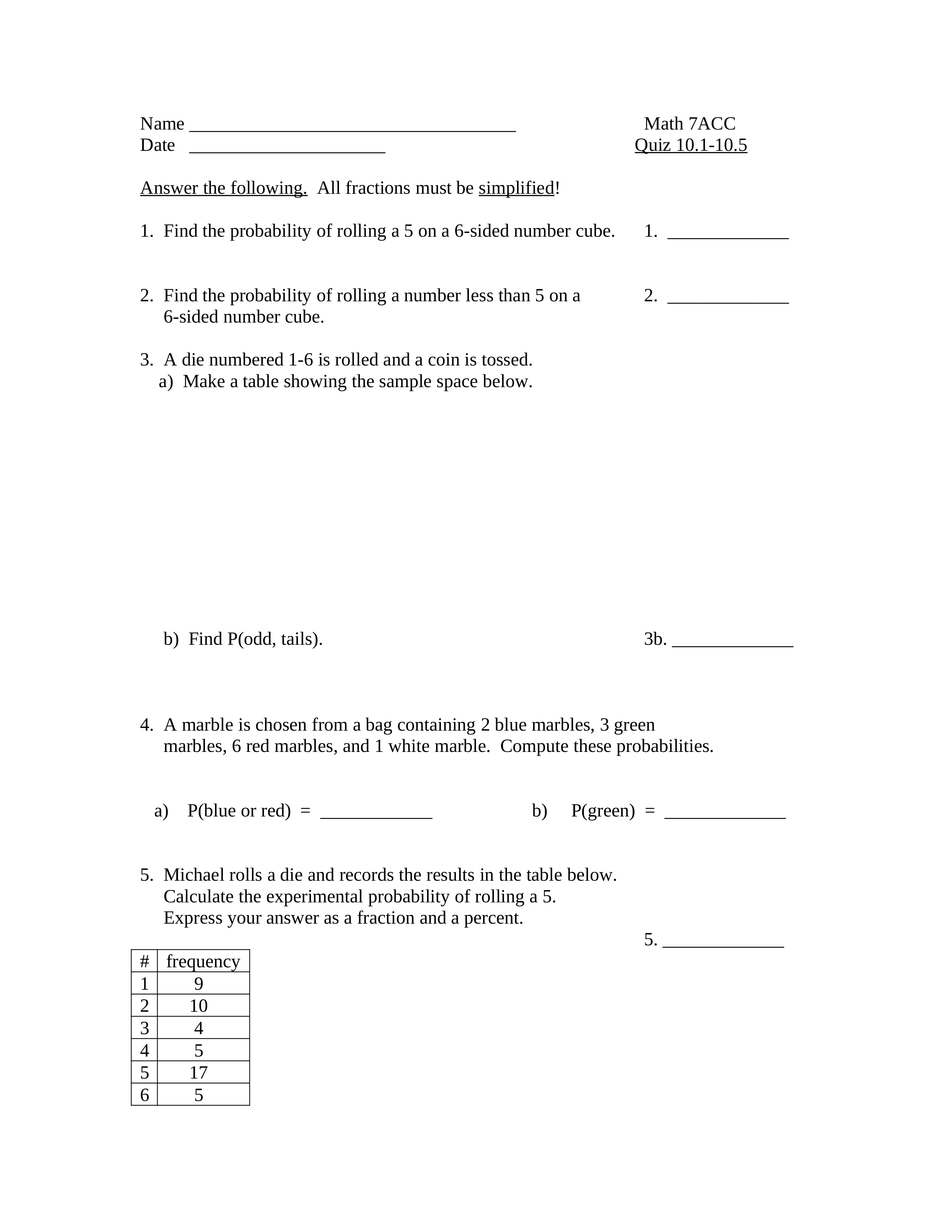
Michael rolls a die and records the results in the table below. Calculate the experimenteal probability of rolling a 5. Express your answer as a fraction and a percent.
Explain the difference between theoretical and experimental probability.
If the probability of an event is 0, what does that mean?
You flip a coin and then roll a number cube. Is this an example of an independent or dependent event?
How many possible outcomes are there when throwing 3 dice?
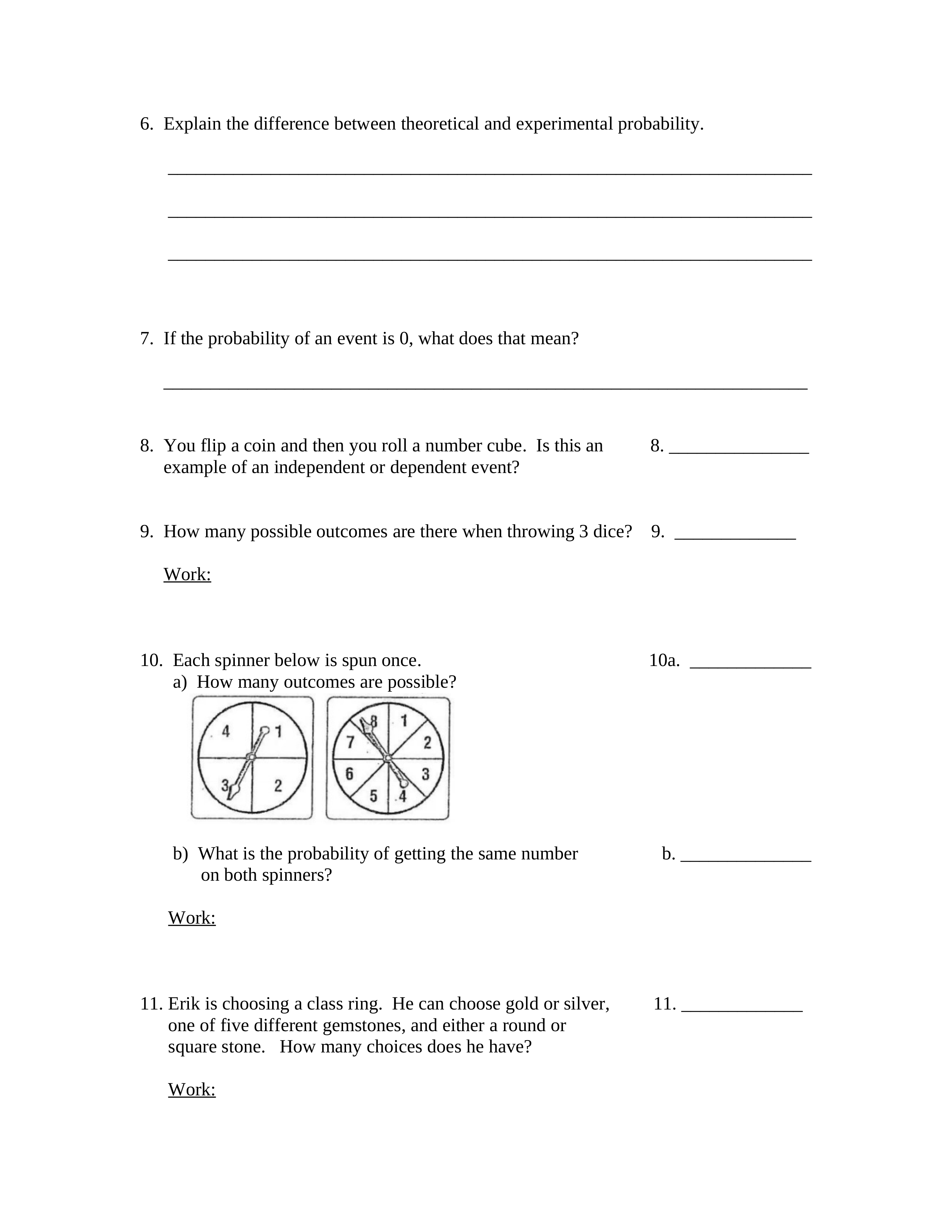
Each spinner is spun once. How many outcomes are possible?
What is the probability of getting the same number on both spinners?
Erik is choosing a class ring. He can choose gold or silver, one of five difference gemstones, and either a round or square stone. How many choices does he have?
An envelope contains 10 cards labeled 1 through 10. Choose a card, put it back and then choose another card. Find the P(7 and then even).
Mary has a drawer containing 4 blue pens, 5 red pens, 1 orange pen, and 2 green pens. She picks a pen from the drawer. Later, without replacing the first pen, she picks a second pen from the drawer. Find the probability of drawing two red pens in a row.
Mary has a drawer containing 4 blue pens, 5 red pens, 1 orange pen, and 2 green pens. She picks a pen from the drawer. Later, without replacing the first pen, she picks a second pen from the drawer. Find the probability of drawing an orange pen and then a green pen.