JAVUREK - AGS 2 4/13

Last updated about 5 years ago
24 questions
Angle Relationships and Vocubalary
In the applet below, the pink angle and the blue angle are said to be supplementary angles.
Interact with this applet for a minute or two by draging the black and pink sliders, and answer the questions that appear below it.
1

In your own words, describe what it means for 2 angles to be supplementary angles.

1

In the applet above, the blue angle is said to be a supplement of the pink angle, and vice versa. Given this information, what would be the supplement of a 130° angle.

1

What is the supplement of a 1° angle?

1

What angle measure has a supplement whose measure is equal to itself?

In the second applet below, the pink angle and the blue angle are said to be complementary angles.
Interact with this applet for a minute or two by draging the black and pink sliders, and answer the questions that appear below it.
1

In your own words, describe what it means for 2 angles to be complementary angles.

1

In the second applet, the blue angle is said to be a complement of the pink angle, and vice versa. Given this information, determine the complement of a 40° angle.

1

What is the complement of a 1° angle?

1

What angle measure has a complement whose measure is equal to itself?

Vertical Angles
Use the applet below to answer the questions that appear beneath it.
1

Use the Angle tool to measure each yellow angle.
The angle tool is in the upper left corner and looks like:
Select it then click on points C, O and B in that order.
Next measure the other yellow angle by clicking on points A, O and D.
What do you notice?

1

Click the other checkbox to show the other pair of vertical angles. Use the angle tool to measure these two green vertical angles now. What do you notice?

1

Now that you have all four angle measures displayed, drag the slider around. What can you conclude about each pair of vertical angles?

Transversal Intersects Parallel Lines
In the interactive applet below there are 2 parallel lines and one line at an angle called a transversal.
Use the applet below to answer the questions that appear beneath it.
You may need to use the back button in the upper right corner to reset the applet.
The pink angles are called corresponding angles. Notice that the pink angles are in the upper right corner of each cluster of four angles. Play with the sliders and the angle tool. Try and find a relationship between corresponding angles.
1

What can you conclude about each pair of corresponding angles?

Now click on the box that says "Show Alternate Interior Angles". They should be green. Notice that they alternate on opposite sides of the main diagonal line (called the teansversal). Play with the sliders and the angle tool. Try and find a relationship between alternate interior angles.
1

What can you conclude about each pair of alternate interior angles?

Now click on the box that says "Show Alternate Exterior Angles". They should also be green. Notice that they alternate on opposite sides of the main diagonal line and are outside of the parallel lines. Play with the sliders and the angle tool. Try and find a relationship between alternate exterior angles.
1

What can you conclude about each pair of alternate exterior angles?

1

Now click on the box that says "Show Same-Side Interior Angles". What can you conclude

1

Now click on the box that says "Show Same-Side Exterior Angles". What can you conclude? about each pair of same-side exterior angles?

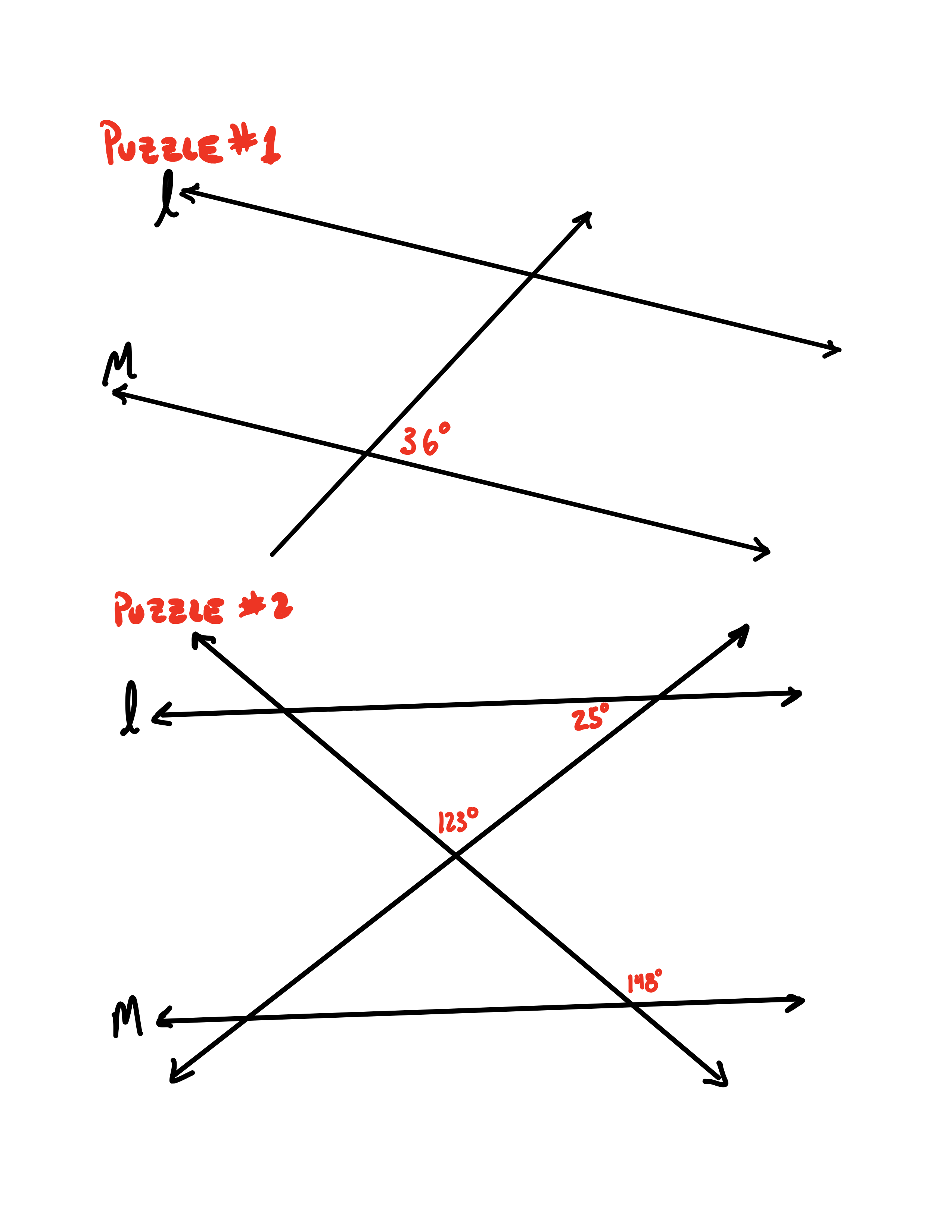
In each of the puzzles below lines L and M are parallel. Enter the degrees for each of the requested angles below. Just enter a number, you do not need the degree symbol.
1
1
1
1
1
1
1
1

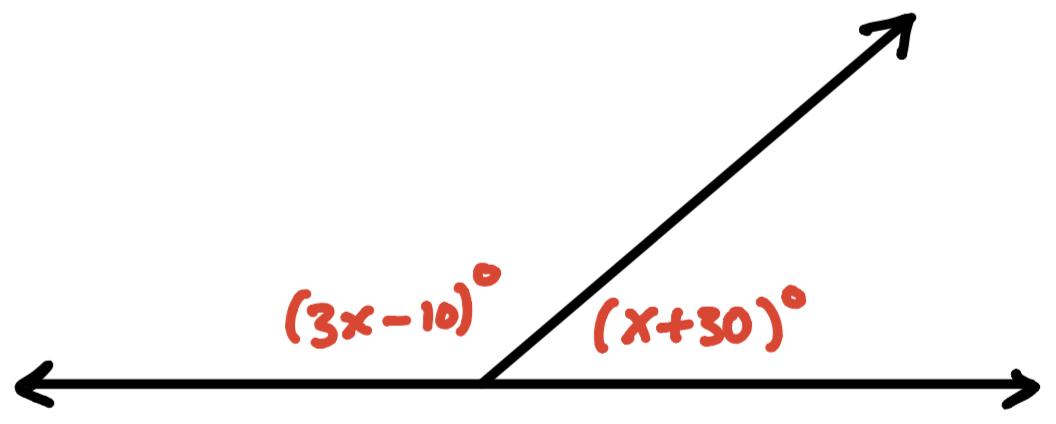
Calculate the value of x in the diagram below.
Show your work.
Also, enter your answer in the box to the right of where is says show your work.

Click the play button below for a recorded hint if you are stuck on the problem number 24 above.