Log in
Sign up for FREE
arrow_back
Library

4/13-4/17 Mean Absolute Deviation and Two-Way Frequency Tables

star
star
star
star
star
Last updated almost 6 years ago
18 questions
1
1
1
1
1
1
1
1
1
1
1
1
1
The Mean Absolute Deviation (MAD) is a measure of how much a data set varies.

Example:
In the data set below, what is the mean absolute deviation?
1, 6, 8, 5, 5, 1, 2

Step 1: Compute the mean,xÌ… .
First add all of the numbers in the data set together. Then divide by the total number of values in the data set.
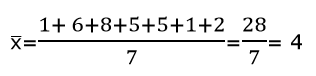
The mean xÌ… , is 4

Step 2: Take each number in the data set, subtract the mean
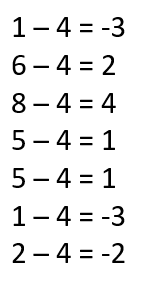
Step 3: Find the absolute value of each number. (Positive Value)
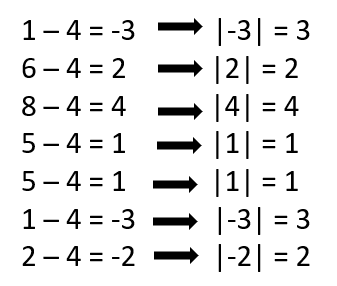
Step 4: Find the mean,xÌ…, of the new values.
First, add the numbers. Then, divide by the number of values.


The mean absolute deviation, MAD is 2.29.
Mean Absolute Deviation


Question 1
1.

Find the mean absolute deviation of
10, 7, 13, 10, 8

Question 2
2.

Find the mean absolute deviation of
110, 114, 104, 108, 106

Question 3
3.

Find the mean absolute deviation of
87, 75, 85, 77, 74, 82, 90, 88, 79, 81

Question 4
4.

Find the mean absolute deviation of
15, 17, 15, 17, 21, 17, 15, 23, 20, 18

Question 5
5.

Find the mean absolute deviation for the set below.

S= {85, 90, 68, 75, 79}

Question 6
6.

Sherrie just registered for her wedding. So far 6 items have been fulfilled on her registry. Find the mean price of the fulfilled items. $29, $58, $15, $129, $75, $22

Question 7
7.

Find the mean absolute deviation of the fulfilled items on Sherrie's registry. $29, $58, $15, $129, $75, $22

Question 8
8.

Find the mean absolute deviation for the set below.

S = {65, 90, 85, 70, 70, 95, 55}

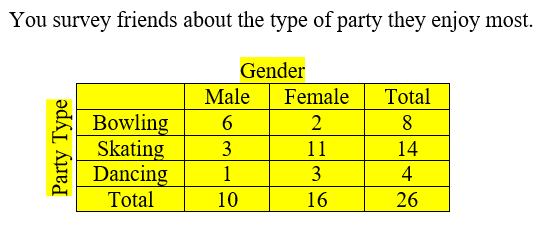
Two-way Frequency Table - A statistical table that shows the frequency for two variables, the rows indicating one category and the columns indicating the other category.

Example:

Relative Frequency - How often something happens (frequency) divided by all outcomes.

Example:
The relative frequency of female friends that enjoy skating based on the friends surveyed is 42.3%.
Two-Way Tables


Calculating Relative Frequency


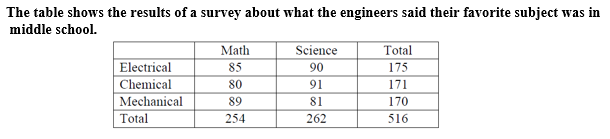
For Questions 9-13, use the two-way table below.


Question 9
9.

How many chemical engineers chose science?

Question 10
10.

How many engineers chose math?

Question 11
11.

Overall, what was the favorite subject of all engineers?

Question 12
12.

What is the relative frequency of mechanical engineers who chose math? (Write your answer as a percentage)

Question 13
13.

What percentage of engineers surveyed were electrical engineers? (Round to the nearest whole percent)

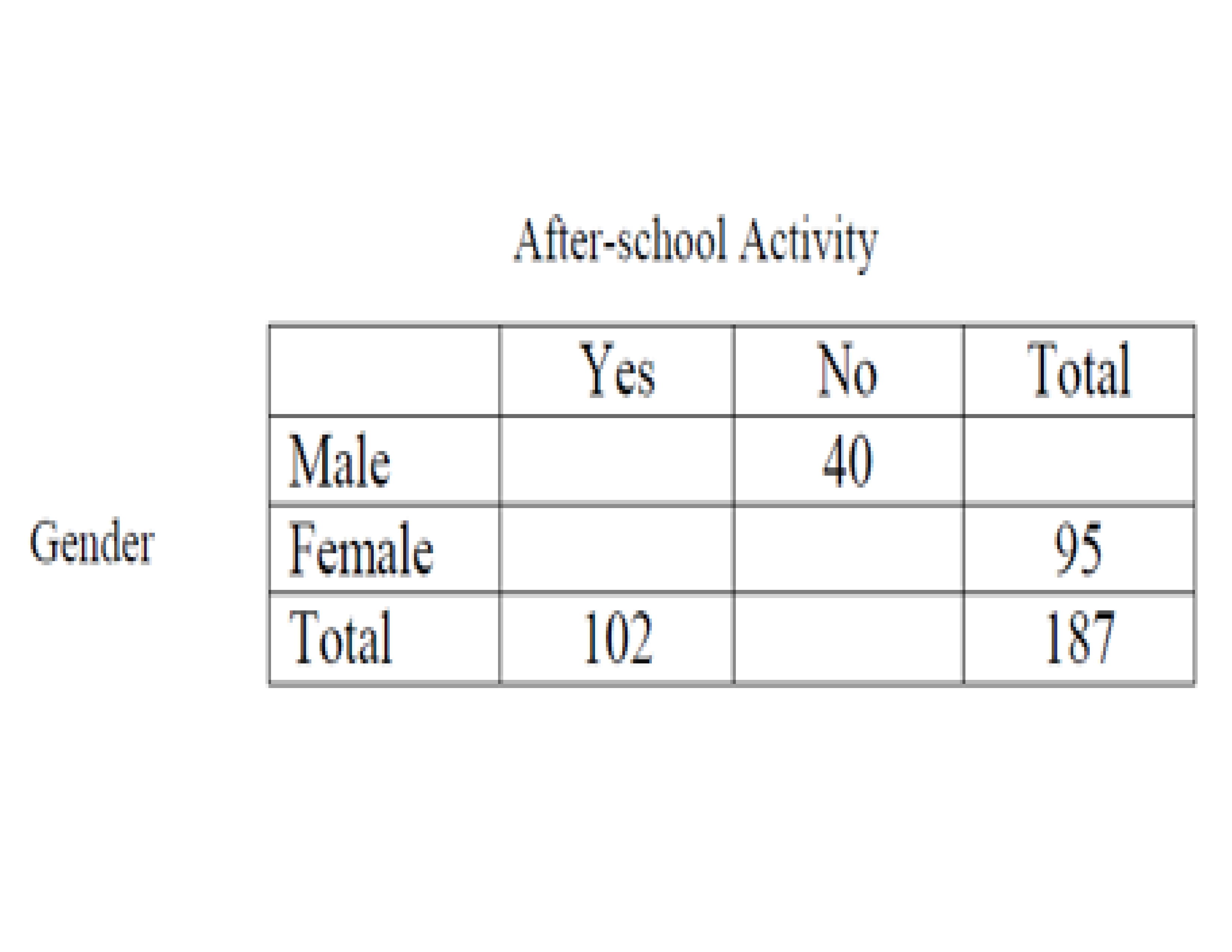
Ninth grade students were asked whether they participate in an after-school activity. Complete the two-way frequency table below.
1
Question 14
14.
1
Question 15
15.
1
Question 16
16.
1
Question 17
17.
1
Question 18
18.