c)
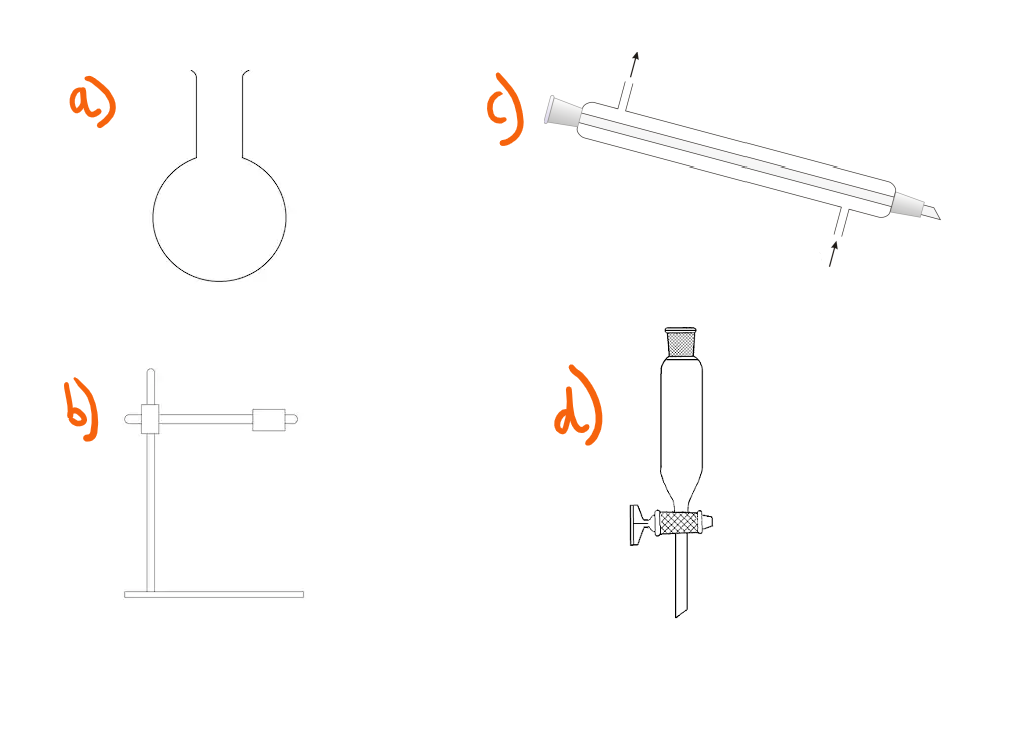
Select the correct diagram for your answer to part b)
c)
Select the correct diagram for your answer to part b)
L6th Alcohols Test
The following instructions are from an experimental procedure for the preparation of cyclohexene from cyclohexanol and concentrated phosphoric acid. Read these instructions and answer the questions that follow.
1 Place 25 cm3 of cyclohexanol into a round-bottomed flask with some porous pot to act as anti-bumping granules. Add 10 cm3 of concentrated phosphoric acid carefully while shaking the flask. Cool the flask under the tap if it gets too hot. Make sure the reagents are thoroughly mixed.
2 Set up an apparatus for simple distillation using this flask.
3 Warm the flask, gently at first, for about 15 minutes. Then increase the heating so that cyclohexene begins to distil over. Collect the fraction that distils below 95 °C.
a) State the purpose of the anti-bumping granules.
b) Name the part of the distillation apparatus where cyclohexene vapour is changed back into a liquid.
c)
Select the correct diagram for your answer to part b)
Q2. Some alcohols can be oxidised by an acidified solution of potassium dichromate(Vl). Aldehydes can be oxidised by Tollens’ reagent or by Fehling’s solution.
An unknown pure liquid A contains only a single alcohol. Outline a simple procedure to allow you to determine whether A is a primary, a secondary or a tertiary alcohol. [3]
Q3) (a) In industry, ethanol is made from ethene in an acid-catalysed reaction. Name the type of reaction. Write an equation and identify a suitable catalyst for this reaction. [3]
Type of reaction...........................................................................................
Equation.......................................................................................................
Catalyst ........................................................................................................
(b) Ethanol burns completely in a plentiful supply of air, but incomplete combustion occurs if the air supply is limited.
(i) Identify a solid pollutant produced by burning ethanol in a limited supply of air.
(ii) Write an equation for the incomplete combustion of ethanol to produce the solid pollutant that you have identified in part (b)(i). [2]
Q4) Glucose can decompose in the presence of microorganisms to form a range of products. One of these is a carboxylic acid (Mr = 88.0) containing 40.9% carbon and 4.5% hydrogen by mass.
(a) Deduce the empirical and molecular formulas of the carboxylic acid formed. [4]
(b) Ethanol is formed by the fermentation of glucose. A student carried out this fermentation reaction in a beaker using an aqueous solution of glucose at a temperature of 25 °C in the presence of yeast.
Write an equation for the reaction occurring during fermentation. [1]
(c) In industry, this fermentation reaction is carried out at 35 °C rather than 25 °C.
Suggest oneadvantage and one disadvantage for industry of carrying out the fermentation at this higher temperature. [2]
(d) The method used by the student in part (b) would result in the ethanol being contaminated by ethanoic acid.
How does this contamination occur? [1]
Q5) Consider the following reaction scheme.
(a) (i) select the correct name of the mechanism for Reaction 1.
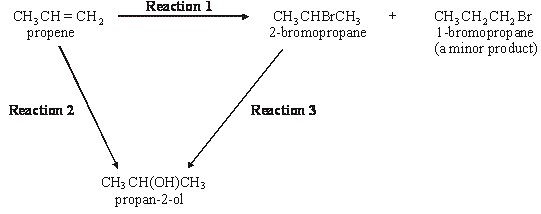
a) (ii) Explain why 1-bromopropane is only a minor product in Reaction 1. [2]
(b) Give a suitable reagent and state the essential conditions required for Reaction 3. [2]
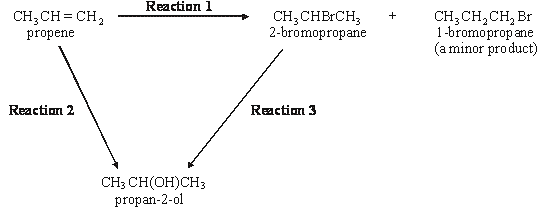
(c) The reagent used for Reaction 3 can also be used to convert 2-bromopropane into propene. State the different conditions needed for this reaction. [1]
(d) Reaction 2 proceeds in two stages.
Stage 1 CH3CH=CH2 + H2SO4 → CH3CH(OSO2OH)CH3
Stage 2 CH3CH(OSO2OH)CH3 + H2O → CH3CH(OH)CH3 + H2SO4
(i) Name the class of alcohols to which propan-2-ol belongs. [1]
(ii) Outline a mechanism for Stage 1 of Reaction 2, using concentrated sulphuric acid. [4]
(iii) State the overall role of the sulphuric acid in Reaction 2. [1]
Q6) Which one of the following alcohols forms a mixture of alkenes when dehydrated?
Q7) Which one of the following is not a suitable method for the preparation of ethanol?
Q8) Some alcohols can be oxidised to form aldehydes, which can then be oxidised further to form carboxylic acids. Some alcohols can be oxidised to form ketones, which resist further oxidation. Other alcohols are resistant to oxidation.
(a) Draw the structures of the two straight-chain isomeric alcohols with the molecular formula, C4H10O [2]
(b) Draw the structures of the oxidation products obtained when the two alcohols from part (a) are oxidised separately by acidified potassium dichromate(VI). Write equations for any reactions which occur, using [O] to represent the oxidising agent. [6]
(c) Draw the structure and give the name of the alcohol with molecular formula C4H10O which is resistant to oxidation by acidified potassium dichromate(VI). [2]