Week 34, Chemistry 3, Task 1, Sec. 13.1 Introduction to Acids and Bases
star
star
star
star
star
Last updated about 6 years ago
9 questions
1
MS-PS1-5
1
HS-PS1-5
1
MS-PS1-5
1
MS-PS1-5
1
HS-PS1-5
1
4
HS-PS1-5
1
1
Chapter 13: Acids and Bases
Section 13.1: Introduction to Acids and Bases
Sec. 13.1 The Nature of Acids and Bases
Pages: 525 - 529
In this section you will learn the following:
Define acids and bases.
Identify some physical and chemical properties of Acids and Bases.
Differentiate the three models of acids and bases.
Write the ionization reactions of acids and bases.
Watch the following video recording titled "How to show your work on goformative" to understand the ways you can attach your work to each question when needed.
Watch the following video recording titled: Properties of Acids and Bases to understand more about the Physical and Chemical properties of Acids and Bases.
Question 1
1.
Question 2
2.
Question 3
3.
Question 4
4.
Watch the following video recording titled "The Three Models of Acids and Bases" to differentiate between Arrhenius, Bronsted-Lowry and Lewis models.
Question 5
5.
Question 6
6.
Watch the following video recording titled "Ionization Reactions of Acids" to understand how to write the ionization reactions of monoprotic, diprotic and polyprotic acids.
Question 7
7.
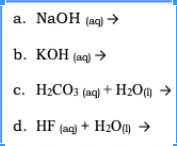
Write the ionization reactions of the following aqueous solutions: *
Question 8
8.
Question 9
9.
If you have any question about this lesson, please write it below to discuss it in the live sessions.
Choose the physical and chemical properties that characterize an acid.
Slipery and Slimy
Sour
Reacts with metals to release a Hydrogen gas
Bitter
Reacts with carbonates to release carbon dioxide and water vapour
Choose the physical and chemical properties that characterize a base.
Slippery or slimy
Sour
Reacts with metals to release Hydrogen gas
As the pH drops below 7, the aqueous solution becomes more:
Acidic
None of the above
Neutral
Basic
As the pH increases above 7, the aqueous solution becomes more:
Basic
Neutral
None of the above
Acidic
The model which states that acids ionize in water to produce Hydronium ions (H3O+) is called:
Lewis Model
Arrhenius Model
None of the above
Bronsted-Lowry Model
Bronsted-Lowry model states that:
Acids are H+ donors and bases are H+ acceptors.
Acids are electron-pair donors.
Bases are electron-pair donors.
Acids are OH- donors and bases are OH- acceptors.
Rate your level of confidence for this topic.
1- Least confident: I did not understand the lesson.
2- Slightly inconfident: I did not understand many areas of the lesson.
3- Slightly confident: I understood the lesson but I need a lot of practice.
4- Confident: I understood the lesson well but I need a little more practice.
5- Highly confident: I mastered the topic very well